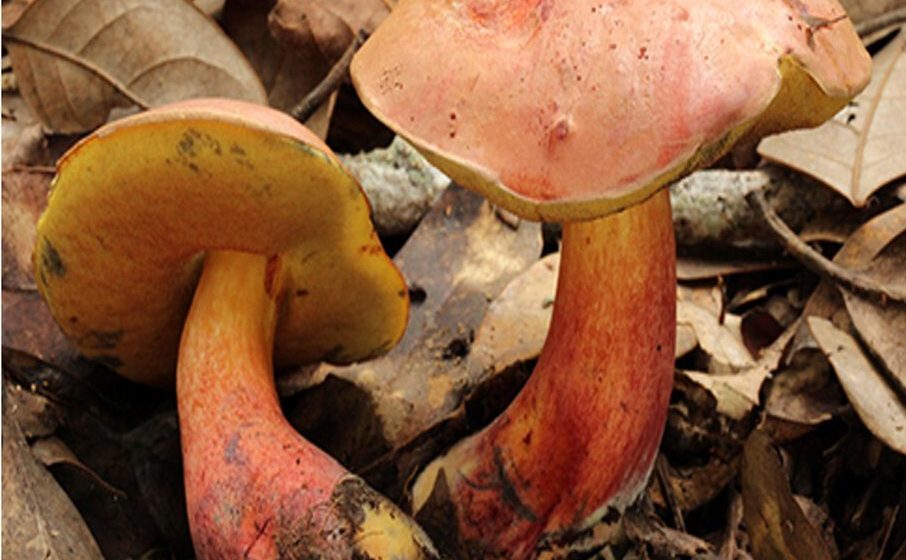

Seeing strange people in your house is never a good sign, especially if they are miniature elf-like creatures that jump around, climb walls, and crawl on the floor. But don’t worry, if you recently ate a meal involving a specific type of mushroom, you haven’t lost your mind. The fungus is the culprit.
The official clinical term for these visions is Lilliputian Hallucinations, named after the tiny inhabitants of the novel’s fictional island. Gulliver’s Travels by Jonathan Swift. These hallucinations can occur in conjunction with different conditions, such as schizophrenia or alcohol withdrawal, among others.
But none of these causes produces Lilliputian hallucinations as reliably as Asian Lanmaoa – if it is eaten raw or insufficiently cooked. A species of reddish-colored bolete, it was only officially described and named by scientists in 2015.
Rich in umami flavor, L. asian is a locally popular food in the Yunnan province of China, sold in markets and featured on many restaurant menus. But it comes with a warning: Don’t eat it before the 15-minute timer goes off, a precaution adopted by most restaurants selling this mushroom. If you do, “you might see little people,” as Colin Domnauer, a doctoral student in biology at the University of Utah and the Utah Museum of Natural History, in the United States, told the BBC.
History
Although this mushroom is best known for its presence in Yunnan province, where locals call it “”Jian shou qing‘, and the little people he refers to as ‘Xiao Ren Ren‘, it actually appears independently in two other places.
In the Cordillera administrative region of the Philippines, it is called “Sedesdem‘, and elf-like creatures like ‘ansisit‘. In 2024, DNA sequencing by Domnauer confirmed that, although different from each other, the two fungi represent the same species.
Reports of a wild mushroom giving people visions of miniature creatures also come from Papua New Guinea and date back to the 1930s. When missionaries visited the Western Highlands, they came across a wild mushroom that local communities call “”nonda” – after consuming it, they seemed to go temporarily crazy, which was later nicknamed “mushroom madness”. One of the characteristics of this madness was Lilliputian hallucinations.
In the 1960s, American author Gordon Wasson and French botanist Roger Heim, specialized in mycology (study of mushrooms), went to Papua New Guinea in search of the culprit of this madness. The collected specimens were sent for analysis to Albert Hofmann, the Swiss chemist famous for discovering LSD, but he found nothing of interest. No further research was therefore carried out.
In December 2025, Colin Domnauer’s supervisor traveled to Papua New Guinea to search for the same mushrooms, but found none.
“They could be the same species, which would be surprising because Papua New Guinea does not generally share the species found in China and the Philippines,” Donmauer told the BBC.
If they are not the same species, that would make the mystery even “more interesting from an evolutionary point of view,” according to Donmauer. This would mean that the same strange effects evolved completely independently in different species of fungi and in different parts of the world.
The story could go back even further – as Donmauer mentions, an ancient Taoist text from the 3rd century CE refers to a “flesh spirit mushroom” which, if eaten raw, allows one to “see a small person” and “immediately achieve transcendence”.
Symptoms
Chemical and genomic analyzes carried out on L. asian at the Utah Museum of Natural History’s Dentinger Lab found that it contains none of the gene clusters that construct the two best-known fungal hallucinogens – psilocybin from “magic mushrooms” and ibotenic acid from fly agaric.
Thus, the cause of Lilliputian hallucinations is unlike any other known psychedelic compound, operating via a mechanism not yet described by science.
“The search for an unknown psychoactive compound is a very exciting position, a frontier towards expanding our understanding of the brain and mind,” Donmauer told Psychedelics.co.uk.
And the tiny creatures that suddenly appear before the unlucky consumer aren’t the only strange thing about this mushroom’s effects. On the one hand, trips produced by L. asian are unusually long, lasting one to three days after an onset of 12 to 24 hours. In some cases, they cause hospitalizations due to side effects such as delirium and dizziness. Each year, a hospital in Yunnan province treats hundreds of such cases.
Most known psychedelic compounds tend to produce varying alterations of reality, not only from person to person but from experience to experience. But not L. asianin which the hallucinations of little people are reliably and repeatedly reported.
“I don’t know of anything else that can produce such constant hallucinations,” Donmauer told the BBC.
Further research into L. asian will not only uncover details about its psychedelic qualities, but answer larger questions regarding consciousness and the connection between mind and reality. Even more, it could help scientists understand what causes spontaneous Lilliputian hallucinations aside from consuming the mysterious mushroom.
Top image: L. asiatica. Credit: Ruanxian Dai, Zhantao Duan, Bin Han, Yating Peng, Lan Zhu, Yuan Shen, Qiang Meng, CC BY 4.0, via Wikimedia Commons
Gn Health