“It’s a nightmare.” Former refugee, professor on Trump’s new Medicaid policy: NPR


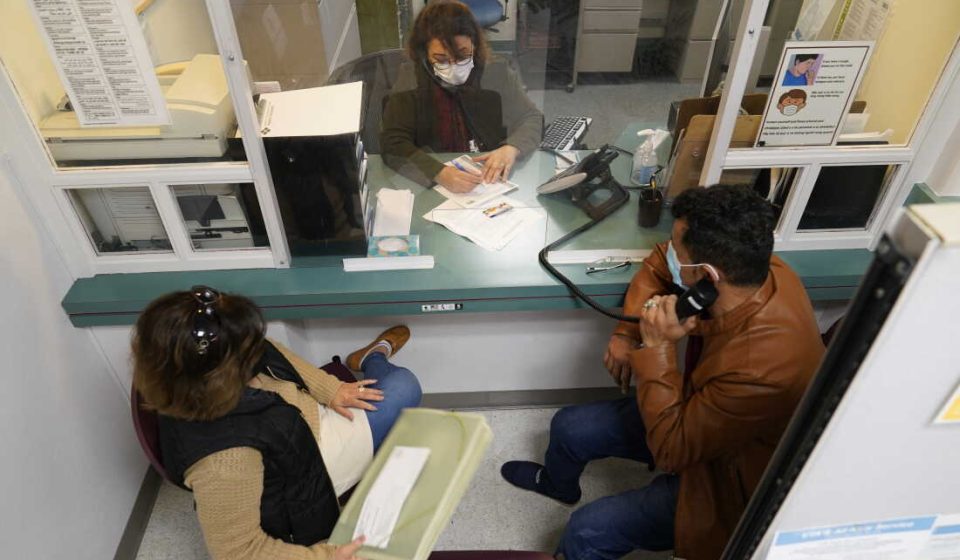
Mohammad Attaie and his wife Deena, newly arrived from Afghanistan, receive help from medical translator Jahannaz Afshar to make a doctor’s appointment at the Valley Health Center TB/Refugee Program in San Jose, California, December 9, 2021.
Eric Risberg/AP
hide caption
Eric Risberg/AP
Mustafa Rfat recently received frantic phone calls from disabled refugees. As of October 1, refugees nationwide have been barred from access to Medicaid because of HR 1, the Trump administration’s main budget bill that Republicans passed last summer.
“I have spent the last two weeks talking with so many of them, literally terrified by the reality that their children with disabilities are losing coverage,” he says. “For example, a father is a disabled refugee, with two disabled children, and he just doesn’t know how he’s going to get the medicine.”
Rfat is a professor of social work at the University of Nebraska at Omaha and his research focuses on refugees with disabilities, an experience he knows firsthand.
When he arrived in the United States as a refugee from Iraq in 2011, the chronic illness affecting his spine was severe. “I was in a really bad situation,” he says. “I couldn’t walk. I was in so much pain. I missed my medication for a long time. I didn’t see a doctor. So it was a very, very difficult and vulnerable situation.”

When Mustafa Rfat arrived in the United States as an Iraqi refugee in 2011, the chronic illness affecting his spine was severe. He says Medicaid was a lifeline for him. Today, he tries to help disabled refugees facing the challenges of life in the United States without that lifeline.
Mustafa Rfat
hide caption
Mustafa Rfat
As he moved from Alabama to Illinois and West Virginia to try to find housing and continue his education, Medicaid was a lifeline, Rfat says. “I had to climb this big mountain of acclimating to the culture here, learning English, dealing with the trauma of war, the loss of family members, the challenges I faced, being alone with a disability,” he says.
“I was determined and in that determination, Medicaid was the major factor in making my dreams come true.” In fact, he says one of the specialists who treated him wrote his first reference for applying to college. He has since become an American citizen with a family, a doctorate and a job as a professor.
Today, he tries to help disabled refugees facing the challenges of life in the United States without that lifeline. As of October 1, refugees are among the groups that will lose Medicaid coverage.
Hundreds of thousands will lose coverage
Only a small portion of legal immigrants have been able to enroll in Medicaid, including refugees and asylum seekers. Because of changes to “alien Medicaid eligibility” in the One Big Beautiful Bill Act that Republicans passed last summer, an even smaller subset now has access. An estimated 280,000 people will lose Medicaid in October, according to a KFF Health News analysis.
This includes immigrants admitted to the United States on humanitarian grounds and awaiting approval for a green card, says Ben D’Avanzo, senior strategist at the National Immigration Law Center.
“People who lose Medicaid and CHIP (the Children’s Health Insurance Program) are among the most vulnerable immigrants: people who have experienced violence in their own homes or during their journey, who may suffer physical and mental problems, who are fleeing persecution and war,” he says. “These are people that we have welcomed for a long time, in the United States, and populations that have benefited from very strong historic bipartisan support.”
Rfat points out that refugees are more likely to suffer from serious health problems than other groups. “More than a third of them suffer from at least one type of disability, that’s what the research tells us,” he explains. In refugee camps and during war, access to doctors and medicines is difficult, and simple conditions can become serious and complex.
It was her own experience with an inflammatory disease called ankylosing spondylitis. “By the time I arrived in the United States, many doctors told me, ‘You’re one of the worst cases we’ve seen,’” he says. “And that’s the case for a lot of refugees who come here.”
In a statement to NPR, the Centers for Medicare and Medicaid Services wrote that it is enacting the law passed by Congress by working with states to accurately implement the policy. They did not respond to a follow-up question about the policy’s effect on disabled refugees.

“Once these changes occur, these immigrant groups will be left with very few options for comprehensive, affordable coverage,” says Drishti Pillai, director of immigrant health policy at the nonpartisan health research organization KFF.
“They could always purchase full price coverage on the ACA marketplaces, but this is often unaffordable,” says Pillai. “Employer-sponsored coverage is also an option, but many immigrants, especially those on Medicaid, do not work in jobs that do not offer employer-sponsored coverage, such as jobs in construction, agriculture, or food service.”
She says a few states are creating their own coverage options for these groups, but many have tight budgets and face even deeper Medicaid cuts in January. Most states have also chosen to allow Medicaid to continue coverage for pregnant women and children who would otherwise lose coverage.
D’Avanzo points out that the categories of people who now lose coverage will eventually become Medicaid-eligible green card holders.

“So these are people who are going to postpone preventative care, who are not going to treat their chronic illnesses, who are going to forgo important medications,” he says. “And then when they’re eligible for Medicaid again in the future, once they get their green card, they’re going to need much more specialized care and much more expensive care.”
Hope for change
Mustafa Rfat is traveling to his alma mater, Washington University, in St. Louis, Mo., this weekend to meet with a few dozen disabled refugees and share some of his recent research. He says the loss of Medicaid and food benefits will weigh on the event.
“It’s a nightmare for the community,” he said. He hopes Congress will reverse course.
He decided to dedicate part of the event to teaching civic engagement. “Understanding the importance of voting when they become citizens, understanding the importance of being aware of policies, knowing who their representatives are, how to communicate with their representatives,” he says.
“They are new Americans,” he adds. “These people aren’t going anywhere. By making their health and well-being worse, it won’t benefit anyone.”
Gn headline