
“It’s our plan B if it becomes less safe to live in the United States”: worried about the political situation, Americans rush to Canadian citizenship

A treasure in the heart of Montreal. Between the walls of the National Library and Archives of Quebec (BAnQ), the silence testifies to the solemnity of the place. The memory of the Canadian province rests here. Old maps, parish registers, legal acts and private correspondence tell the history of Quebec since the beginnings of the French presence in North America. The smell of old books floats in one of the archive rooms, where everything is carefully classified on shelves, sheltered from time and outside light.

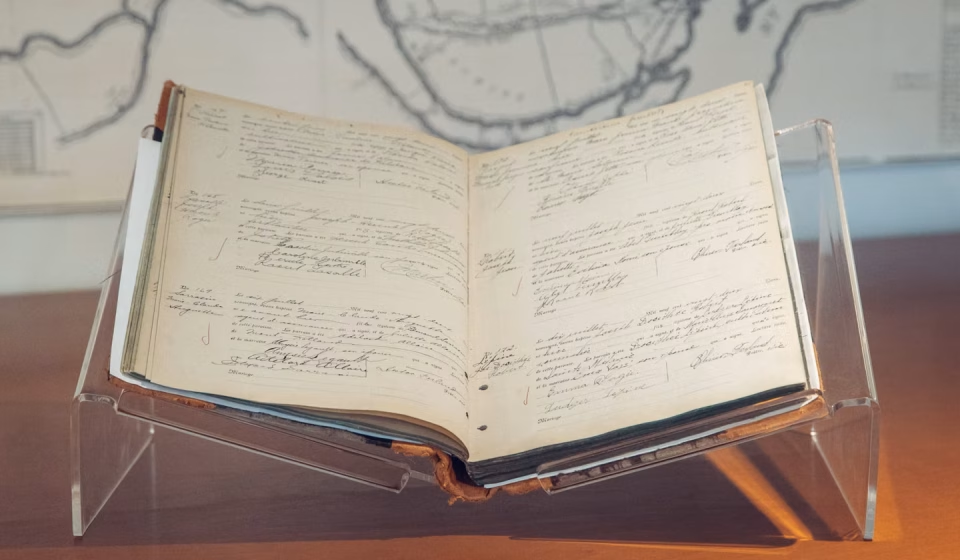
In recent months, the calm that usually reigns there has given way to a certain excitement behind the scenes. The center is overwhelmed with requests from American citizens. “They come looking for proof that they had a Canadian ancestor”explains Sarah Hanahem, archivist, while carefully turning, wearing white gloves, the pages of a register dated 1900. Her teams have received more than 12,000 requests since January, compared to 520 over the same period last year, an explosion of 2,000%. To respond to such an influx, around ten people had to be hired and distributed to several branches across Quebec.
Everything accelerated with a federal law adopted in December 2025, which relaxed the rules for granting Canadian citizenship by descent. Before this date, a person born abroad could generally only obtain citizenship by descent if their direct parent was themselves Canadian. This limit, called the “first generation”had been deemed unconstitutional by the Ontario Superior Court in 2023. The federal government was therefore forced to review its legislation, paving the way for the retroactive recognition of citizenship for people born abroad and of Canadian lineage.
You have 67.41% of this article left to read. The rest is reserved for subscribers.