
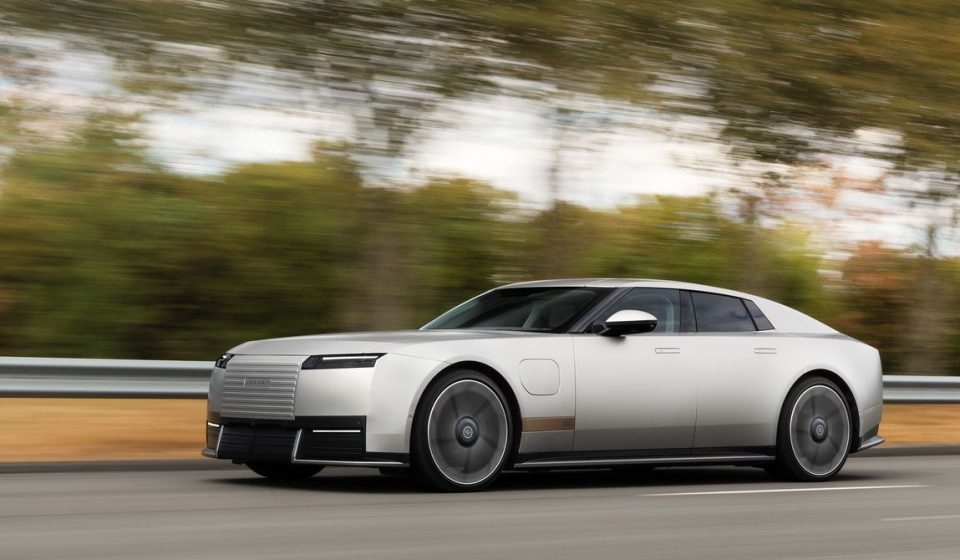

“A bold grand tourer that never goes unnoticed, like all the best Jaguars of the past,” Jaguar’s press release says. This is most certainly true: you will see this thing coming. The low roofline, short front and extended rear overhangs, long hood and huge 23-inch wheels all remain from the prototype, as promised. The rear cabin design hides a 50:50 weight distribution, and the huge surface areas make it hard to reconcile the fact that this is the most aerodynamic Jag ever, with active vanes, a deployable spoiler and an airflow trick delivering a drag coefficient of 0.23 Cd.
Crucially, the production model’s extra doors give more design meaning, moving the Type 01’s look from Thunderbird territory into more familiar territory. The front end has also been softened slightly, which is again preferable to the extremely bluffing nose of the prototype. The rear, however, is where the exterior design really shines with full-width lights hidden until switched on, integrated into horizontal bars.
Let’s put the specs aside: the Type 01 is the most powerful Jaguar road car, with up to 1,030 Pferdestärke (PS) and 1,365 Newton meters. It goes from standstill to 100 km/h in 3.2 seconds. Justifying the slogan “power in reserve”, the car can go from 62 to 180 km/h in an additional 4 seconds. I’ve been driven in it, and it feels like the acceleration never stops thanks to the tri-motor setup of a 260 kilowatt (kW) front motor paired with two 310 kW rear motors.
It measures 5,235mm long and 1,403mm high, but all-wheel steering makes it seem much smaller on the road. Jaguar’s bespoke 850-volt architecture and usable 118-kilowatt-hour battery are claimed to deliver an EPA range of up to 400 miles (450 miles on WLTP), with a “sustained highway speed” range of up to 320 miles. Drivers can add up to 200 miles of range in 13 minutes with 350 kW fast DC charging. So the TL;DR? It’s huge, fast, aerodynamic, powerful and, without a doubt, unique.
Inside, a dramatic center column runs the full length of the cabin, creating a zone for each occupant. Many “brass-inspired” finishes are intended to emphasize the luxury message. A panoramic glass roof with adjustable virtual blinds brings in light, but there’s no rear windshield. Instead, a ‘ClearSight’ digital rearview display is integrated into the center of the full-width surround sound bar at the base of the windshield to show what’s behind. Cleverly, the image from this rear-facing camera is positioned at the same height as the exterior mirrors, which is supposed to reduce the annoying focal adjustment these systems usually require.
Gn headline