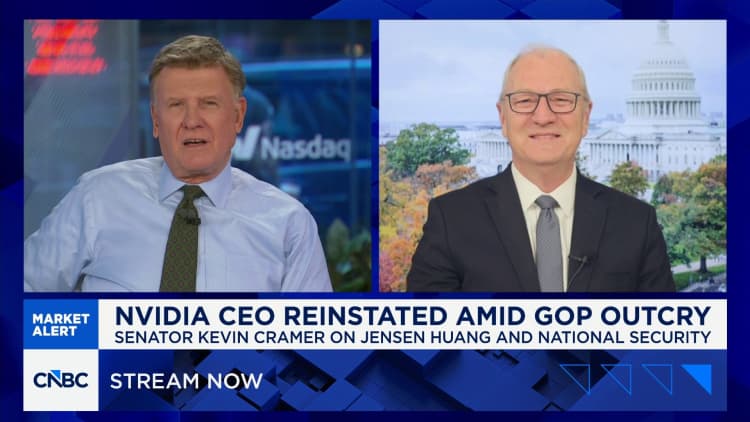

Nvidiaand is now tasked with selling the company’s vision for artificial intelligence while defending itself in Washington.
As Nvidia employees celebrated their leader’s return to company headquarters, Huang told the gathered crowd, “I’ll be a better CEO the second time around.” »
Huang will need to be a better CEO to avoid problems related to Nvidia and the broader AI industry exposed by Huang’s departure. The challenges include a growing list of investigations and hearings from Congress, regulators and state officials, as well as technical and competitive questions about how long Nvidia’s currently dominant graphics processing units can stay on top.
“There’s nothing stopping him from doing what he does in his daily job,” said Gil Soffer, Katten’s president and former federal prosecutor. But investigations take considerable preparation time, Soffer said. “We’re not just walking in the cold.”
At Nvidia’s GTC conference in Washington, DC, next week, the company will try to convince customers, partners and suppliers that it is developing the future of AI. At the same time, legislators will be pressing his newly reinstated CEO over what he knew and when about Megaspeed executive Alice Huang.
Huang, before his scandals, was scheduled to deliver the GTC DC keynote address on December 1 to discuss new Nvidia products and the trajectory of the AI ecosystem. In the past, the two-hour speech was the highlight of the event with hordes of fans filled with Huang-inspired “Jensanity.”
“People will want to see that it’s business as usual, which hopefully for Nvidia shareholders will mean Jensen Huang announcing some exciting new products,” said Peter Cohan, an associate professor at Babson College.
Currently, Nvidia has Ian Buck, vice president of hyperscale and high-performance computing, serving in the role. An Nvidia representative declined to answer several questions about whether Huang would appear at the company’s event.
The same day, Huang is scheduled to speak behind closed doors with three House committees – Foreign Affairs, the Select Committee on the CCP and the Select Committee on Intelligence – where his interview will be transcribed.
“The NVIDIA Board’s brief internal investigation and the reinstatement of Jensen Huang do not erase the national security threats and issues that must be addressed,” the chairmen said in a joint statement. They said Huang confirmed he would appear for the transcribed interview on December 1.
Tuesday’s interviews are just the first in a series of investigations.
On December 3, as the Nvidia conference wraps up, the Senate Banking Committee will hold a hearing titled “Protecting America’s AI Advantage: Oversight of U.S. Export Controls.” Sen. Tim Scott, RS.C., who chairs the committee, said Huang will publicly testify as the sole witness.
California’s attorney general is also investigating Huang’s comments, and politicians on the Senate Finance, Intelligence and Foreign Relations committees have inquired about the scandal. In the House, Energy and Commerce requested a briefing from Nvidia, in addition to the three committees mentioned previously. That’s not counting a Justice Department investigation and a reported investigation by the SEC.
Additionally, Huang must still cooperate with a board investigation, led by the law firm Wachtell Lipton.
Competition
Meanwhile, Nvidia needs Huang to reassure investors and the broader AI ecosystem that the company is developing new products that will be in high demand. Investors had said that even though Nvidia’s products for the next two years were fully designed, they feared the chipmaker’s pace of innovation would slow without Huang.
Nvidia is facing new competition from its biggest customers’ chips, including OpenAI, Anthropic, Google, Amazon And Microsoft. Companies have developed their own chips to reduce their dependence on Nvidia and to control AI costs.
“We were already worried about spending too much money,” said Stephanie Balaouras, vice president of research at Forrester Group. “One of those cost management strategies is to match…workload requirements to the right infrastructure. You don’t need to put everything on an Nvidia GPU.”
Many in the AI industry view Huang as one of the strongest advocates of “open source” AI that is free to use for commercial purposes, compared to the “frontier models” of companies like Anthropic and OpenAI, which charge users per token.
Nvidia has also spent a lot of money developing its own open source models called Nemotron. Currently, Nvidia Vice President Kari Briski is expected to present the new Nemotron technology at the GTC.
Nvidia Corp. CEO Jensen Huang, right, arrives for meetings on Capitol Hill in Washington, DC, U.S., Tuesday, July 28, 2026.
Finn Gomez | Getty Images
Investigations
On Monday, Nvidia’s board said “senior levels” of the U.S. government had provided input on the potential risk Huang poses to national security. President Donald Trump told CNBC that he played a central role in convincing Nvidia’s board to reinstate Huang and said he had given assurances to the board.
Trump’s aid could draw even more attention from Democratic lawmakers, who were already focused on investigating Nvidia’s chip sales.
“Today’s news that Donald Trump engineered the rehiring of Jensen Huang at Nvidia is evidence of the political corruption and rot at the heart of the Trump administration’s technology and AI policy,” Democratic Sen. Chris Van Hollen said in a call with reporters Monday.
Republicans also criticized Huang’s return amid growing focus on the company’s sales in China. However, the investigations could start to weigh on Nvidia’s CEO, experts say.
“How could he do this job?” Jeff Sonnenfeld, senior associate dean of the Yale School of Management, told CNBC, citing the Senate, House and other state investigations, even before Democrats take power next year.
And Washington’s reaction to the Huang scandal could start to affect Nvidia’s sales.
Last week, the Commerce Department announced it would prevent Chinese companies from circumventing export controls by leasing Nvidia chips across borders. On Monday, Commerce also added Megaspeed to a commercial blacklist.
And Nvidia isn’t the only one building on a strong performance from Huang. The company’s investors, customers, partners and shareholders will also consider whether Nvidia still wants to be at the center of the AI ecosystem. Before Huang was removed from office, he pushed Nvidia to invest in AI startups, while selling them products and helping fund their infrastructure.
Remarks from CFO Colette Kress last week, while she was interim CEO, suggested that Nvidia would “very seriously” look at using its balance sheet to support the AI ecosystem, but it’s unclear whether Huang’s second term as CEO will continue his previous showmanship or stick to a more measured approach.

Gn headline