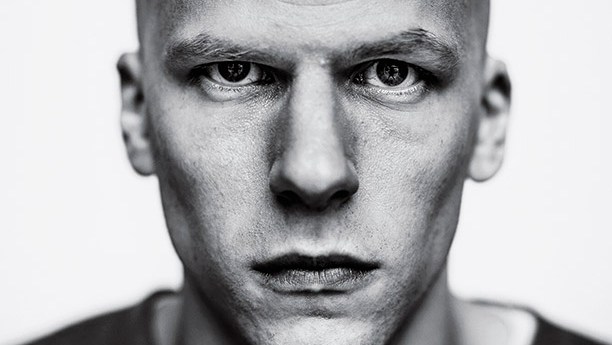

Jesse Eisenberg says he was shut out of studio films after winning a Razzie for Zack Snyder’s “Batman v Superman: Dawn of Justice.”
The Razzies – short for Golden Raspberry Awards – are a tongue-in-cheek ceremony that “honors” the so-called worst films of the year. They are traditionally awarded the day before the Oscars.
Eisenberg, who played villain Lex Luther opposite Henry Cavill and Ben Affleck, was awarded worst supporting actor, Razzie, for his role in the 2016 superhero film.
Although supposedly slight, the “award” hurt his acting career, Eisenberg admitted during an on-screen talk Sunday as part of the BFI London Film Festival, leading him to retire from acting and instead turn to writing and directing. (Eisenberg’s latest directorial effort, “The Debut” with Julianne Moore and Paul Giamatti, will close LFF on Sunday night).
“Look, a lot of it comes from fear,” he said of his career pivot. “I couldn’t participate in movie studio roles anymore because I won a Raspberry Award for (being in the) ‘Batman’ movie…and I saw the trajectory.”
“If you’re an actor, you’re constantly panicking about whether I’m going up or down,” he explained. “Because there’s no set. Acting is just a volatile, horrible industry where you’re either on the treadmill and you’re doing great and you’re running, or you’re yesterday’s news and it’s horrible. And if you’re a paranoid person like me, you see that well in advance.”
“So I said to myself, I have to direct films. That’s why I started writing them, just to keep my career afloat, really.”
“Batman v Superman,” which opened globally with an impressive $424.1 million box office, won four Razzies in total, including for worst screenplay, worst sequel and worst screen combo for Cavill and Affleck. Eisenberg has previously said that the film’s “poor” reception hurt his career.
At the BFI conference, the actor said his takeaway from the experience was that he shouldn’t star in superhero films anymore. “The industry tells you what it expects of you,” Eisenberg said. “The industry didn’t want me to be in a superhero movie, and if you’re smart and self-aware, you learn that quickly. And you know, it’s the actor who fails who says, ‘No, I want to be in more of those.’ It’s not going to happen and they don’t want you there and they wouldn’t have given you a Raspberry Award if they wanted you there. It’s a reward for bad acting. And so the industry tells you what it wants and if you want to have a career in the arts, you have to follow the things that you’re told are valued.
A role for industry did wanting to see it revived was that of Facebook founder Mark Zuckerberg, given that Eisenberg was nominated for a best actor Oscar for playing the tech titan in 2010’s “The Social Network,” written by Aaron Sorkin and directed by David Fincher.
Despite this, the actor insisted he did not want to return in the recently released sequel “The Social Reckoning,” which Sorkin both wrote and directed. He did not elaborate on this decision during his speech at the LFF, except to say that the “accompanying film,” as it has been dubbed, “is quite different.”
He was more open to the idea of working with Kieran Culkin in Eisenberg’s second film, “A Real Pain,” released in 2024. The film earned Eisenberg a best screenplay nod and Culkin a best supporting actor win at last year’s Oscars, but the film could have turned out very differently.
“We didn’t know if Kieran was ever going to show up in Poland,” Eisenberg revealed. “Emma Stone is producing the film. She personally took him on the plane to Poland (where filming was underway) because we didn’t know if he was going to show up. She sent me a video of him going through customs, saying ‘We’re here!’ and then he was late again.
And Culkin, who was recently coming off HBO’s mega-hit “Succession,” was adamant that he wanted Eisenberg to use a similar “spontaneous” filming style, which was not part of the plan. “We ask ourselves: What is best for the film? “” the actor/director recalled as he tried to figure out what to do. “And I guess probably the best thing for the movie is to follow that live feed because that’s the driving force of the movie anyway. If he had a small role, you’d be like, ‘We just need to tell this guy to shut up,’ you know? But he’s the lead… So it was a real learning curve.”
Gn entert