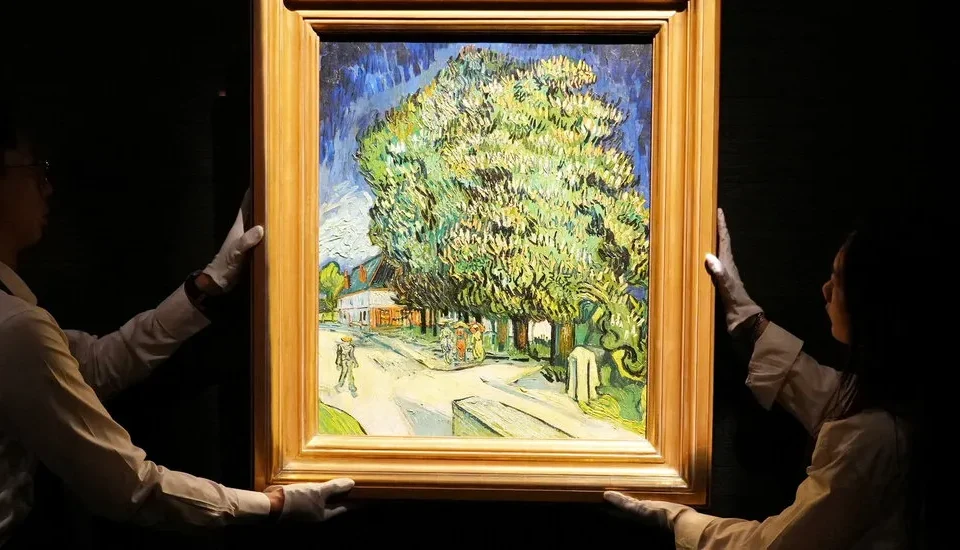
The heirs of the former Jewish owner of an important Vincent van Gogh painting have asked Sotheby’s to withdraw the work from sale just days before it was to be auctioned in Manhattan, arguing that it was sold under duress in 1936 following Nazi persecution.
The 1890 painting, “Chestnut Trees in Bloom,” is estimated at $180 million, the highest of any lot at this season’s art auction, and higher than any price ever paid at auction for a Van Gogh work. The artist painted it in Auvers-sur-Oise, near Paris, after spending two years in the south of France. The work, which is the centerpiece of next week’s fall auction, is backed by a financial guarantee from Sotheby’s.
The heirs, who live in the United States, say the painting was sold in Amsterdam before World War II because of financial losses suffered by the family publishing house under Nazism. Gunnar Schnabel, the heirs’ Berlin lawyer, urged Sotheby’s to prove beyond doubt that the painting was sold for market value in 1936 and that the family “would have wanted to proceed with the sale even without the Nazi regime.”
“Otherwise,” Schnabel wrote in a Nov. 12 email to Marco Toracca, head of Sotheby’s restitution department, “no auction can take place.” In the email made available to The New York Times, he said his client “is prepared to work toward a fair and just solution in the spirit of the 1998 Washington Principles,” international guidelines designed to help institutions and governments deal with artwork confiscated or looted by the Nazis.
“Blossoming Chestnut Trees” is part of the Blaquier-Arrieta Collection, which Philip Hook, a former Sotheby’s executive and author, described in the auction house’s announcement of the sale as “legendary material: whispered, hidden from public view.” Carlos Pedro Blaquier and Nelly Arrieta de Blaquier of Buenos Aires began collecting impressionist and modern art in the 1960s.
Twelve impressionist and post-impressionist paintings from the collection, including works by Claude Monet, Paul Gauguin and Edgar Degas, will be offered for auction next week. Together, they are expected to raise around $450 million. “Blossoming Chestnut Trees” is featured on the cover of the Sotheby’s catalog.
Sotheby’s said in a statement that it had undertaken extensive research into the painting’s ownership history, but did not say whether the lot would be auctioned Wednesday evening, as planned.
“We are aware of the concerns recently expressed by representatives of the Fischer heirs and have engaged with them regarding the history of the painting,” the auction house said. “While our research to date has not established that the painting was sold under duress, we recognize the importance of thoughtful and constructive dialogue with the family and are committed to working toward a mutually satisfactory resolution.”
With Sotheby’s guarantee, the van Gogh would easily surpass the Dutch artist’s current record of $117.2 million set in 2022 during the Paul Allen sale at Christie’s (or about $133 million today).
Unseen to the public for more than 60 years, “Blossoming Chestnut Trees” is dominated by an enormous chestnut tree in bloom. Three brightly dressed women with parasols walk away from the viewer on the sidewalk, while a lone man approaches on the road.
According to the Sotheby’s catalog, the painting was acquired in 1909 by Samuel Fischer, great-grandfather of one of the heirs represented by Schnabel and who bought it in a Parisian gallery. He was the founder of the illustrious German publishing house S. Fischer Verlag, whose list of authors included Thomas Mann, Hermann Hesse and Alfred Döblin.
After Fischer’s death in 1934, his son-in-law, Gottfried Bermann Fischer, took over the company. With the Nazis coming to power, many of society’s authors were banned from publishing. S. Fischer Verlag was split in two and Bermann Fischer left Berlin for Vienna to try to continue publishing his work.
The family deposited “Chestnut Trees in Flowers” and two works by Cézanne with the dealer Walter Feilchenfeldt at the Paul Cassirer gallery in Amsterdam in 1932 or 1933, according to Sotheby’s. Van Gogh’s painting was loaned to the Boymans Museum (now Boijmans Museum) in Rotterdam for an exhibition in 1933 and from there it was transferred to the Kunsthalle in Bern, Switzerland, for another exhibition in 1934.
In 1936, Feilchenfeldt sold the painting to a Parisian collector. After several other changes of ownership, it was purchased by the current Argentine owners in 1975. (Nelly Arrieta de Blaquier, who died in 2020, was the sole heir to the Ledesma sugar fortune.)
The claim focuses on this 1936 sale, which Schnabel says took place three months after the family left Berlin for Vienna. The Nazis limited what departing Jews could take with them and, according to Schnabel’s research, the family was forced to pay the “Reich flight tax” imposed on those who emigrated.
After World War II, Gottfried Bermann Fischer regained control of his Berlin publishing house and sought compensation for his confiscated assets. However, he did not attempt to reclaim the paintings sold in Amsterdam. At that time, there was no legal basis for compensation for art sales in territory that was not under Nazi rule – which was not the case in the Netherlands in 1936.
But in recent years, claims over art sold under duress outside Nazi-ruled territories by persecuted Jewish collectors have increasingly resulted in settlements. Last year, the Museum of Fine Arts in Bern decided to return a painting by Alfred Sisley to the heirs of Carl Sachs, who fled to Switzerland in 1939 and sold the work there the following year. The museum said it found “anomalies in the sale in Switzerland.”
In a press release, the museum explains that it prefers to use the term “Nazi persecution loss” in order to “cover the range of possible loss contexts inside and outside the National Socialist sphere of influence, ranging from direct confiscation by authorities to legal transactions under unfavorable conditions.”
“This also covers transfers of property to third countries outside the National Socialist sphere of influence, where a ‘seizure’ in the technical sense of the term has often not taken place,” the text continues.
Gottfried Bermann Fischer’s daughter, Gisela Bermann Fischer, handled the family’s artistic claims until her death in 2014. In 2007, Christie’s offered at auction another painting from the Fischer collection, a Cézanne portrait of his wife. Like the current Van Gogh, it had also been deposited with Feilchenfeldt in Amsterdam and sold in 1936. Before the 2007 sale (where the painting did not find a buyer), Christie’s contacted Gisela Bermann Fischer to inform her of the auction. She responded by saying she was not opposed to it.
“However,” she added, “I reserve all rights to do so in the future with respect to any other paintings sold by my father under duress due to persecution by Nazi Germany,” she wrote in her letter to the auction house, dated February 2, 2007, and made available to The Times. She added that the withdrawal of rights to Cézanne “will in no way create a precedent in the future for other paintings that belonged to Samuel Fischer.”
With their new claim on Van Gogh, the next generation of heirs showed that they agreed with her.
Gn entert