Hong Kong
Joshua Wong, once a teenage figurehead of Hong Kong’s democracy movement, faces entering his 50s in prison after a court on Thursday handed down a 10-year prison sentence for a second conviction on national security grounds.
Wong became a prominent activist as a teenager and first entered prison at age 23. He turned 30 last month.
In September, he pleaded guilty to conspiring with other activists to seek foreign sanctions against China and Hong Kong in 2020 – the year Beijing introduced the city’s National Security Law (NSL), which led to a crackdown on dissent, the shutdown of vocal news outlets and the dissolution of civic groups.

Wong is already serving 4 years and 8 months in prison, after pleading guilty in a historic subversion trial in 2024. He was due to be released in January.
Beijing imposed the NSL on Hong Kong after huge and often violent pro-democracy protests rocked the international financial hub in 2019.
The law strengthened Beijing’s hold on the former British colony. The Hong Kong and Chinese governments say the law has helped restore stability, but rights groups say the law has stifled dissent and made criticism of the government risky.
Describing Wong’s case as “serious”, Judge William Tam said the activist had conspired with others to call for foreign sanctions at a time when Hong Kong was grappling with its own social unrest – referring to anti-government protests.
After the arrival of the NSL, the judge said, Wong and his conspirators “continued to promote such calls not only through their own social media accounts, but also through news or prominent media outlets in the West, reaching local and international audiences.”
“While this is a very harsh sentence for the accused, the punishment must be commensurate with the seriousness of the crime committed,” he said, adding that it is “also necessary for this court to express the community’s horror” at Wong’s actions.
Chinese leaders have previously called Wong and other activists “separatists.”

In the latest case, prosecutors accused Wong of conspiring with others to pressure the United States and other countries into sanctioning China and Hong Kong, before the imposition of the NSL.
This, they say, happened through social media campaigns, as well as meetings with US politicians, including former Speaker of the House of Representatives Nancy Pelosi and then Senator Marco Rubio, now US Secretary of State.
Lobbying continued after the law was signed into law, prosecutors said, with the United States sanctioning more than a dozen Hong Kong and Chinese officials after 2020.
A Hong Kong government spokesperson previously dismissed international criticism of Wong’s prosecution.
“The lawful exercise of freedom of expression should not be confused with collaborating with a foreign country to impose ‘sanctions’ aimed at harming one’s own country,” they said in September.
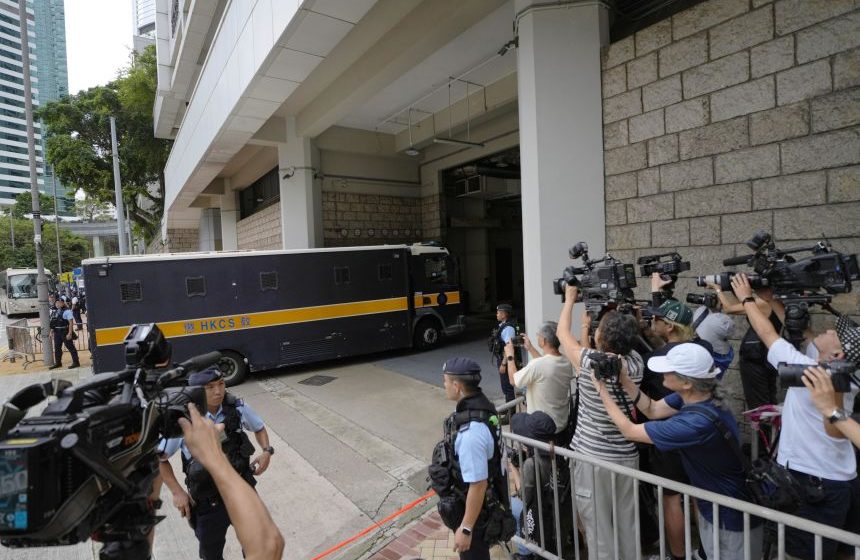
Before the sentencing Thursday morning, police stepped up security outside the court near Hong Kong’s financial district, where dozens of people had camped out – some for two nights – to get a glimpse of one of the city’s most famous prisoners.
Among them was ET Wong, a housewife, who said she began following Wong’s campaign when he was still a teenager.
“He chose a difficult path for the future, human rights and Hong Kong’s student movements,” she said. “He shouldn’t have stayed in prison for a single day.”

Activist Lui Yuk-lin held a card with Wong’s name as she entered the building, lamenting the fate of the former teenage figurehead.
“He’s a child in my heart,” she said.
As he was led into court, Wong, wearing a navy blue shirt and his usual black-rimmed glasses, nodded to supporters in the public gallery. Given the limited space, supporters took turns parading through the gallery.
Weeks after pleading guilty to his second national security charge in September, Wong – who has been behind bars since 2020 – told his friend in a letter that he was feeling “so-so”.
“(It’s) very difficult to describe this feeling and this thought,” Wong wrote in the letter shared with CNN by his friend.
But the former activist also encouraged his friend to stay positive, quoting a verse from the Bible.
“There is no fear in love,” Wong wrote, quoting the First Epistle of John, adding that the fear he had experienced in recent years had made him appreciate his love for his friends and the city even more.
Louis Lee, who shared his interactions with Wong, said they discussed everything from music to their favorite Japanese anime, and remembered good times.
Reading Wong’s letters sometimes made Lee cry.
“As a friend, I miss him so much and look forward to the day he gets out of prison,” Lee said.
The skinny, bespectacled activist with a gift for spirited public speaking, rose to prominence in 2012 at the age of 15, leading sit-in protests with his friends to successfully overturn a government plan to introduce Chinese civics education in the city’s schools.
At the time, critics feared the proposed program amounted to propaganda from Beijing. Under the NSL this is now compulsory in all schools.
Two years later, Wong became a key leader of the city’s Umbrella Movement protests, which brought thousands of people, mostly young people, into the streets to call for more democracy by blocking major thoroughfares for 79 consecutive days.


In 2016, he co-founded the pro-democracy Demosisto party, which managed to send co-founder Nathan Law to the city’s Legislative Council as its youngest member (Wong was too young to run.) The party announced its dissolution hours after Beijing adopted the NSL, with Law revealing days later that he had left Hong Kong.
Law is now one of dozens of overseas democracy activists wanted by Hong Kong’s national security police and who have received a cash bounty.
Authorities disqualified Wong when he tried to run again in 2020. He was later arrested and charged along with dozens of others for participating in unofficial primaries held to select candidates for the Legislative Council elections.
In what was widely known as “Case 47,” after the number of opposition figures put on trial, prosecutors said Wong and others overthrew Hong Kong’s government in 2020 by holding primary elections — a common practice in many democracies.
At the time, Hong Kong authorities said the primary vote was a “vicious plot” intended to “paralyze the government and undermine state power”, and accused those who participated in it of intending to use their mandate to block legislation indiscriminately.
Of the 47, most pleaded guilty while 14 were convicted and sentenced to up to 10 years in prison, after a 2024 trial that marked the largest prosecution of pro-democracy activists under the NSL. Two were acquitted.
Since the NSL came into force, civil groups have been dissolved and some independent media outlets have been closed. The city’s parliament now includes only pro-Beijing loyalists, while most pro-democracy figures are either in prison or in exile abroad.
Gn world