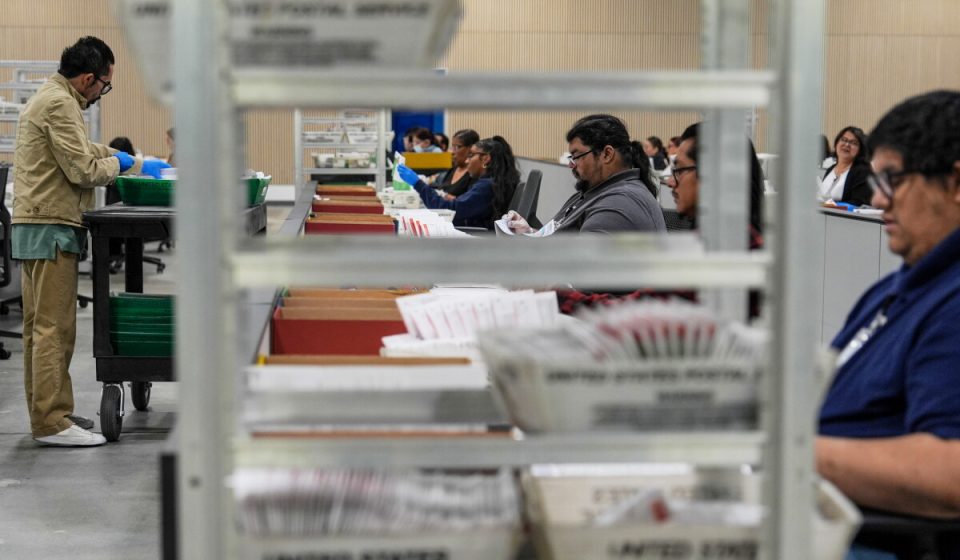
LOS ANGELES — A federal judge on Wednesday rejected a Trump administration request to block California from processing the ballots of up to 20,000 people over allegations they were likely non-citizens, warning it would “wreak havoc” in the midterm elections.
The decision by U.S. District Judge David O. Carter comes as more than 3.7 million people have already voted in the state.
“Eroded trust in our democracy is irreparable. Once a vote is split, lasting damage occurs,” Carter wrote. “If the Executive Branch can set aside votes and threaten ongoing elections based on unproven allegations, then our democracy is in danger. This Court refuses to participate in such a process.”
Justice Department prosecutors said they would immediately appeal the decision.
The ruling is the latest legal setback for President Donald Trump in his efforts to expand federal control over state-run elections ahead of the vote that will decide control of Congress for the remainder of his term.
The Republican administration sued election officials in the Democratic state in mid-October, accusing officials of failing to meet a 48-hour deadline to review a list of 20,000 people who they said were likely non-citizens registered to vote in the state. The administration had asked the judge to require the state to wait to count those ballots until the voters’ immigration status could be verified.
The Department of Justice made a similar request in Washington State this week for the state to sequester ballots submitted by hundreds of people it suspects are not U.S. citizens. Meanwhile, another trial filed in Alaska last week, we seek to delay the certification of the vote if the Republican incumbent president running for U.S. Senate doesn’t win. All three states have House or Senate races that will help determine the balance of power in Congress.
Judge rules Justice Department request violates civil rights laws
Carter’s order was a strong rebuke to the federal government’s request, arguing that separating ballots at this point in the election would force counties to develop new methods of sorting ballots and “risk disenfranchising untold numbers of voters.” In other words, Carter argued, it would have the same effect as a voter purge and would therefore violate the National Voting Rights Act, which prohibits any changes to voter rolls within 90 days of an election.
The federal government’s request, Carter wrote, “would wreak havoc and disrupt elections already underway, create a chilling effect on election workers and voters, and reduce the votes of American citizens.”
California sends ballots to 23 million registered voters. Court records show more than 500,000 ballots had already been processed this week, meaning their envelopes were checked and the ballots removed. That would make it virtually impossible to know which ballot belonged to a particular voter, Los Angeles County officials said.
Carter, appointed by former Democratic President Bill Clinton, also rejected the Justice Department’s argument that California was hindering the federal government’s ability to enforce the law. He argued that prosecutors had already demonstrated their ability to enforce election law when they arrested 28 non-citizens who may have voted or registered to vote illegally.
Carter previously said in court that he was inclined to appoint a special master to control the government’s data processes. His order Wednesday appeared to reverse the trend, and he did not establish one in his order rejecting the Trump administration’s demands.
The Justice Department will appeal the decision
The federal government announced it would appeal for the second time Wednesday evening. The United States’ first appeal was rejected by the 9th Circuit Court of Appeals because it anticipated the district court’s decision. Two of the three judges also expressed considerable skepticism about the merits of the trial itself.
First Assistant U.S. Attorney Bill Essayli doubled down on the trial’s arguments Wednesday.
“Every day, more ballots are processed by election officials,” Essayli wrote on social media after the decision. “This ongoing emergency is disenfranchising American citizens through dilution.”
Essayli, who argued on behalf of the federal government on Tuesday, previously said the federal government’s request would not hinder the election. Instead, he argued that the Justice Department was trying to prevent “dilution” of the vote with non-citizen voters.
“Separating a ballot does not prevent its subsequent counting,” Essayli said. “It is designed to preserve the status quo and prevent our elections from being infected with illegal ballots. »
California decision echoes national trend
Election law experts who followed the case said the decision was consistent with a broader change.
David Becker, executive director of the Center for Election Innovation and Research, said the district court’s decision “confirms what we already know: States, not the federal government, run elections.”
He said the DOJ’s demands on California election officials so close to Election Day seemed “designed to cause chaos.”
“But fortunately, the administration’s efforts to interfere with the midterm elections are failing,” he said.
Jon Miller, program director for the Public Rights Project, a progressive civil rights organization that represents Los Angeles County officials, said he considered Wednesday’s decision a “major victory for voters.” But he said his organization was always ready to take on new challenges as part of “broader efforts to undermine elections, undermine the credibility of election officials and sow distrust in the electoral process,” he said.
———
This story has been updated to correct that more than 500,000 votes have been processed and not counted.
Gn usa