
This story was last updated at 6:00 p.m. on November 20.
The U.S. Justice Department said it would oppose an emergency request to stop the military from detonating about five tons of unstable lead azide in southeast Iowa. A federal appeals court temporarily suspended the permit, leaving it unclear whether the explosions will take place on Monday.
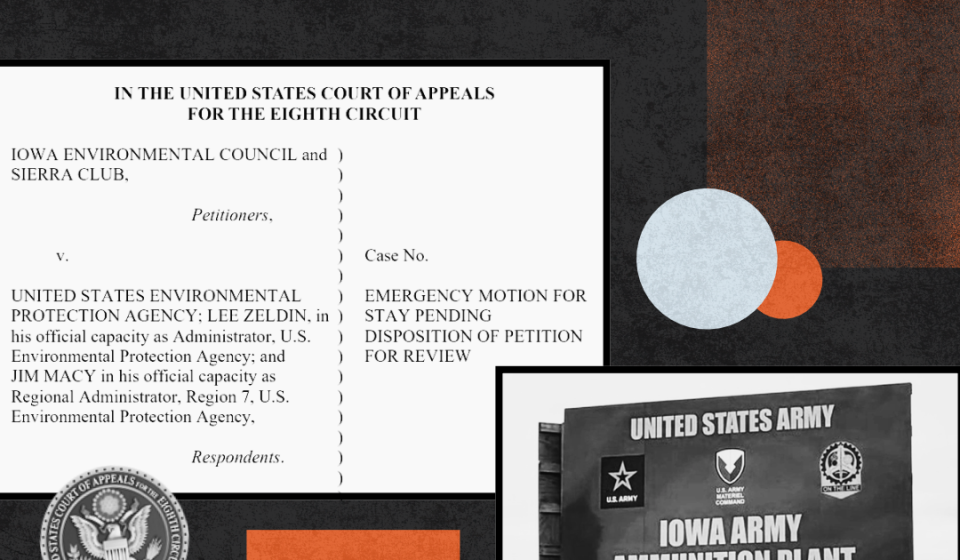
The 8th U.S. Circuit Court of Appeals on Thursday evening suspended the Environmental Protection Agency’s emergency permit. The order remains in effect until the court rules on a motion filed by Earthjustice on behalf of the Iowa Environmental Council and the Iowa chapter of the Sierra Club to block explosions at the Iowa Army Ammunition Plant in Middletown, near Burlington.
Earthjustice’s lead lawyer, Thien Chau, said Friday that the court could rule before Monday, but gave no timetable.
The Justice Department said in its notice that deterioration of the explosive poses an imminent and significant danger to human health and the environment. He also pointed to a federal regulation that allows waste treatment without an EPA permit in qualifying emergency situations involving an immediate threat to people, property or the environment.
Chau called the exception “an extraordinary and extreme safety net.” He declined to speculate on why federal lawyers raised the issue and urged the military not to invoke it to circumvent legal process. He said the military could not rely on the suspended permit to carry out the explosions.
The groups argue that the EPA gave residents too little notice and did not require a full review of alternatives or adequate testing and cleanup. Their emergency motion says lead dust could travel 100 miles or more under certain weather conditions. They want the military to take a closer look at chemical neutralization, a technology described in an EPA compendium. The military says the chemical treatment would require prolonged handling of the 68 drums, increasing the risk of accidental explosions.
“It really seems unprecedented, doesn’t it? To take that many explosives containing lead and detonate it, knowing that it’s going to disperse over communities, over farmland, over bodies of water – including one of the most iconic bodies of water in this country, the Mississippi River – and possibly affect more than one state,” Chau said. “I think it’s absolutely an abnormal and extraordinary thing to do.”
Asked about Middletown residents and plant employees fearing an unexpected explosion during the delay, Iowa Environmental Council general counsel Michael Schmidt said the groups want to protect workers as well as people who might be exposed to lead dust. Wally Taylor, legal chairman of the Sierra Club’s Iowa chapter, said he wants the Army to provide more evidence that the equipment needs to be destroyed immediately.
Acting Secretary of the Army Adam Telle announced Thursday that the Army was moving the explosions from Friday to Monday. Telle said Monday was the latest the military could wait before an expected drop in temperatures that could make the explosive more unstable. He did not announce the time of Monday’s operation.
The delay follows calls from lawmakers in both parties for more answers on health risks and safety precautions. Illinois Governor JB Pritzker, U.S. Senators Tammy Duckworth and Dick Durbin, U.S. Representatives Eric Sorensen, Darin LaHood and Mary Miller, and U.S. Senators-elect Josh Turek of Iowa and Julianna Stratton of Illinois signed a bipartisan letter urging Telle and EPA Administrator Lee Zeldin to consider a delay while safer options are explored.
Gov. Kim Reynolds announced Friday evening that she had activated the State Emergency Operations Center to coordinate the state’s response to the military’s planned detonation Monday.
The activation creates a platform for state agencies to organize ahead of the controlled explosion at the Iowa Army Ammunition Plant.
This came after the Iowa Emergency Management Association asked Reynolds earlier Friday to activate the SEOC, issue a disaster emergency proclamation for potentially affected counties and put Iowa Homeland Security and Emergency Management in charge of coordinating the response.
The association said local officials need clear guidance on protective measures and post-blast monitoring, even as they await more federal information.
The governor’s office said Friday that it is “actively coordinating with federal officials at the Environmental Protection Agency and the military to continually monitor the situation and keep local partners informed.”
This is a developing story and may be updated.
Gn headline