Kevin Warsh is managing the cost of US debt, not inflation, as interest rates may soon outpace GDP growth.

Trying to define Kevin Warsh as a hawk or a dove has been tricky, with his statements and actions leaving Wall Street perplexed.
As President Donald Trump’s chosen Federal Reserve chairman, Warsh was expected to lean toward looser monetary policy. He then said inflation was a “choice,” suggesting a tougher approach.
Over the summer, he suggested looking at other inflation indicators and that the bond market would take on some of the Fed’s tightening work, suggesting less aggressive policy.
But he delivered a hawkish speech at the Jackson Hole conference in August and led the Fed to a unanimous rate hike in September.
Last week, he hesitated to support another rate hike, despite a further rise in inflation, his lack of explanation and his refusal to give any indication on the next policy decision producing a generally conciliatory effect.
But Robin Brooks, a senior fellow at the Brookings Institution, said asking whether Warsh is a hawk or a dove is not a good question. Instead, he views all of the Fed chairman’s mixed messages from a different perspective, arguing that high inflation numbers cannot rationalize Warsh’s statements.
“We are not in hawkish or dovish territory. What is happening is yield curve management, which itself is a function of the precariousness of the U.S. debt situation,” Brooks wrote in a Substack article Thursday.
Indeed, rising Treasury yields this year threaten to worsen the already gloomy outlook for U.S. debt, which now exceeds $40 trillion in gross terms, with government debt representing 100% of GDP.
In fiscal year 2026, which ended in September, interest costs on the federal government’s debt topped $1 trillion, outpacing defense spending.
“The bottom line is that inflation and other macroeconomic data are secondary,” Brooks added. “Fed policy twists and turns are about the direction of long-term yields.”
He suspects the Fed and Treasury Department are in de facto collusion to keep borrowing costs stable. Brooks pointed to Treasury Secretary Scott Bessent’s surprise announcement to buy back more long-term bonds, briefly lowering yields.
Bessent also intervened in the foreign exchange market to support the yen without Japan having to sell its US debt securities, which would have pushed up yields.
How effective these attempts at managing bond yields actually are is another story. Expectations of a further escalation of the war in Iran have driven up oil prices and yields. Signs that the U.S. economy is overheating have also boosted inflation and rate forecasts.
But the United States also experienced some respites. Fears that the AI boom, a major driver of GDP growth, might go bust have eased pressure on yields. France’s political unrest and fiscal dysfunction have raised fears it could trigger a debt crisis that would spread to other parts of the euro zone.
Since then, investors have once again embraced Treasury debt as a safe asset, and the 10-year yield has fallen back below 5%.
“Warsh is neither a hawk nor a dove,” Brooks said. “Instead, like Bessent, it simply tries to keep long-term returns manageable.”
Such management risks putting the United States on a path to so-called fiscal dominance, where high debt and deficits outweigh the Fed’s ability to independently manage monetary policy and combat inflation.
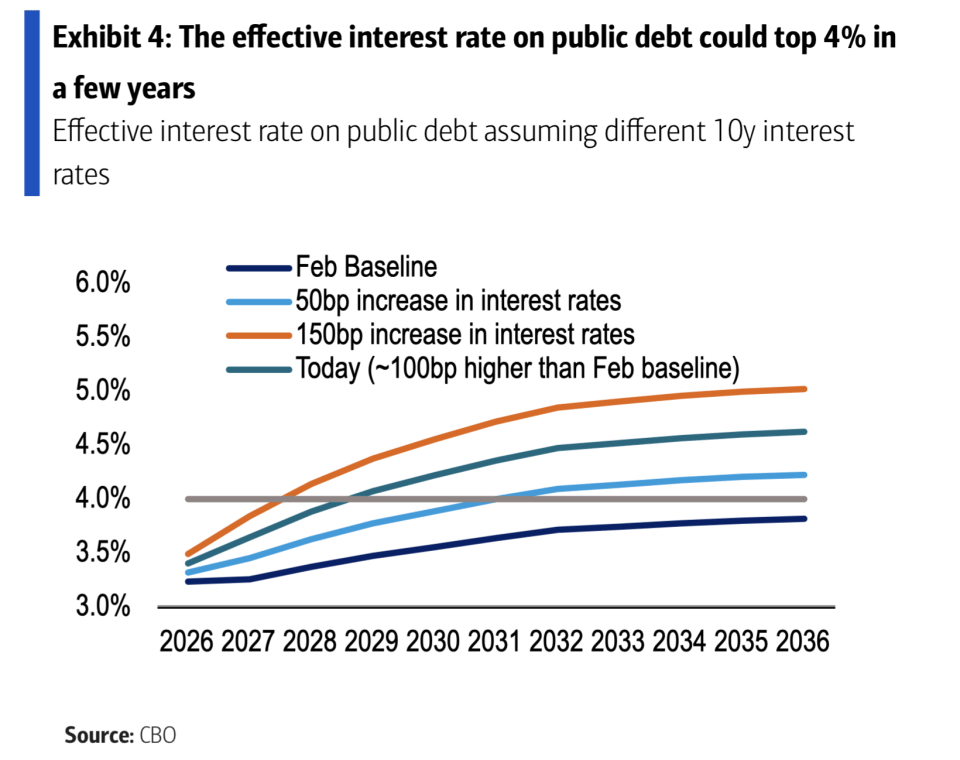
Bank of America
Economists have pointed out that as long as nominal GDP growth remains above interest rates, the United States can avoid a debt spiral in which borrowing costs accumulate faster than the economy grows.
But bond yields have risen so high and so quickly this year that they have exceeded long-term estimates, raising alarms about the debt’s trajectory. In fact, the Congressional Budget Office was asked to evaluate scenarios in which returns would be 150 basis points and 50 basis points above the watchdog’s 4.3% benchmark.
In the 150-point scenario, net interest costs will rise by $4.9 trillion over the next 10 years, and government debt will reach 133 percent of GDP by 2036. Although yields have fallen recently, they have jumped more than 100 basis points from the CBO’s baseline scenario.
Bank of America analysts looked at the CBO numbers and estimated that in the alternative scenario, the effective interest rate on government debt would exceed long-term nominal GDP growth (assumed to be 4%) as early as fiscal year 2028, which begins in October 2027.
For now, nominal growth remains robust and stood at 5.6% in the third quarter, helped by the AI boom and high inflation.
“However, these two forces are likely to prove more temporary than permanent, unless AI adoption ultimately generates substantial productivity gains,” BofA said in an Oct. 19 memo. “If this were to occur, concerns about fiscal sustainability would ease significantly. Even so, we think it is optimistic to assume that the United States can simply dig itself out of its growing debt burden.”
Gn bussni