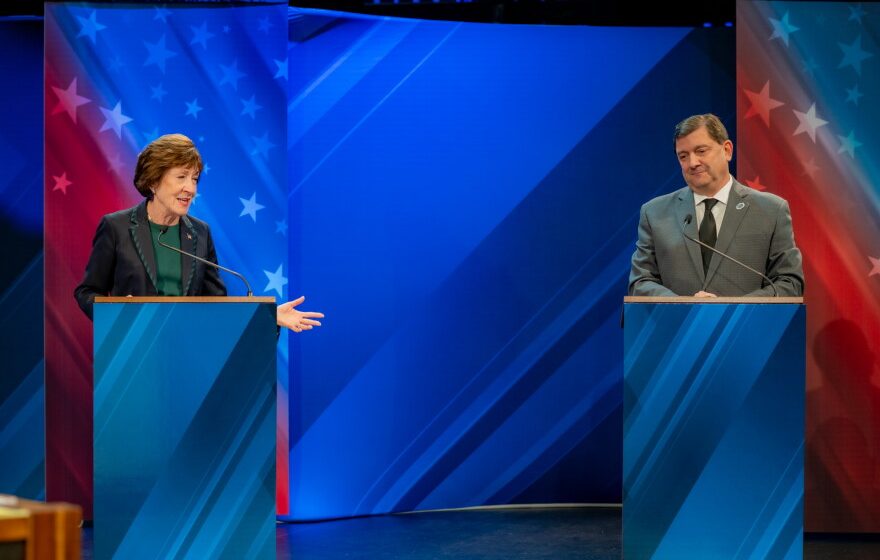
Key takeaways from the final, fiery debate between Susan Collins and Troy Jackson

It was likely their last face-off in a race with potentially major national implications.
For an hour, Republican Senator Susan Collins and Democrat Troy Jackson denigrated each other, described themselves as beholden to political interests far from Maine and made the audience laugh with their sharp barbs. At one point, Jackson even told Collins to “shut up” after he joked that a protester was obviously from his camp.
But they sometimes agreed on issues such as the pernicious effects of “dark money” flowing into Maine to attack and support both candidates.
Here are some key takeaways from Thursday night’s debate co-sponsored by Maine Public, NEWS CENTER Maine and the Portland Press Herald.
Trump’s shadow looms
As he did in their three previous joint appearances, Jackson sought to portray Collins — a 30-year Senate veteran — as a key cog in a Republican majority in Congress that he says refuses to stand up to what he sees as a dangerous president.
“They will not stop Donald Trump and I think our democracy is a risk,” Jackson said before accusing Trump of trying to stop the November vote. “Donald Trump is trying every trick possible to hold on to power. And we’ve already seen what he’ll do on January 6 when he leads an insurrection.”
And he repeated one of his favorite statistics: Collins reportedly voted with Trump 96 percent of the time.
“The reality is, 100 percent of the time, when Donald Trump needs her, Susan Collins will be there,” said Jackson, a professional lumberjack and former Maine Senate president who entered the race in July after former Democratic candidate Graham Platner withdrew. “The votes she rejects are managed votes whose results she already knows.”
As she has in previous debates, Collins accused Jackson of cherry-picking a number from a study that looked at only about a third of the votes cast. The real number, she said, is about 72 percent. And Collins, who chairs the powerful Senate Appropriations Committee, pointed to years of analysis consistently showing her to be the most or one of the most bipartisan senators in either party.
“He will automatically vote for the Democratic position no matter what,” Collins said of Jackson. “We lost a lot of centrists and one of the reasons is we need people who will work across partisan lines.”

Rebecca Conley
/
Maine Public
The “Oh Shut Up” Moment
It’s probably safe to assume that both candidates wanted to say this to each other at some point (or numerous times) during the previous three tense debates. But it took an unexpected disruption to bring it out.
The brief scene began when an audience member began yelling at Collins about the environmental impact of data centers as she began to answer a question on an entirely different topic.
“So he’s obviously a Troy supporter,” Collins said, leaning slightly toward the microphone.
“Oh, shut up,” Jackson retorted. “I didn’t…I don’t even know this kid.”
“Oh, that’s right,” Collins said sarcastically.
Just before Collins’ initial remark, Jackson frowned and shook his head at the protester. And from the audio and video, it appears Jackson’s “oh shut up” was more casual than mean-spirited. The two rivals even appeared to exchange smirks before the debate quickly resumed without further disruption.
Unsurprisingly, the Senate Leadership Fund — one of the super PACs spending millions of dollars to support Collins — called attention to Jackson’s statement in an email.
The protester was later identified as Henry Elgie, a 19-year-old student at Bowdoin College. A press release from the Sunrise Movement – a “self-described youth movement aimed at stopping climate change and creating millions of jobs in the process” – says Elgie was part of a group of students confronting politicians on the campaign trail.
Some new issues and divisions
Although this was the fourth debate, both panelists – Maine Public chief political correspondent Steve Mistler and NEWS CENTER Maine host and political reporter Phil Hirschkorn – managed to get the candidates to weigh in on new issues.
In some cases, they almost agreed.
Both Jackson and Collins said they are opposed to so-called “dark money,” which is when political donors hide their contributions by giving to organizations that are not required to disclose their sources, such as politically active 501(c)(4) nonprofits. According to Mistler, Collins and Jackson have benefited from at least $75 million in dark money spending so far.
Collins said she has supported sweeping campaign finance reforms in the past that failed to meet constitutional requirements.
“I still think there are reforms that could be made, and one of them would be full disclosure of everyone who contributes,” Collins said.
“I’m 100 percent for overturning Citizens United,” Jackson said, referring to the Supreme Court decision that opened the door to unlimited campaign spending and, by extension, the creation of super PACs. “I mean, the billionaires bought Congress and regular people can’t afford to buy them out.”
On the issue of guns, Collins reiterated that she would support a ban on so-called bump stocks that allow semi-automatic weapons to function more like a machine gun and that she would support “reasonable” limits on magazine capacity. She also said she was “open” to raising the age of purchasing an assault weapon from 18 to 21.
Jackson said he opposed raising the minimum age. But unlike Collins, he would support a ban on the purchase of assault weapons — but would not support taking them away from people who already own them.
But rivals sharply disagreed over whether the Supreme Court should be expanded.
Some progressives are pushing to add justices to counter the 6-3 conservative majority on the court. Jackson supports the idea and has also called for term limits on judges and ethics reforms.
“We have the best Supreme Court right now that money can buy and I think it needs to be overturned,” Jackson said.
But Collins said adding judges would amount to political interference.
“This is inconsistent with the general idea that the Supreme Court would be insulated from politics … thereby making it a political body in its own right,” Collins said.
The last time Congress added seats to the Supreme Court was in 1869.
!function(f,b,e,v,n,t,s) {if(f.fbq)return;n=f.fbq=function(){n.callMethod? n.callMethod.apply(n,arguments):n.queue.push(arguments)}; if(!f._fbq)f._fbq=n;n.push=n;n.loaded=!0;n.version=”2.0′; n.queue=();t=b.createElement(e);t.async=!0; t.src=v;s=b.getElementsByTagName(e)(0); s.parentNode.insertBefore(t,s)}(window, document,’script’, ‘https://connect.facebook.net/en_US/fbevents.js’); fbq(‘init’, ‘1316195455504306’);
Gn headline