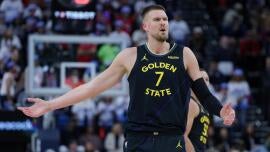

There is no such thing as an untradeable player in the NBA. As often as we talk about contracts being set in stone, it’s worth remembering that Russell Westbrook has already changed teams in five seasons of a supermax contract. Proximity to retirement is not necessarily an obstacle either. In 2007, the Dallas Mavericks managed to draft and trade Keith Van Horn about eight months after he played his last NBA game because they needed additional salary to complete their blockbuster Jason Kidd. If a team really wants to trade a player, there is almost always a way to do it.
Still, the Golden State Warriors face an uphill climb to move Kristaps Porziņģis, at least for now. On Wednesday, ESPN reported that the Warriors were exploring possible deals involving their top center, but for a variety of reasons he is an extremely difficult player to trade right now:
- Porziņģis has suffered from POTS (postural orthostatic tachycardia syndrome) for the past two seasons and is considering stepping away from basketball for good. At the very least, availability issues mean he currently has no positive trade value as a player. Any team considering acquiring him should view any future on-field value as nothing more than a bonus.
- When they re-signed Porziņģis this offseason, the Warriors gave him a $3 million guarantee for the 2027-28 season. That’s not a huge number by any means, but in the age of the apron, every penny counts. No team is going to be willing to pay Porziņģis $3 million not to play for them, which makes it a bit more cumbersome than a traditional expiring contract. Frankly, it was a weird own goal from Golden State. One potential path forward for Golden State’s 2027 offseason is near-maximum cap space, and given that Porziņģis would have had to pass a physical with another team to leave, it’s simply hard to imagine that he had the clout to demand any sort of 2027-28 guarantee. This is especially true considering the Warriors are paying him $20 million this season, well above the mid-level exceptions that most other teams were potentially expected to offer him.
- Due to the use of the taxpayer mid-level exception on De’Anthony Melton, the Warriors are limited to the second apron. They currently only have about $350,000 in cap room, meaning Golden State doesn’t have the wiggle room to accept a higher salary than Porziņģis without adding other players.
- Much of the NBA is not eligible for trade at this time. Most 2026 free agents aren’t tradeable until Dec. 15, and a few must wait until Jan. 15 instead. Porziņģis notably avoids that fate because the Warriors were able to complete his deal just before the start of free agency, allowing them to structure it as an extension that did not include a raise large enough to trigger a six-month trade restriction. He can be moved right now, but many other players who might consider a deal like this, including seven of his teammates, cannot.
Warriors exploring trades for Kristaps Porziņģis, who eyes future despite health concerns, report says
Robby Kalland
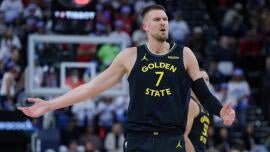
Put it all together and you get a set of extremely inconvenient business circumstances. The Warriors, with Jimmy Butler and Moses Moody also out, begin the season with nearly $90 million in salary due to injuries leading up to this season. Part of their motivation in exploring a Porziņģis trade would likely be to save this season. If they have to wait until December 15 for the right combination of players to become tradeable, it may be too late.
At best, Porziņģis is simply about matching the money from a business perspective. At worst, it’s someone they’ll have to attach something to in order to move.
So, are there any viable solutions? A few come to mind.

Milwaukee Bucks
The best version of Golden State’s roster depends largely on having centers who can shoot. As the Warriors learned with Jonathan Kuminga, pairing a shaky third-down 3-point shot with Butler and Draymond Green tends to compromise their spacing. Green can play center when needed, but at this point he shouldn’t do it full time. And even if Al Horford is here, he’s 40 years old and not equipped for a starter’s workload. This was the theoretical purpose of the acquisition of Porziņģis. Golden State needs big men who can make 3s, especially now that Quinten Post is gone.
The only beginner caliber shooting center available at a probably reasonable price is Myles Turner. The Milwaukee Bucks signed him in a last-ditch effort to keep Giannis Antetokounmpo. It didn’t work. Turner had a bad year and has three expensive seasons left on his contract. With Kel’El Ware needing minutes to potentially become Milwaukee’s long-term center, trading Turner for a shorter Porziņģis contract and Moody (necessary for money-matching purposes) makes perfect sense.


The Bucks don’t even have to worry about Porziņģis’ health throwing them into the relegation zone because they don’t control their own first-round pick. A team like Milwaukee, with no short-term challenges, is the ideal landing spot for Porziņģis. If he can return down the line, great, he would be a good replacement. If they have to cut him, well, it’s not like they need that wiggle room anyway.
There’s one pretty big problem here, though, and that’s the remaining years on Turner’s contract. Adding him more or less takes away cap space for the Warriors next summer. The question then is, what is the real value of this option? Nikola Jokić and Antetokounmpo are technically slated for unrestricted free agency… but does anyone really doubt they’ll re-sign with their current teams? Even if they don’t, why would they choose the aging Warriors? Karl-Anthony Towns can opt out of his contract in New York, but he’s made it clear he wants to remain a Knick for life. Chances are something will get done there. Difference makers no longer change teams via free agency.
Additionally, preserving that cap space means giving up their rights to their own free agents. Maybe Green is taking a discount to stay for sentimental reasons. Butler has never shown a willingness to do so. The addition of Turner robs the Warriors of upside potential over the next few years, but it’s not like Golden State really has much of that to begin with. What is the goal here? Are they really looking to win a title? Or just trying to allow Stephen Curry to retire with dignity? If it’s the latter, Turner makes sense.

Charlotte Frelons
The Hornets intentionally took a step back this season by trading LaMelo Ball, and since then, they’ve been perfectly willing to take money when it’s convenient for them. They got three second-round picks to eat up Dorian Finney-Smith’s contract, for example, and are more than flexible enough to waive Porziņģi next offseason if necessary. If anything, they may prefer to use his inflated cap hit and partial guarantee to secure more draft capital to take on another, larger contract in the future.
The Hornets are relatively light on high-end talent, but loaded with mid-sized contracts attached to playable NBA veterans. Royce O’Neale could help the Warriors. Grant Williams could help the Warriors. Grayson Allen could help the Warriors, even though they already have several shooting guards. If the goal of the game is simply to “transform a salary that doesn’t work for us into a salary that could work for us”, Charlotte is a fairly easy solution. Of the three, Williams is the only one with an expiring deal, but O’Neale has the lowest cap figure.
The Warriors have three tradeable second-round picks. Is that enough to close a deal like this? Maybe, depending on who the Hornets send. Charlotte may want to see how her rotation develops over the first few weeks before determining who, if anyone, she would like to trade. First-round capital, even a trade, just doesn’t make sense in such a small deal, so it’s either a second or a bust.

New Orleans Pelicans
The Pelicans are primarily a placeholder for the idea of using Porziņģis’ salary as well as draft picks to trade for a very good player. The Warriors have at times been linked to Trey Murphy and Herb Jones. The Pelicans, after signing Saddiq Bey to a three-year extension, could choose to move one of their other wings to possibly give him a starting job. Jones, as a shaky shooter, is the worse of the two. Murphy, given his score and friendly contract, would cost a lot more. Golden State controls most of its own trading capital. The question is how much, if any, it actually makes sense to give up in a win-now trade.
Murphy is a very valuable #3 option. The Warriors are absolutely not a #3 option away from any sort of significant victory. If this is the direction the Warriors want to take a Porziņģis trade, it probably needs to be accompanied by a proof of concept. If Curry can keep Golden State in, say, contention for the top six for a month or two, and Butler appears close to a return, then maybe it makes sense to make a trade involving multiple first-round picks. In the more likely case that the Warriors are more of a Play-In team (or worse), these picks would become valuable.
Curry is always a top-10 pick when healthy. He missed half of last season and is nearing the end of his legendary career. Golden State must balance the advantages his mere presence creates with the reality that its window likely closed when Butler tore his ACL last season. Improving while he’s still a star player would be nice. This is still, functionally, a rebuilding team, and fundamentally everything would have to go right to justify trading future for present here.
Gn sports