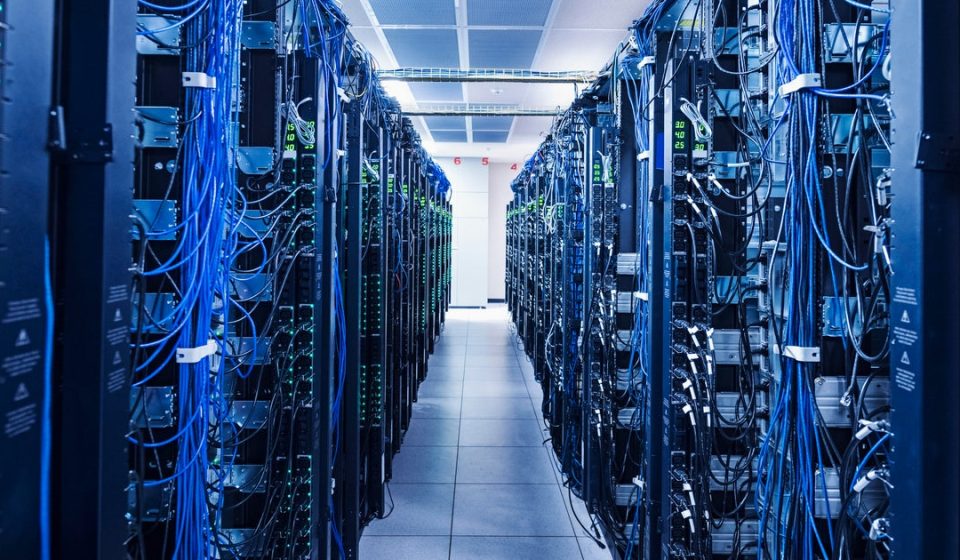
America’s largest data centers collectively consume about as much energy as some states and even countries, according to a new study from Harvard University.
Researchers found that so-called hyperscale data centers, which take up as much space as several football fields, consumed 82 terawatt hours of electricity, or 1.8 percent of all U.S. electricity, between 2024 and 2025. That’s roughly the equivalent of what a state like Missouri or a country like Denmark uses. Together, the facilities also produced 26 tons of carbon dioxide.
Harvard scientist Gianluca Guidi, lead author of the paper published this week in Nature Sustainability, told CBS News that it took two years to analyze the electricity consumption and carbon dioxide emissions of 403 large-scale data centers between May 2024 and April 2025. The study likely underestimates the centers’ estimated energy consumption, given the rapid pace of AI construction in the United States, he added.
“The data stops in April 2025, which in the age of AI is basically ancient history,” Guidi said. There are now more than twice as many large-scale facilities operating in the United States, with another 2,000 planned or under development.
“The industry is growing faster than anyone can keep up with it,” Guidi added.
Factories that never sleep
The study highlights AI’s reliance on data centers and their outsized impact on the environment. Guidi explained why the facilities are such large consumers of electricity.
“Every email you send, every photo you post, every show you stream, every question you ask generative AI software goes through a building like this,” he said of the windowless facilities housing tens of thousands of computers that run 24 hours a day.
Machines generate a lot of heat and require constant cooling. “So it’s basically a factory that never sleeps,” Guidi said.
Although he is excited about the capabilities of AI and considers himself a proponent of the technology, Guidi called for more transparency in evaluating when and how facilities are built, as well as their impact, before data centers are built.
“Evidence should not appear after the buildings, and the public voice should not appear either,” he said. “There are better ways to build this, maybe it costs more, maybe it takes longer. So we have to ask ourselves: Are we confusing what is possible or what is profitable with what is actually good for society?”
To this end, it has posed a challenge to hyperscalers like Amazon, Meta and Microsoft. “We’ve proven that we can build AI very quickly. Now let’s prove that we can build it right,” he said.
Negotiators at the UN COP31 climate talks in Turkey launched a voluntary pledge earlier this week calling on businesses and governments to power AI with cleaner energy.
“We cannot ask people today to accept higher bills, more pollution from global warming and deeper inequality in exchange for promises of a better future,” UN climate chief Simon Stiell said Monday at the launch of the pledge. “Claims about future emissions reductions cannot excuse the current increase in pollution, further worsening climate disasters.”
So far, that pledge has failed to attract signatures from U.S. tech companies driving AI development.
Gn bussni