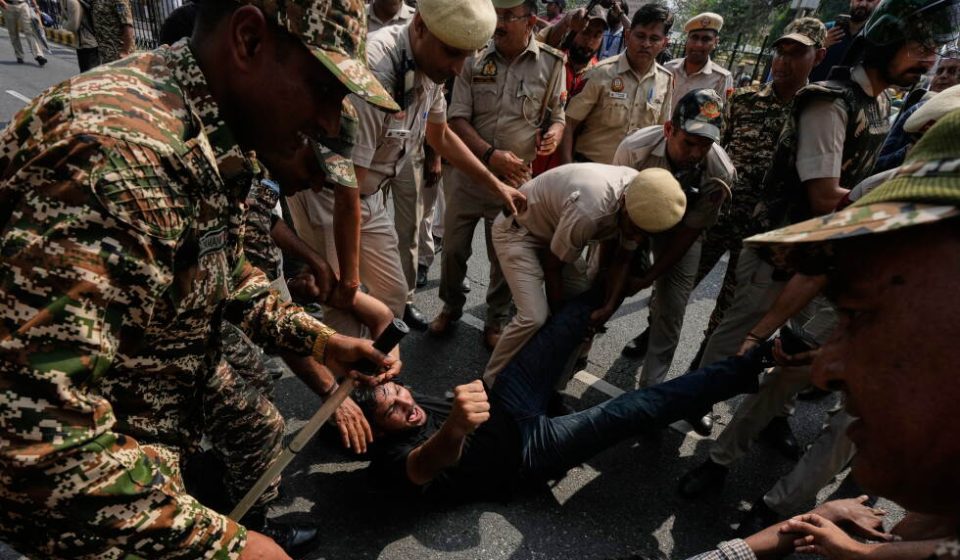

NEW DELHI (AP) — Indian authorities launched a sweeping crackdown in New Delhi and arrested thousands of protesters Saturday as Indian youth “Cockroach” movement sought to intensify a national campaign against a controversial revision of the electoral list this fueled anger against the Prime Minister Narendra Modi Hindu nationalist government and electoral authorities.
Police moved to disperse the protest before it could begin, intercepting demonstrators as they made their way to Jantar Mantar, the designated site for the protest in the heart of the Indian capital, chasing some away and arresting many others. Some were evacuated before being crammed into police vehicles and taken to temporary detention centers. Several leaders of the “Cockroaches” movement, opposition deputies and student activists were arrested before their arrival, effectively paralyzing the demonstration before it began.
The crackdown extended beyond the protest site, with police stopping buses, cars and other vehicles at checkpoints on roads leading to the capital and searching for demonstrators. Jantar Mantar was barricaded, while anti-riot vehicles equipped with tear gas launchers were stationed along key roads. Restrictions on mobile internet and access to parts of the city have added to the obstacles protesters face.
Police said Friday they had refused permission to protest because the request was submitted late.
Sambit Patra, a spokesperson for Modi’s party, called the protesters “anarchic elements.”
“Their flop show was completely demolished,” Patra said.
The extent of the repression underlined the authorities’ determination to disrupt a growing protest campaign that has mobilized thousands of young people, attracted support from the opposition and intensified scrutiny of Modi. The protests also come at a politically sensitive time, months after protests led by the “Cockroaches” movement against leaked exam papers. forced Modi’s education minister to resign in July.
Police arrest leaders, tighten control around protest site
Leaders of the ‘Cockroaches’ movement Abhijeet Dipke, Saurav Das and Ashutosh Ranka, who were expected to be at the forefront of the protest, were arrested on Saturday after their arrival at Delhi airport from Mumbai. A video shared by the “Cockroach Janta Party” on X showed police boarding the plane and arresting the three men.
“The planned interception by the Delhi Police is aimed at paralyzing the leaders of today’s peaceful protests even before they reach the protest site,” the movement said in a statement.
Loudspeakers around the protest site warned that gatherings of five or more people were banned in parts of New Delhi as authorities imposed draconian security restrictions rarely seen in the capital. Journalists also faced restrictions in some areas, with police briefly detaining some of them.
Some demonstrators nevertheless broke police lines, chanting slogans against Modi and the electoral authorities before being arrested.
“We are a democracy, but peaceful protests are crushed by force. Shouldn’t we fight for our rights,” said Tanya Negi, a student who came from Mumbai with two friends and arrived early on Saturday. “Why is Modi afraid of young Indians?
The police response marked an extraordinary show of force in a capital where Modi’s government has repeatedly sought to contain public dissent in the past. Under Modi, authorities have often used arrests and restrictions on public gatherings to contain protests, raising questions about space for demonstrations in the world’s largest democracy.
The latest crackdown has renewed criticism from opposition leaders, who have accused the government of curbing dissent.
“Is there a democracy in this country? A total siege of the city. Citizens are being driven out,” opposition lawmaker John Brittas told the Associated Press. Brittas was later arrested by police.
India’s electoral roll dispute raises election fairness concerns
The protests focus on the Election Commission of India’s intensive special review, which the opposition says has disenfranchised millions of eligible voters. The protesters are demanding the resignation of Chief Election Commissioner Gyanesh Kumar and an end to the change, which has so far removed more than 130 million names from the electoral rolls.
The Electoral Commission and the government reject allegations of voter manipulation, saying the revision aims to eliminate duplicate and ineligible registrations.
The conflict has become a rallying point for opposition parties seeking to challenge Modi’s Hindu nationalist Bharatiya Janata Party.
The protest planned for Saturday follows several days of demonstrations in the Indian capital, where opposition lawmakers have also stepped up their campaign, along with the leader of the Congress party. Rahul Gandhi be briefly detained by the police.
Gandhi and other opposition leaders have accused the commission of conducting the electoral review in a way that benefits Modi’s party. The opposition says voters most likely to support its parties were disproportionately affected by the deletions, while BJP supporters were spared or added to the lists.
The commission and the government deny these allegations.
Indian youth movement expands campaign against Modi
For the “Cockroach” movement, the conflict over the electoral list offers an opportunity to expand its campaign.
The movement began online in May and grew to prominence through protests, sit-ins and hunger strikes over alleged leaked exam papers. Those protests culminated in the resignation of Modi’s education minister in July, a rare political setback for a prime minister who has maintained a firm grip on national power for more than 12 years.
For Modi, the protests pose a challenge midway through his third term, even if their political impact remains uncertain. National elections are not due until 2029, but national elections next year in BJP-ruled Uttar Pradesh, India’s most populous state, and Gujarat, Modi’s home state, will test the party’s position.
___
Associated Press journalists Shonal Ganguly in New Delhi and Aniruddha Ghosal in Hanoi, Vietnam, contributed to this report.
Gn headline