Less than 42 minutes of bright light per day is a stronger predictor of dementia than obesity, study finds: ScienceAlert

Every morning, when we open our eyes to a bright new day, our brain’s “master clock” synchronizes our body and its rhythms with the Sun.
The more light we are exposed to daily, the more our brain will benefit in the long term.
According to a recent study of nearly 88,000 older adults, those who are exposed to more light daily are less likely to develop dementia over the next decade.
The longer the exposure to light, natural or artificial, the stronger the association.
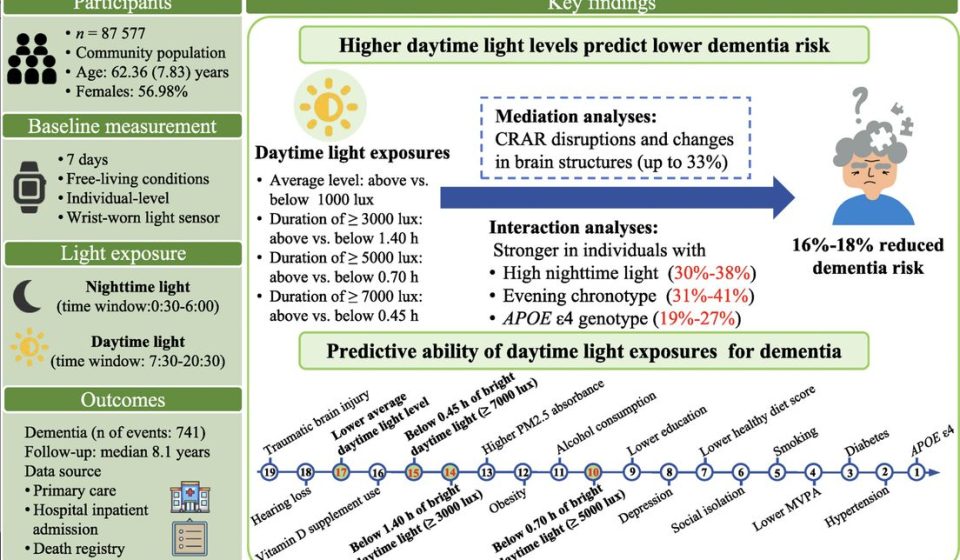
In fact, spending at least 42 minutes per day exposed to bright light (5,000 lux or more) was associated with a 17% lower relative risk of dementia.
It is a better indicator of dementia than six other traditional risk factors, including obesity, alcohol consumption, air pollution and hearing loss.
For “night owls,” the association was even stronger. Greater daytime light exposure was associated with up to 41% lower risk of dementia.
The results, published in General psychiatrysupport the idea that light-based interventions hold promise for people at risk of cognitive decline.
“These findings position daytime light exposure as a new robust and measurable indicator of dementia risk,” write the authors of the study, led by researchers at Guangzhou Medical University in China.
“They could inform future research on light-based interventions and public health guidelines that recommend increased daytime light exposure as an inexpensive strategy to support brain health, particularly in high-risk populations.”
Many dementia patients experience sleep disorders or disruptions to their sleep-wake cycles, and yet surprisingly little research has investigated light exposure and its links to cognitive decline.
The human body’s circadian clock tells us when to wake up and go to sleep, and it is naturally synchronized with sunlight.
When light enters the eyes, it activates the brain’s master clock, regulating the rest of the body’s daily rhythms.
Sunlight on the skin stimulates the production of vitamin D, which is also linked to the risk of dementia.
Previous studies have shown that brighter nights and darker days can disrupt circadian rhythms, but it’s still unclear how this affects long-term brain health.
In a recent analysis, researchers looked at data from the UK Biobank, in which participants wore a light sensor continuously for seven days.
Those who were exposed to more daytime light during that one-week period had a significantly lower risk of dementia about eight years later.
This was particularly evident for night owls (as opposed to morning people), people with high nighttime light exposure, and those with genetic risk factors for dementia.
For example, those who carry the APOE ε4 allele and are exposed to more daytime light had up to a 27% lower risk of dementia.
“No previous studies have investigated associations between average daytime and nighttime light exposure and dementia risk,” the authors note.
It’s unclear what impact light exposure might have on cognitive decline, but in this observational research, participants exposed to more daytime light tended to have greater brain volume or surface area in parts of the medial temporal lobe.
This region plays an important role in memory and is often one of the first areas affected by dementia.
It is also possible that light has a more indirect impact on the brain.
Previous studies, for example, have shown that daytime light levels can predict lower risks of major depressive disorder, which is a risk factor for dementia.
“Therefore, ensuring exposure to brighter daytime light (e.g. ≥1,000 lux) may be a simple way to prevent psychiatric disorders and dementia,” suggest the authors of this recent study.
“This is particularly relevant given that people in modern society spend almost 90 percent of their day indoors under artificial lighting, which typically provides insufficient brightness (∼300 to 500 lux) during the day.”
Maybe a brighter day today could lead to a brighter brain tomorrow.
The research was published in General psychiatry.
This article was fact-checked by Rebecca Dyer and edited by Rebecca Dyer. Although we are proud of our process, we are only human. If you spot an error, please let us know.
Gn Health