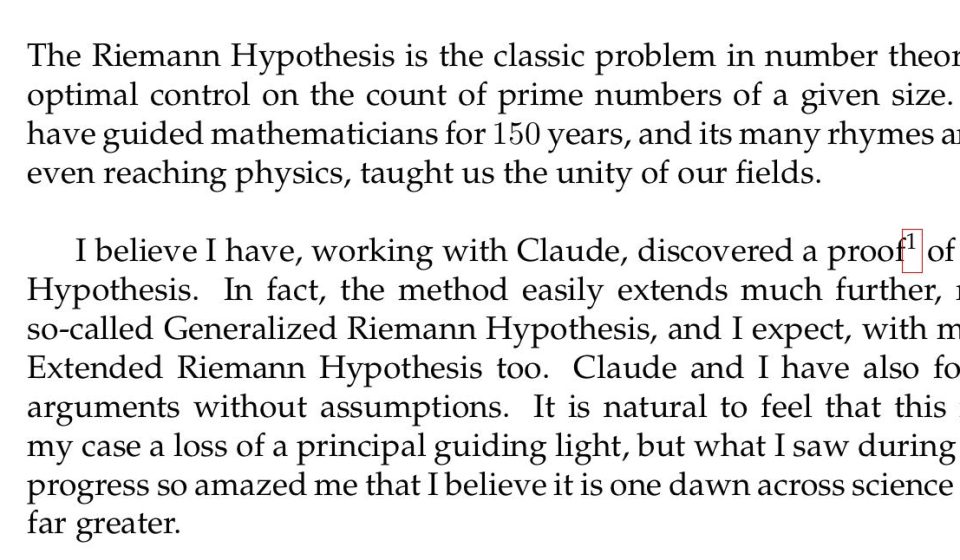
The surprising news on Friday, just after the market closed, was that Levent Alpöge appears to have proven the Riemann hypothesis with the help of Claude from Anthropic.
It’s really, really amazing.
But it has also (as is often the case) been widely misinterpreted.
For starters, on social media, a lot of people seem to think that AI *alone* solved the Riemann Hypothesis. This is not the case.
Indeed, as far as I know, current AI could not we did it alone.
Above all, the solution required extensive human advice from Alpöge, an exceptionally talented mathematician with expertise in AI. He worked together with AI to jointly solve HR, over a period of several months.
As AI mathematics pioneer Christian Szegedy said, “Levent made all the right (life) choices at the right time” in order to get the result, and we wouldn’t be here any other way. He didn’t just type a prompt”Solve Riemann“, and get the final answer. His contributions to the development of the final product were considerable.
Basically, a brilliant mathematician with brilliant instincts drove a deeply collaborative process.
Importantly, the results don’t mean AGI happened, or anything like that. (If that were the case, you wouldn’t have needed the human mathematician to guide the whole process.)
This doesn’t even mean that the result is useful or technically innovative; it’s 250,000 (unelegant) pages long, and no general lessons about how to do math have yet been learned, nor (as far as I’ve heard) any new techniques or concepts have yet been introduced.
Most importantly (from the perspective of assessing future impact), Alpöge and the Claude AI system have relied heavily on a unique set of resources that you won’t find in a field like medicine. The solution depended not only on Alpöge’s considerable talents, but also on a special-purpose symbolic AI resolution system, Skinnyand a vast library specific to mathematics, mathlibdesigned to work with. The latter, mathlib, consists of “more than two million lines of formalized mathematics” constructed over several years by hundreds, even thousands, of people.
This library is fantastic for math, but also specialized for math. It is likely of relatively limited use for solving more open-ended problems in fields like biology, business, or robotics.
And critically, Lean and Mathlib revolve around formal verifiability, which is simple in mathematics but difficult to achieve elsewhere. Exactly like I predicted in 2024testable methods have been more useful in mathematics than in other fields.
In short, it is not at all clear that everything Alpöge has done has the generality that many people hope for.
As Jeremy Kahn said, “Fixing HR doesn’t help you negotiate a contract better or properly prepare a corporate tax return. So there’s no real change in the value of the company.” Or, in the words of Sébastien Krier of Google DeepMind, “Solving an old pure math problem does not immediately increase Anthropic’s operating margins.”
§
It seems to me a bit like that moment when DeepBlue beat Garry Kasparov at chess in 1997: an absolutely astonishing use of brute force in a special way that hasn’t generalized to much else. Many people have written about how this would change the world; this is not the case.
The market seems to understand all this… RH Didn’t Move Anthropic Stock Much After Hours – even if many AI fans don’t.
Clinging to Riemann’s results as a life raft after the stock market correction – as AI hype-mongers do on social media – does not change the fact that (a) current AI is still not reliable enough for many applications and (b) is still not cost-effective enough to justify massive investments.
Gn bussni