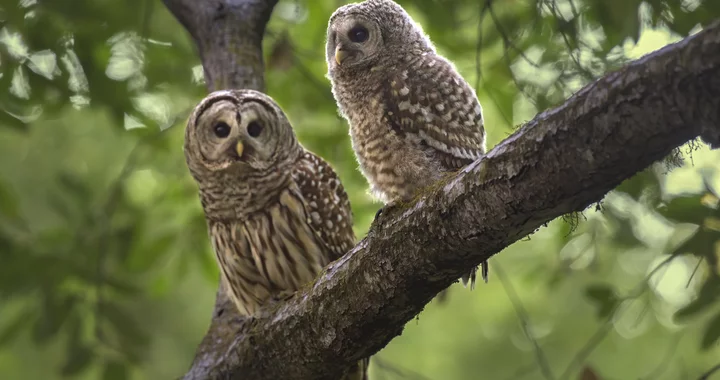
Local research into killed barred owls shows bans on the most harmful rodenticides work | Lost Coast Outpost

New research from the Integral Ecology Research Center (IERC) offers some of the clearest evidence yet that California’s efforts to restrict dangerous rodenticides are paying off in nature, while also signaling a new contaminant that deserves careful attention in the future.
The study, published in the journal Environmental Pollution, analyzed liver tissue from 1,003 barred owls collected in northwest California between 2019 and 2025, the largest rodenticide biomonitoring dataset ever assembled for a single wildlife species in North America. Because the owls were removed as part of an ongoing regional conservation program rather than recovered as diseased animals or dead carcasses, the sample provides a much more representative picture of the population as a whole.
The results are a mix of a real political victory and a new warning.
The political victory: Among young owls sampled in the study area, exposure to the deadliest class of rodenticides, known as second-generation anticoagulants, decreased from approximately 50% of birds in 2019 to approximately 20% in 2024. This decline closely aligns with California’s progressive statewide restrictions, including the California Ecosystems Protection Act (AB 1788), passed in 2020, as well as a 2024 law extending restrictions to older generation compounds (AB 2552). It also reflects a feedback loop at the heart of IERC’s work: providing the science that informs policy decisions, then documenting the concrete benefits that policy delivers in just a few years.
The new concern: At the same time, the study examined cholecalciferol (vitamin D3), another type of rodenticide, in this species for the first time. It appeared in almost one in five owls (18.5%) and detections increased during the same period that exposure to anticoagulants decreased, a trend suggesting product substitution as older compounds become more difficult to access. Overall, when all rodenticides were counted, up to 46% of the owls sampled contained at least one rodenticide compound in their bodies.
The Spotted Owl Connection: Female Barred Owls and older adults were most exposed and had the broadest mixture of compounds, consistent with lifetime accumulation of pesticides. These are exactly the individuals, the females of reproductive age and the holders of established territories, on whom a population depends the most to maintain itself. Given that the Northern Spotted Owl is a closely related species with a higher proportion of rodents in its diet, this trend may indicate additional risk to Spotted Owl recovery.
“Almost all rodenticide investigations rely on animals that turned out to be sick or dead, so they tend to capture the worst cases,” said Dr. Vitek Jirinec, lead author of the study and a research scientist at IERC. “Our owls were apparently healthy birds living their lives. This gives us a much truer picture of what’s circulating in the population and greater confidence that the trends we’re seeing are real.”
Dr. Greta M. Wengert, co-founder and co-director of IERC and principal investigator of the study, has been tracking rodenticide contamination in the region for more than a decade. She said the results demonstrate something rare in conservation science, a policy translating directly into a measurable outcome for wildlife:
“We have been observing illegal use and unregulated products leading to rodenticide exposure in these forests for over a decade,” Wengert said. “Seeing exposure to blood thinners decline a few years after California’s regulations took effect is evidence that policy, when supported by good data from effective biomonitoring efforts, can improve outcomes for wildlife.”
The study also reinforces and extends previous IERC research findings. A 2012 IERC study first documented widespread anticoagulant exposure among Pacific fishermen linked to trespassing cannabis cultivation on public lands, and a 2018 IERC study found rodenticides in 70% of Northern Spotted Owls sampled in the same region. Barred Owls, Spotted Owls, Fishers, and other sensitive wildlife all feed on the same contaminated food web, so this much larger data set adds substantial weight to this previous evidence. Over more than a decade of IERC research, the same underlying threat has persisted in several species dependent on old-growth forests, and it is now, for the first time, being addressed by policy.
The authors caution that the exact source of the continued exposure is not entirely resolved. National pesticide use records only capture licensed commercial applicators, not household purchases or illegal uses. Trespassing cannabis cultivation, long documented by IERC as a major source of rodenticide contamination on public and tribal lands, is not tracked by any regulatory database, and legacy contamination from past illicit cultivation sites may also continue to roam these forests long after active cultivation has ceased. Researchers say these hidden, historical sources likely explain at least some of the exposure that persists even as legal and regulated use declines.
About the Integral Ecology Research Center
Founded in Blue Lake, California, in 2004, IERC is a nonprofit, women- and minority-founded science-based conservation organization dedicated to conserving wildlife and the ecosystems they depend on in Northwest California and beyond. IERC partners with tribal, state, and federal agencies to conduct field research, from GPS telemetry and wildlife forensic science to toxicology and habitat monitoring, that translates directly into on-the-ground conservation actions for species. Learn more at iercecology.org.
Publication: Jirinec, V., Gabriel, MW, Peery, MZ, Higley, JM, Hofstadter, DF, Varian, CP, Rex, A., Franklin, AB, Poppenga, RH, Woods, LW, Volker, SF, Wengert, GM 2026. Forest food web contamination by rodenticides is ubiquitous but sensitive to regulation: insights from barred owl biomonitoring. Environmental pollution, https://doi.org/10.1016/j.envpol.2026.129205
Gn Health