
Cathy Valentine lost her job as a transformation manager in 2023. After three years of difficulty finding comparable full-time work, the 61-year-old is now a cook in a cafe. She said she earned about one-eighth of her previous salary.
“I feel like I’ve tried to do everything right and I’m still stuck,” said Valentine, who lives in Florida.
Some older workers who lose their jobs can afford to retire, while others return to comparable roles relatively quickly. But those who don’t risk finding themselves stuck in a job search that drags on for months or even years – and keeps getting longer.
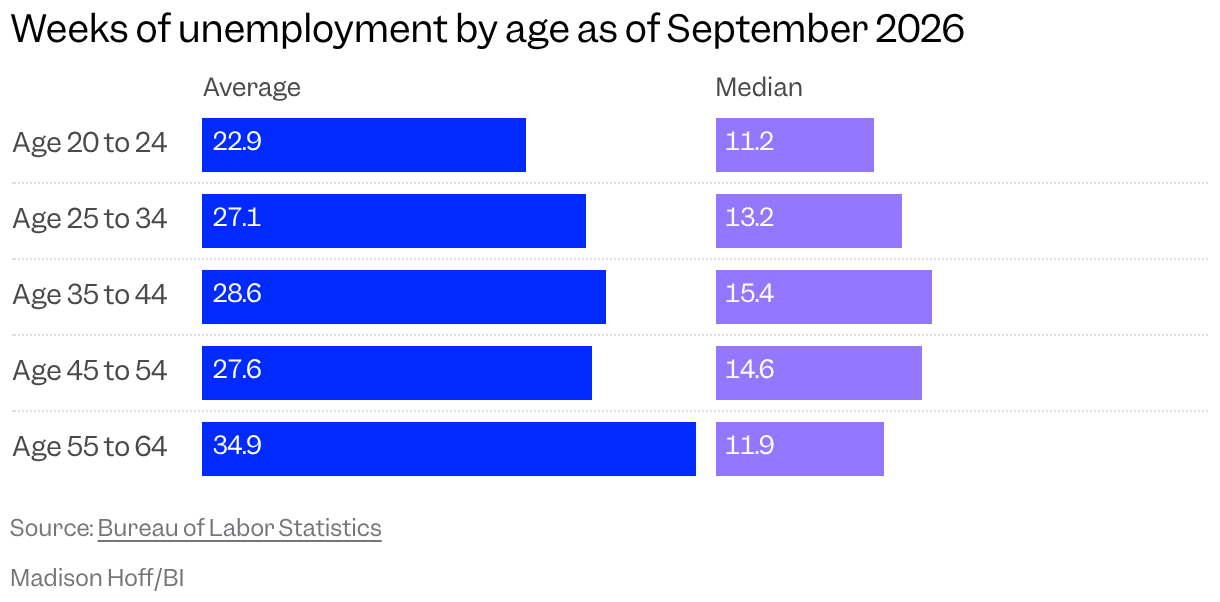
By some indicators, older Americans are doing very well in the job market. In September, older workers had lower unemployment rates than younger workers, and when they were unemployed, the median duration of that unemployment was shorter.
But these figures hide a worse trend for older job seekers. While half of those aged 55 to 64 were unemployed for a relatively short period of three months, the average duration of unemployment in this group was more than eight months in September. This means that some older workers have been unemployed for so long that their average is increasing.
The gap between the mean and the median has widened in recent months, suggesting that the longest job searches could get even longer.
As of September, about 173,000 unemployed Americans ages 55 to 64 had been out of work for at least six months, and some face much longer spells of unemployment. A Bureau of Labor Statistics analysis found that only 57% of workers ages 55 to 64 who lost their long-term jobs between 2023 and 2025 had found new jobs by January 2026. In contrast, 73% of workers ages 25 to 54 who lost their long-term jobs during that period had found new jobs.
Some older workers may have taken their job loss as a sign that they should retire. But for others, it marked the start of an uphill battle to find another job.
The difficulty of being hired after 50
As their searches drag on for months or even years, older job seekers like Valentine often attribute age discrimination to at least part of their struggles.
Thomas Heep, a Denver resident in his 60s, has been looking for full-time work since losing his job as operations manager in April 2025. He struggled to pay his bills and filed for bankruptcy earlier this year.
Heep suspects that some employers favor younger job seekers over someone his age because they fear he won’t stay in the job market long.
“Even if a company likes my resume, my skills and my work history, they’re going to look at my age and wonder: How long is he going to stay? He’s close to retirement age. It’s too risky.” he said.
Thomas Heep has struggled to find full-time employment since losing his job last year. Thomas Heep
Other older workers suspect their salary expectations could work against them.
A former Big Tech employee in her early 60s who lost her job last year said she feared her years of experience would put her at a disadvantage to younger candidates willing to accept lower pay.
“There are so many people laid off at this point, who are younger, willing to accept these ridiculously low salaries with no benefits,” she said.
Although some research suggests that age discrimination plays a role in hiring, it can be extremely difficult to prove this in an individual case. And for older job seekers who suspect their age is holding them back, there is often no clear solution to the problem.
When finding another job seems out of reach
For some older workers, a prolonged job search ultimately leaves them with only two options: settle for lower-paying work or abandon the search altogether.
Jon McCarty spent 18 months trying to find another software engineering job after losing his position in 2022. Earlier in his career, it typically took him about a month to find a new job. But he said as he got older, his periods without work got longer.
McCarty, who is in his 60s and lives in Virginia, eventually took a job as a part-time cashier at Home Depot. He has come to believe that he will probably never return to his old career.
Jon McCarty spent over a year looking for another job in software engineering. Jon McCarty
Steven Fielding, 58, has been fired more than five times during his career in technology communications. He has been looking for work since April and said employment gaps during his career have taken a toll on his finances, leaving him with little savings.
Fielding, who lives in Washington state, said he’s trying to adapt to the changing job market, including developing his AI skills. He suspects his age might be contributing to his difficult search, in part because he believes some employers prefer younger workers, willing to accept lower wages.
Still, he hopes his decades of experience can help him land another opportunity.
“It’s like my house has been destroyed to the foundations and I have to rebuild it again,” he said. “It’s quite intimidating to think about.”
Do you have a story to share? Contact the journalist by email at jzinkula@businessinsider.comor via Signal at jzinkula.29.
Gn bussni