
By GLENN GUILBEAU, Tiger Rag editor
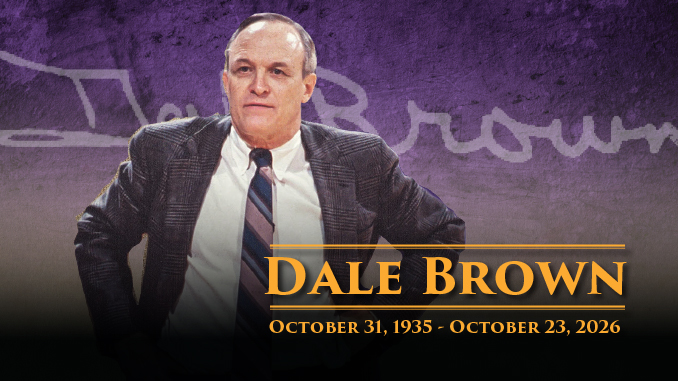
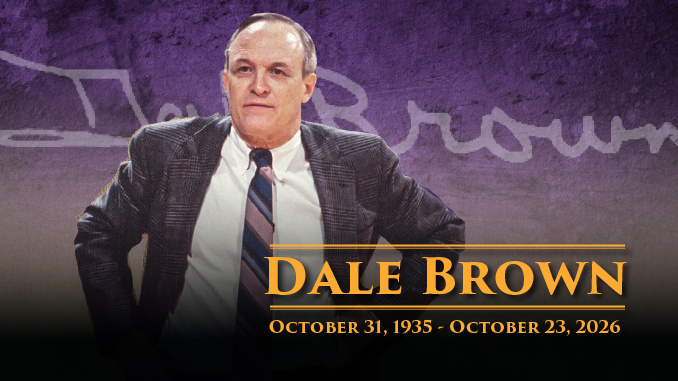
Dale Brown, who radically turned around a dormant LSU basketball program in the 1970s and took it to its first Final Four since 1953 in 1981 with another in 1986 and who brought some of the nation’s most talented players to LSU such as Shaquille O’Neal and Chris Jackson, died at the age of 90 Friday in Baton Rouge, Tiger Rag has learned.
Brown was just over a week shy of his 91st birthday. He was born on Halloween, October 31, 1935, in Minot, North Dakota. He moved to Baton Rouge before the 1972-73 season after taking an assistant coaching job at Utah State and never moved.
He had been ill for several months at home in Baton Rouge with his wife Vonnie and daughter Robyn Brown Prudhomme. Dale and Vonnie were high school sweethearts and married in 1959. They have three grandchildren – Christopher, Peyton and Cameron – from Robyn and her husband Chris Prudhomme, who met while students at LSU in the early 1980s.
“We have lost the most loving and beloved man we have ever known,” the Brown family said in a statement Friday. “Dale Brown always put others first. He always led with his heart. He was always a great humanitarian above all else. Dale fell in love with Louisiana a long time ago. And the people of Louisiana loved him immediately. We will be forever grateful.”
A 1957 graduate of Minot State, where he was a three-sport star: football, basketball and track and field, Brown was an assistant at Utah State from 1966 to 1971 after coaching high school basketball in North Dakota and California for several years.
Brown was named Associated Press Coach of the Year in 1981 and was a four-time Southeastern Coach of the Year. In 1979, Brown led the Tigers to their first SEC regular season championship since 1954 and won three more league titles in 1981, 1985 and 1991.
His four SEC regular season titles were the most by any SEC coach in history, not at Kentucky. Kentucky coach Adolph Rupp won 27, Joe B. Hall eight and John Calipari six. Brown was the last LSU coach to win the SEC Tournament, in 1980.
A salesman through and through, Brown steadily began selling out the Pete Maravich Assembly Center – nicknamed the “Dome of the Deaf” in the late 1970s and continued to fill it into the early 1990s before retiring after the 1996-97 season.
Brown’s Tigers reached 10 consecutive NCAA tournaments from 1984 to 1993, with O’Neal dominating the SEC from 1989 to 1992 after Jackson from 1988 to 1990. In total, Brown took LSU to 13 NCAA tournaments from 1979 to 1993. The Tigers had won two before him in 1953 and 1954 after the tournament began in 1939.
The final years of Brown’s career were marked by an NCAA investigation into alleged recruiting violations. During the 1996-97 season, the NCAA concluded that an LSU booster paid approximately $5,000 to one of Brown’s former players, Lester Earl, while he played for the Tigers. The Tigers were placed on probation in 1998 under Brown’s replacement, John Brady. Earl apologized to Brown years later, and Brown, as he did so often in his life, forgave him.
Brown was inducted into the College Basketball Hall of Fame in 2014, the Louisiana Sports Hall of Fame in 1999 and the LSU Athletics Hall of Fame in 2013.
The field at the Pete Maravich Assembly Center was named in Brown’s honor in 2022. When Brown’s name was unveiled on the field during a halftime ceremony, Brown credited his former players and assistant coaches, many of whom were in attendance that evening.
“The best potential in me is us,” Brown said, using one of his favorite comments, during the ceremony. “That’s an example.”
Brown idolized UCLA coaching legend John Wooden and remained friends with him until Wooden’s death in 2010.
“I will always remember Dale for his enthusiasm,” Wooden said of Brown. “He surprised me because there is a lot more depth to this man. He was much more than a basketball coach.”
Just this week, Brown received the John Wooden Legends of Coaching Award.
Brown promoted LSU basketball early on by traveling the state and hanging purple and gold nets on every goal he saw in passing.
He finished with a 448-301 record at LSU in 25 years with Elite Eight finishes in 1980 and 1987 in addition to the Final Fours.
After his coaching career, Brown focused on motivational speaking, something he did often while coaching. He also launched the Dale Brown Foundation which works to promote educational opportunities for young people who are physically disabled, from poor backgrounds or from broken homes.
Brown came from a broken home because his father left him at a young age with his mother, who raised him in a small apartment in Minot.
“I will never forget where I came from,” Brown said during his Louisiana Sports Hall of Fame induction weekend in 1999. “It never left me and it fueled me throughout my life.”
Gn sports