
Fewer than half of Minnesota students are proficient in math and reading. That’s according to new data from Minnesota’s comprehensive assessments released Wednesday.
In reading, 48.6 percent of Minnesota students met state proficiency standards. In math, only 44.9 percent of Minnesota students met state proficiency levels.
Math scores are down from 45.21% in 2025. In reading, this year’s statewide test is an updated version that “cannot be compared to previously administered versions.”
“We are asking more of our students and teachers,” Minnesota Education Commissioner Willie Jett said in a written statement. “In this data, we see the hard work Minnesota educators are doing to create safe and supportive learning environments and implement rigorous new standards. We see where students are on their journey to meeting these standards. And we see the potential for growth.”
MPR News helps you cut through the noise and build common understanding. Raise your support for this public resource and keep trusted journalism available to all.
“The students were afraid”
MCAs are conducted statewide each spring. This year, the tests were administered from March 2 to May 8 – a time when many schools were still dealing with the profound effects of Operation Metro Surge.
More than 80 percent of Minnesota school leaders said the surge in immigration enforcement has had a negative impact on their students’ ability to learn. More than 1,000 students have dropped out or disenrolled, according to a University of Minnesota survey. Thousands more missed school.
In Bloomington, school officials surveyed students about the increase, and 16 percent of respondents in grades 6 through 12 said immigration measures were affecting them or their families. Another one in five said they preferred not to share.
For Julio Caesar, Bloomington Public Schools’ executive director of research, assessment and evaluation, these findings are indicative of the impact of this increase on children.
“Here in Bloomington last winter, many students and families were afraid, and we have evidence that students felt it,” Caesar said.
“Especially our high school students. Not only did they feel unsafe coming to school, but they also shared that they had to take on other responsibilities at home that they didn’t have before Metro Surge started,” Cesar added.
The potential impact of this increase on test scores is one reason Caesar is nuanced in his interpretation of this year’s MCA test results. Another reason is that he knows that many students withdraw from the exam. In some districts, according to one report, up to 60 percent of students choose not to take standardized tests. High school students are among the least likely to take the MCAs: about 75% take the math test and 85% take the reading test.
“We need to look at this participation effort before we treat (the) high school average as a complete picture,” César said. “Our high school students don’t want to spend their time taking an exam that has absolutely no consequences for them, no buy-in, where they can spend their time doing other things.”
New reading tests
The reading test Minnesota students took this year was different than last year. The update is due to the state’s recently revised language arts standards. This year’s tests, in addition to measuring students’ ability to understand and analyze what they read, also tested whether students were able to judge the credibility of a source, interpret images and consider an author’s point of view.
Tests cannot yet measure the results of Minnesota’s Read Act, adopted in 2023.
State officials say nearly 80 percent of teachers who are required to complete updated literacy training have already completed their science of reading courses. Still, MCA test scores, which begin assessing third graders, are not expected to begin showing results from Read Act changes until 2027.
“When an intervention like this happens – and it’s a massive intervention – it doesn’t happen overnight. It will take us a few years to see the major impact it will have,” César stressed.
Still, state officials say schools are already seeing “encouraging results” from early literacy screening data, which shows more than 70% of kindergarten students finished the 2025-2026 school year at or above baseline. In first grade, 86 percent of students met criteria for phonemic awareness.

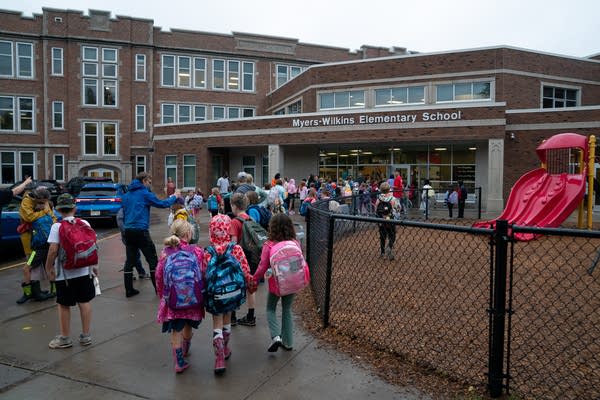
Students enter Myers-Wilkins Elementary School for their first day of school after summer break Sept. 8 in Duluth.
Erica Dischino for MPR News
Big picture
Although Minnesota’s test scores haven’t changed dramatically since last year, they still haven’t returned to their pre-pandemic levels.
Julio Caesar said that when comparing Minnesota’s test scores to other states or comparing national test scores to levels achieved in 2019, American students are still struggling to learn at the levels they were before the pandemic.
“We’re seeing that scores are lower than they were before the pandemic and we’ve made very little progress since the pandemic started,” César said. “It’s not just a Minnesota story. It’s something we need to pay attention to.”
César believes that ongoing difficulties with regular attendance and an over-reliance on screen time could be to blame.
“We have evidence … that associates days spent in front of a screen with students falling asleep later, which means they come to school tired, which means they are not able to concentrate,” César said.
Change MCAs
Minnesota is considering how it might change its annual K-12 academic testing procedures. The state Department of Education will convene a working group in October to make recommendations on a possible update to Minnesota’s comprehensive assessments.
“Our educators, our parents, our students themselves tell us again and again that our assessments don’t really provide the detailed, real-time information…that is needed to inform instruction,” said Deputy Education Commissioner Angela Mansfield.
Officials say the task force is expected to make recommendations by March 2027.
Correction (September 30, 2026): An earlier version of this story incorrectly stated the start date for Minnesota’s Comprehensive Assessment testing. Testing began on March 2. The story has been updated.
Gn headline