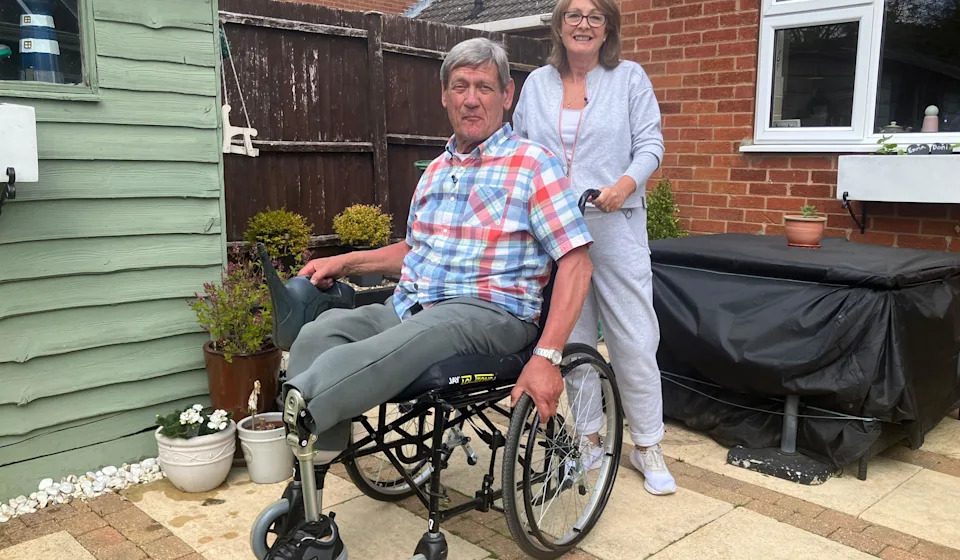
“No one wants to lose their leg, but this is the reality of what could happen,” says Paul Hardy, who was diagnosed with peripheral artery disease (PAD) four years ago.
He underwent angioplasty procedures to maintain blood flow to his legs to save them from amputation, and manages the condition – caused by the narrowing or blockage of arteries in the legs – with medication and exercise.
The 62-year-old from Leicester is now part of a campaign urging people not to ignore the warning signs of PAD, including foot pain at rest and non-healing foot and leg ulcers.
The “Are your legs killing you?” » The campaign was launched on Monday by the University of Leicester and will run over six weeks.
Supported by doctors from Glenfield Hospital, it will be featured on digital billboards, buses and bus stops across Leicester, Leicestershire and Rutland.
Experts say that although PsA affects around 20% of people over 60 in the UK, many people are unaware of the condition or its symptoms.
If left untreated, it can lead to amputation or sudden death.
A simple test known as the ankle-brachial index (ABI) – which measures blood pressure in the arms and ankles – can be carried out to identify this potentially fatal condition.
“A simple analysis”
He adds: “I put it off a little longer than I should have, but I finally got it checked out.
“I had a simple scan of my leg and then eventually had a leg bypass because the arteries had narrowed.”
Hardy, who was involved in the development of the campaign and vascular research at Glenfield Hospital, believes his leg was able to avoid amputation thanks to early detection of the disease.

Nic Olsen learns to walk again using prosthetics with the help of his wife Fiona (Fiona Olsen)
Nic Olsen was diagnosed with PAD in October 2024, but by then the disease had progressed to the point that both legs eventually had to be amputated.
The 80-year-old was an avid walker and cyclist, but began experiencing leg pain for several years, before it became “unbearable”.
He also suffered from ulcers and cuts on his feet that did not heal. He also experienced thickening of his nails and hair loss on his feet, all of which are symptoms of PAD.
Olsen, from Tugby in Leicestershire, visited health professionals including GPs, podiatrists and orthopedists more than 20 times.
Ultimately, a Doppler exam – a non-invasive ultrasound test commonly used during pregnancy – revealed that there was no detectable blood flow in her feet.
Olsen, who is now learning to walk again with prosthetics, says he wants people to know how to spot the warning signs before it’s too late and not “relive what I went through.”
Athanasios Saratzis, a research professor of vascular surgery at the university and a vascular and endovascular surgeon based at Glenfield Hospital, says there were up to 150 PAD-related amputations a year at the hospital and most of these could have been avoided.
“Early diagnosis and evaluation can make a significant difference in their outcomes.
“By raising awareness, we hope more people will seek help sooner and receive the care they need.
“If left untreated, PAD can lead to serious complications, including limb loss and increased risk of heart attack and stroke.”
Listen BBC Radio Leicester on Sounds and follow BBC Leicester on Facebookon Xor on Instagram. Send your story ideas to eastmidsnews@bbc.co.uk or via WhatsApp on 0808 100 2210.
Learn more about this story
Related web links
Gn Health