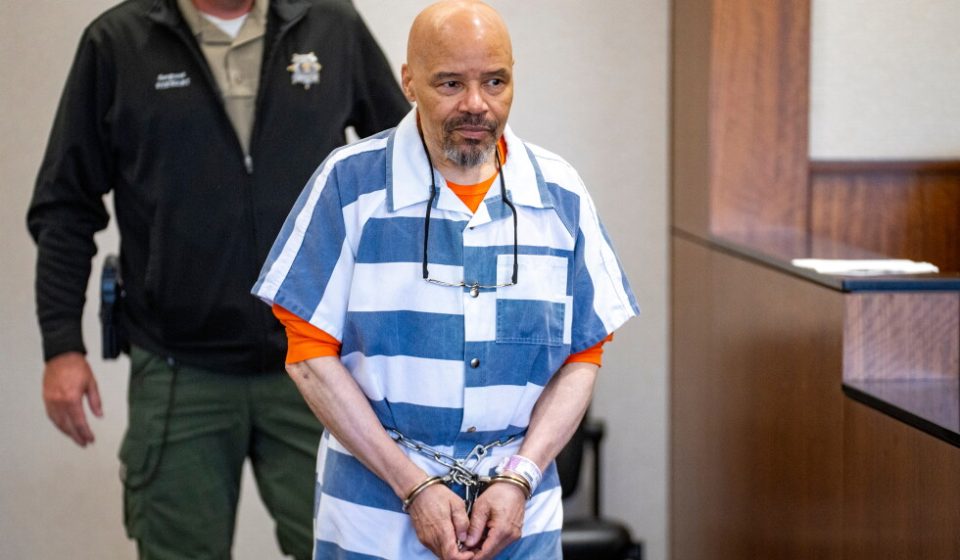

A 71 year old man who was convicted of murdering a police chief’s aunt and spent decades on death row was freed Monday after prosecutors said newly analyzed DNA evidence did not link him to the crime.
A Utah judge ordered Douglas Stewart Carter released on bail Monday evening despite objections from the victim’s family. Carter must wear a GPS monitor while awaiting a retrial for the 1985 murder of Eva Olesen.
The State Supreme Court ordered a new trial last year, citing misconduct by investigators. Carter has maintained his innocence and claims a signed confession was obtained under duress.
No physical evidence links him to the crime scene. But the jury convicted Carter, a black man, based on the confession and testimony of two witnesses who said he bragged about killing Olesen, who was white. These witnesses later recanted.
DNA analysis received Sept. 22 ruled out Carter as a possible match with blood found on a doorknob and genetic material recovered from the handle of a knife used to stab Olesen, who was also shot.
Judge Derek Pullan said those findings further undermined the case against Carter, but a reasonable jury could still find he killed Olesen.
Prosecutors reexamine the case
Carter was released Monday evening and ordered to have no contact with Olesen’s family.
“If the state of Utah had wanted, he would have been executed 15 or 20 years ago before we discovered his wrongdoing,” defense attorney Neal Hamilton said after reading the judge’s order. He urged prosecutors to seek dismissal of the aggravated murder charge still pending against Carter.
Carter will be placed in an extended-stay hotel near the family of his son, Tyler Anger, who was adopted by another family as a baby and did not learn of the conviction until years later, Hamilton said. Carter will also need therapy to deal with his prolonged incarceration, the attorney said.
“This is going to be a lot for him,” Anger said as he waited outside the Utah County Jail, where Carter was being held. “I want Doug to get his feet on the grass. He hasn’t done that in 40 years.”
A two-month retrial was scheduled for next year, but last week county prosecutors withdrew a notice indicating they intended to seek the death penalty.
Utah County Prosecutor Erwin Petilos told the judge Monday that Carter’s bail reassessment was “necessary and just” as the state continues to review remaining evidence in the case.
Carter, a Chicago native, was living with his mother in Utah when Olesen was killed on Feb. 27, 1985. Court documents say the investigation ultimately focused on Carter, who was suspected of killing Olesen during a robbery.
In April of that year, Carter fled Utah, believing he was a suspect in an unrelated assault case, according to court documents. He was apprehended in June in Nashville, Tennessee, where he signed a confession while being questioned by a Provo detective.
Carter later said he falsely confessed after police repeatedly threatened him. He was convicted and sentenced to death after a trial in which the defense called no witnesses. He was sentenced to death again after a retrial in 1992, and Utah courts rejected many of Carter’s appeals in the following years.
Key witnesses say police gave them money and gifts
A turning point came in 2011, when the two witnesses from Carter’s original trial were found in Mexico. They said they were asked to lie in court and received money and gifts from police, who asked them not to disclose the payments. They also said police and prosecutors threatened them and their son with deportation if they did not implicate Carter.
More than a decade of legal wrangling followed before the Utah Supreme Court last year ordered a new trial, citing “multiple instances of intentional misconduct” by police and a prosecutor. A DNA analysis of the evidence was conducted in response to that order, and prosecutors said the results came in last week. They declined Monday to say whether they were using the DNA evidence to search for other suspects whose DNA matched.
Victim’s husband was a potential suspect
Carter’s defense attorneys said witnesses saw a white man fleeing the crime scene and that an investigator removed evidence pointing to other suspects, including the victim’s husband, Orla Olesen.
They say prosecutors were about to file charges against the husband, but a Provo police lieutenant asked them not to so they could continue the investigation. Carter was identified as a suspect a short time later, according to court documents.
Orla Olesen, a painting contractor who died in 2009, told police he found his wife dead in their home, partially undressed and with her hands tied behind her back.
Theresa Olesen, a stepdaughter of Eva Olesen, said during Monday’s bond hearing that her family had “serious concerns” about Carter’s release.
“Geez, we were hoping for a concrete match,” Olesen said of the DNA analysis. “That doesn’t mean he wasn’t there.”
“We just want justice for Eva. And if he was involved, we want that to be known,” she added. ___ Associated Press photographer George Frey in Provo, Utah, contributed to this report.
Gn headline