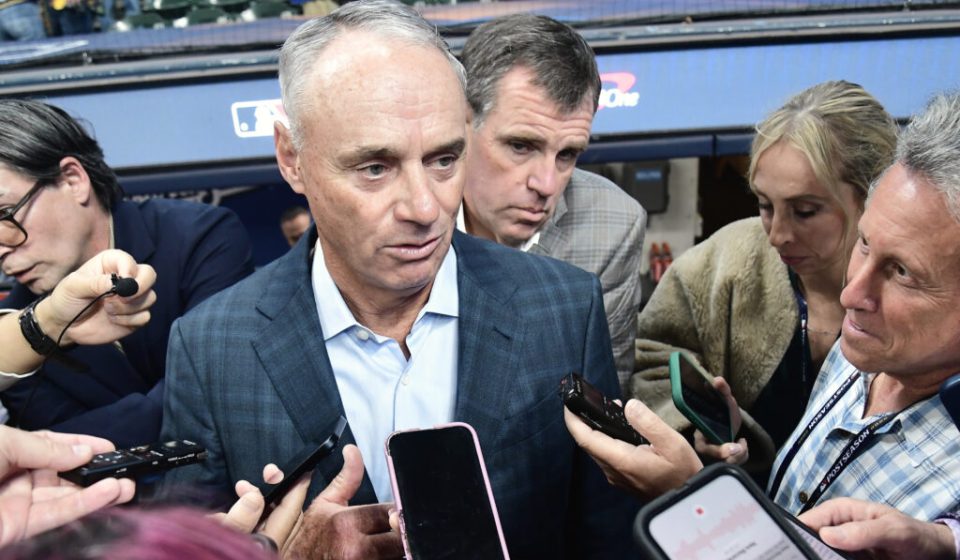
Rob Manfred met with reporters at the quarterly owners’ meetings in New York on Wednesday afternoon. As expected, the commissioner was forceful about the league’s stance on getting the players’ association to move on the cap/floor system in the next collective bargaining agreement.
“There’s a lot of room for compromise,” Manfred said (links via Jorge Castillo of ESPN and Ronald Blum of the Associated Press). “But there is one thing I will not compromise on, and that is the issue we hear from the vast majority of our fans: They want a salary cap and a salary floor, and on that we will not compromise.”
The MLBPA has always maintained that it would not compromise on implementing a cap. So far, every league proposal has been conditioned on the cap/floor that MLB has proposed implementing for the 2028 season. Every union proposal has assumed no cap. As long as this remains the case, “negotiations” amount to discussions between the parties.
The league is currently looking for a cap of $258.2 million and a floor of $180.2 million. Any cap/floor system is designed to codify a revenue split (which MLB wants to establish at 50-50) between players and management. The cap numbers are based on revenue projections, meaning some of the money must be tied up in case revenue doesn’t meet expectations. Blum writes that MLB’s proposal would limit an individual player from earning more than 15 percent of a team’s payroll — with an exception of up to 16 percent for re-signing his own free agent.
MLBPA Executive Director Bruce Meyer responded to Manfred’s media session with a statement released by the union. “There can be no clearer example of the league’s lack of seriousness than its insistence on not negotiating on economics short of a radical change to the system that would significantly reduce overall player compensation for all categories of players and strip players of basic rights like the ability to have truly guaranteed contracts,” Meyer said in part (as relayed by Evan Drellich of The Athletic).
The union has previously said any proposal involving a salary cap is doomed to failure. Mayer did not use that specific term in his statement Wednesday, although his argument remains the same. Manfred asserted that “another word for ‘non-start’ over the months is a refusal to negotiate,” a term he certainly chose on purpose. The National Labor Relations Act prohibits parties from refusing to negotiate in good faith.
It goes without saying that the union will contest that the refusal to accept a cap constitutes a refusal to negotiate. They have made their own proposals for higher minimum salaries, penalties for teams that fail to meet the soft floor and a slight increase in luxury tax thresholds. It is far too early for either party to consider filing a complaint against the NLRB for unfair labor practices over what constitutes good faith.
Columns from ESPN, The Athletic and The Associated Press all contain additional quotes from Meyer and Manfred. Readers can probably infer the gist of these comments. Each largely pointed to the other as being responsible for the lack of productive conversations to date. This was always expected to be the case, since the December 2 lockout is all but officially guaranteed. The 2021-22 lockout lasted 99 days, although the parties were able to reach an agreement in time to play a 162-game schedule and avoid a loss of revenue. MLB didn’t do a cap/floor push last time, which complicated this round of negotiations.
It is in both parties’ interests to make known the strength of their resolve as they prepare for a long union battle. As frustrating as it may be for fans, neither side has any incentive to stray from their initial demands until there are time constraints where revenue losses become a real threat.
Gn sports