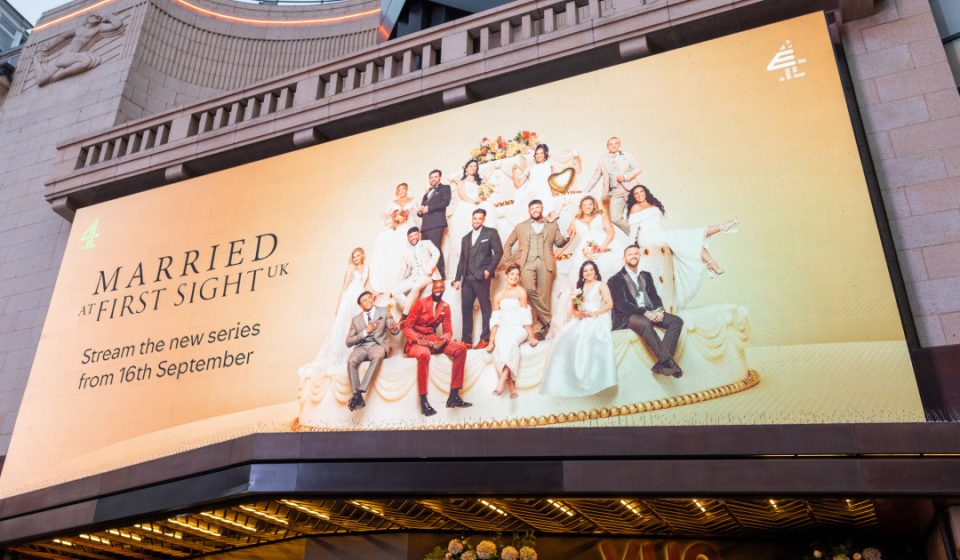
‘Married At First Sight UK’ dropped by channel after women say they were raped during show

The British version of the ‘Married At First Sight’ reality TV franchise will no longer air on Channel 4 after allegations that two women were raped during production of the show.
Channel 4 chief executive Priya Dogra confirmed in a statement on Thursday that the channel was cutting ties with the reality series following an external review of allegations made during the filming of its sixth season.
The review found no wrongdoing by the network or the show’s production company, CPL, but Dogra said “the right path was to end Married At First Sight UK on Channel 4”.
“Even though the study praised the social protocols in place and did not conclude that… the format is inherently dangerous, I have to wonder when is the right time for Channel 4 to exit a format,” Dogra said.
The rape allegations first came to light this summer as part of a BBC Panorama investigation. One of the two women claimed that her husband had raped her and threatened her with an acid attack, according to the BBC.
A third woman has accused her on-screen husband of sexual misconduct.
All three men involved have denied the allegations.
The premise of “Married at First Sight” is that a group of contestants agree to be matched with complete strangers and meet at the altar. The couples are then followed by cameras throughout their relationship and discuss their problems on air with the show’s counselors. Versions of the show have been broadcast around the world, including the United States, Australia, France and Spain.
Channel 4 has hired a law firm to review safety protocols at the time of the sexual misconduct allegations and how the production company handled them once they were raised, the company said in a news release. The network’s review did not seek to “resolve” the allegations, which it said “remain within the purview of the appropriate authorities.”
More than 30,000 documents were reviewed by law firm Clyde & Co, in addition to hours of footage, according to Channel 4. The review found that the production company and network complied with UK Office of Communications regulations.
A full version of the study has not been made available, but Channel 4 provided a summary of the findings, noting that the report was a “legally privileged and confidential study.”
There were no overall violations of the broadcasting code, although the entire “social protection framework” was not applied in some incidents, the study found. One of the incidents involved contributors who broke rules regarding “banned substances” but were given a warning rather than kicked out.
A report from former BBC One controller Lorraine Heggessey, who was asked to examine whether any protocols needed to be changed, said elements of the show could put pressure on individuals to be physically intimate. She recommended that the show consider discontinuing events such as Intimacy Week and Partner Swap Week.
Heggessey’s report says the show’s stars could “become dependent on production and lose touch with reality,” which could affect their decision-making.
She also recommended that the show consider changing the mechanism in place that requires a couple to stay an extra week if one person in the couple wants to leave but the other asks to stay during their weekly commitment ceremonies.
Among some of the recommendations were installing video and recording equipment in couples’ apartments that would be monitored 24/7, providing separate bedrooms for couples, providing “panic buttons,” and allowing contributors to have at least one unsupervised visit to their homes during production.
The network said full implementation of the recommendations “would involve a significantly higher level of intervention, monitoring and oversight that would fundamentally change the format and editorial proposal of the program.”
“The recommendations are entirely reasonable and achievable, but their massive implementation has raised fundamental questions about the editorial proposition of a show that I believe has now run its ten-year course,” Dogra said.
Dogra said the money earmarked for the series would be reinvested in finding “the next generation of distinctive and disruptive British television”. She thanked the staff who worked on the series and praised them for their “significant efforts to protect the well-being of contributors.”
Production company CPL has said it understands Channel 4’s decision to part ways with the reality show, according to Sky News. He stressed in his statement that the Heggessey report considered the social protocols to be “extensive, extremely comprehensive and of a high standard”.
“CPL has always placed contributor well-being at the heart of its program development and will continue to do so,” the company said.
This isn’t the franchise’s first controversy.
The Australian series of the show was criticized for subjecting contestants to potentially dangerous situations, including a man who had a history of domestic violence allegations. Although the allegations were dismissed before filming began, the woman who met with him told the Guardian in June that the show “obviously needs a better vetting process.”
“We are strangers sleeping alone in a room the first night, you have no security, you are alone,” Awhina Rutene told the media outlet.
She added that she was not a victim of abuse, but noted that the environment felt invasive and the physical intimacy felt “forced.”
“Every morning (during interviews), they would say, ‘Why don’t you have sex?'” Rutene said.
The Australian Communications and Media Authority has conducted 10 investigations, according to the Guardian, and no breaches of its code of practice have been found.
If you or someone you know has been sexually assaulted, call National Sexual Assault Hotline at 1-800-656-4673. The hotline, run by the Rape, Abuse, and Incest National Network (RAINN), can connect you with your local rape crisis center. You can also access RAINN’s online chat service at https://www.rainn.org/get-help. Confidential chats are available in English and Spanish.
Gn entert