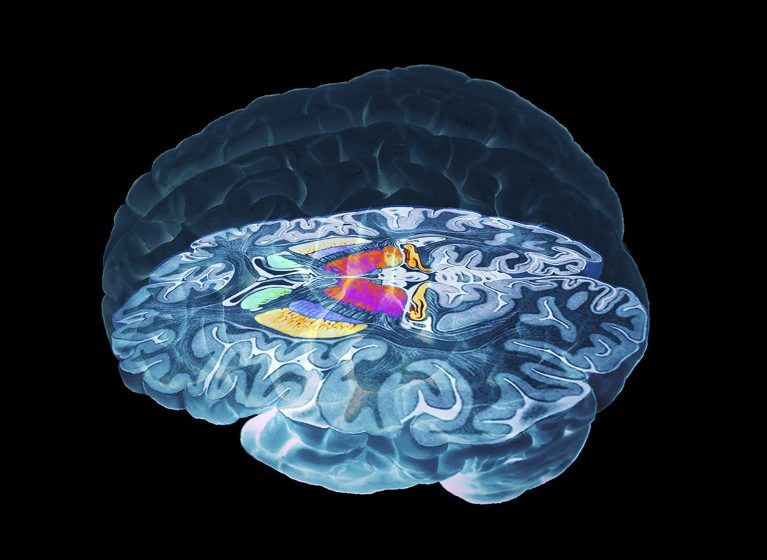

Credit: Zephyr/Science Photo Library
The basal ganglia are groups of cells located deep in the brain that process motor, cognitive, mood, and decision-making information. They are linked to neurodegenerative and psychiatric diseases ranging from Parkinson’s and Huntington’s disease to schizophrenia, bipolar disorder and substance abuse.
Today, researchers released the world’s most detailed basal ganglia atlas to date, including 25.5 million brain cells from humans, macaques and marmosets. The work is described in a collection of 26 articles published in Cell, Cell Reports, Cell Reporting Methods, Cellular systems, Cellular genomics And Neuron. Research includes understudied neurons1provides insight into how certain brain cells change with age2 and suggests what might be linked to illnesses3.
The atlas, a collaboration between hundreds of scientists from nine countries, is part of the BRAIN Initiative Cell Atlas Network (BICAN) – a $500 million project launched in 2022 by the US National Institutes of Health aimed at creating reference maps of the mammalian brain.
“It’s a huge dictionary that we needed in this area,” says Ana Muñoz-Manchado, a neuroscientist at the University of Cádiz in Spain, who studies the basal ganglia in neurodegenerative disorders.
Inter-species comparison
The basal ganglia atlas contains 21 million cells from the brains of six humans, three million cells from three rhesus and cynomolgus macaques, and 1.5 million cells from two marmosets.4. The researchers also used data from previously published maps of the entire mouse brain.5,6.
By comparing the basal ganglia of primate species, researchers identified 61 cell types in humans, macaques and marmosets that have been preserved over 76 million years.3.
The team analyzed brain tissue samples from different developmental stages throughout the life of the species. The latest work combines information about these cells in unprecedented detail, from measurements of their gene expression and the changes in their DNA that control gene regulation to recordings of their electrical activity, as well as how DNA is folded inside their nuclei.
The researchers also mapped the location of each cell in the brain and designed a common framework for characterizing and annotating cells. It’s “basically a scaffolding on which we can now pretty easily complete the rest of the brain,” says Michael Hawrylycz, a bioinformatician at the Allen Institute for Brain Science in Seattle, Washington, who was involved in the project.
Molecular boundaries
One study examined 1.1 million cells in the largest structure of the basal ganglia, known as the striatum, from 19 deceased human donors.7. Unlike many other brain areas, the striatum does not have precise anatomical boundaries. The researchers identified six areas in the human and macaque striatum with distinct molecular signatures, each containing distinct populations of neurons and glial cells.
“The cells in these areas all look the same under the microscope, but have very strong transcriptional differences and are surprisingly consistent across people,” co-author Evan Macosko, a neurobiologist at the Broad Institute of Harvard and MIT in Cambridge, Massachusetts, said in an institute news release.
Macosko and his colleagues also found that the gene expression patterns that distinguished each area from the other became increasingly similar with age, particularly in brain regions affected by Huntington’s disease and Parkinson’s disease.
Different brains
Another study analyzed nearly four million cells from the striatum and prefrontal cortex from 178 deceased adult donors aged 27 to over 90 years old.2. The researchers found that the cellular composition of the two brain regions varied from person to person, particularly for non-neuronal cells called glial cells. This highlights the need for brain cell atlases to account for these individual differences.
Gn Health