Most breakfast tips focus on what to put on your plate.
But a large study of American adults suggests that the clock also deserves attention: The time you consume your first and last calories of the day may be linked to how long you live.
The results show an association, but do not prove that changing the clock changes a person’s destiny. Yet they add to the evidence that health may depend not only on what we eat, but also when we eat it.
Previous studies have linked skipping breakfast and late-night eating with poor health, but the risks associated with specific times remain unclear.
The researchers therefore analyzed data from 31,044 adults aged 40 and over in the US National Health and Nutrition Examination Survey between 1999 and 2018.
Participants reported everything they ate or drank in the previous 24 hours, including the time of each item.
The study, published in the European Journal of Clinical Nutritiondefined any calorie-containing food or drink consumed after 4 a.m. as the “first meal”, meaning it was not necessarily a conventional sit-down breakfast.
The final calorie intake became the last meal, and the time between them became the eating window.
The team linked these records to deaths recorded through the end of 2019.
During a median follow-up of 8.6 years, 7,129 participants died, including 2,259 from cardiovascular causes.
The analysis took into account factors such as age, smoking, physical activity, diet quality, body mass index, energy intake, income and existing disease.
A trend emerged when the first meal was moved later.
Compared to a meal between 7 and 8 a.m., a first meal between 8 and 10 a.m. was associated with a 10% higher risk of death from any cause. The difference amounts to 19 percent between 10 a.m. and noon and 29 percent after noon.
Cardiovascular mortality followed a similar trajectory.
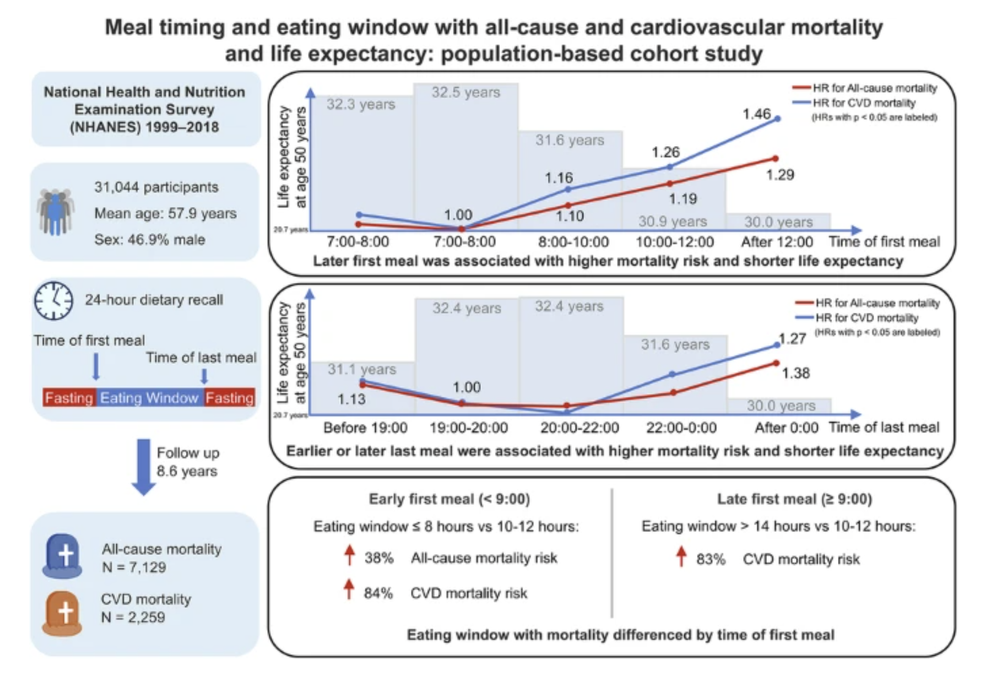
Eating for the first time after noon was associated with a 46% higher risk of cardiovascular death than eating between 7 and 8 a.m. At age 50, the group who ate their first meals later also had a life expectancy estimated to be 2.46 years shorter on average.
The last meal of the day produced a more surprising result.
Rather than the risk simply increasing over hours, the relationship was U-shaped. Compared to finishing between 7 p.m. and 8 p.m., eating before 7 p.m. was associated with a 13 percent higher risk of death from any cause.
Meanwhile, eating after midnight was associated with a 27% higher risk of death from any cause, and this was linked to an estimated 2.35 years shorter life expectancy at age 50.
The lowest modeled risk was around 8 p.m.
“However, this does not mean that 7-8 p.m. is a universally optimal dinner time for everyone,” lead author Zhilei Shan, a nutrition scientist from Huazhong University of Science and Technology, told ScienceAlert.
Finishing eating between 8 p.m. and midnight was not linked to a significantly higher mortality risk than finishing between 7 p.m. and 8 p.m.
Eating very late can disrupt circadian rhythms and metabolism, Shan explained. But a very early last meal could reflect schedules, illness or lower energy intake.
Early eaters tended to be older, eat less often, and suffer more illnesses. The clock may therefore reveal something about their health rather than being the cause.
The restore window added another complication.

Once the timing of the first meal was taken into account, its duration showed no consistent relationship with mortality in the entire sample. Instead, its association varied depending on when the meal began.
This adds nuance to concerns about very short eating windows: Simply counting fasting hours may miss part of the picture.
“Meal timing is an important signal for peripheral circadian rhythms,” Shan said.
“A later first meal or a late evening meal may contribute to circadian misalignment and metabolic disorders, including impaired lipid and glucose metabolism.”
Animal studies suggest possible pathways involving weight gain, fat accumulation in the liver, disrupted clocks in organs outside the brain, and impaired fat absorption.
It is unknown whether these mechanisms explain mortality patterns in humans.
A 2026 analysis of randomized trials found that meal periods ending earlier in the day improved metabolic markers more than later periods, although these trials measured outcomes such as blood sugar and weight, not survival.
Reverse causality is also possible. Eating late may be a consequence or marker of poor health, poor sleep, shift work, or socioeconomic circumstances.
A previous study of older adults also found that breakfast was shifted later as health problems accumulated.
“Therefore, eating later should be interpreted as a marker of potential risk, and possibly a modifiable behavior, rather than definitive evidence of a direct causal effect,” Shan said.
Related: Scientists Have Identified 10 Healthy Diets Linked to Slower Biological Aging
The study’s biggest limitations stem from its observational design. Meal timing was primarily captured by a single 24-hour recall at baseline, which may not represent years of habitual meals.
Chronotype, detailed sleep patterns, activity timing, and other unmeasured factors could still influence results despite extensive adjustments and sensitivity analyses.
“Based on these findings alone, people should not make extreme changes to their eating schedules,” Shan said.
“A practical interpretation is to maintain regular eating and sleeping habits, avoid consistently delaying the first meal until very late in the day, and avoid frequent late-night eating, while prioritizing overall diet quality and lifestyle.”
The study was published in the European Journal of Clinical Nutrition.
This article was fact-checked by Rebecca Dyer and edited by Rebecca Dyer. Although we are proud of our process, we are only human. If you spot an error, please let us know.
Gn Health