
Dongryul Kim hopes to spend his life as a mathematician. But the postdoctoral researcher is experiencing a worrying transformation.
Kim, who is based in London and specializes in number theory, discovered last month that a groundbreaking claim from OpenAI about a mathematical proof had a direct impact on his work.
The so-called solution simplified his research by removing some annoying technical details. But this advance, still unverified, was not only led by artificial intelligence; it lacked an easily understandable argument as to why it was correct.
“From a purely mathematical point of view, I think it was good to have this problem solved,” he said of the question, which concerned a geometric phenomenon known as Hodge’s rational conjecture for abelian CM varieties.
“But the way the problem was solved – I don’t know if anyone really understands the evidence, even to this day.
“It puts everything in a very strange position.”
Kim and her supervisor, Ana Caraiani, professor of mathematics at Imperial College London, live and work in an AI revolution. A flood of digitally aided discoveries is raising questions about the future of human mathematicians, even as AI agents help produce answers to problems that have perplexed people for decades.
This month, a mathematician working for AI company Anthropic claimed to have produced an AI-based proof of the Riemann Hypothesis. The 167-year-old riddle of the distribution of prime numbers is one of the most famous open problems in mathematics.
Levent Alpöge published the purported result in Lean, a specialized programming language for verifying and expressing proofs. His announcement is still being evaluated, but some members of a respected international group known as the Lean Community have already said they are “fully confident” that it is accurate.
Alpöge’s announcement caps months of activity in AI at the cutting edge of mathematics. OpenAI last month unveiled hundreds of manuscripts, including what it claims are evidence of some long-standing problems — although experts said it mixed some impressive works with others that contained errors or were unreadable.
These advances have sparked admiration, while stoking concerns about human obsolescence, intellectual property rights, and the usefulness of results generated without full understanding.
Caraiani argued that the proof of the Riemann hypothesis was in many ways a “victory for human mathematics” since it is supported by “all the beautiful structures we have built”.
“It’s important to celebrate this achievement, but also to highlight the importance of human control and human understanding of how mathematics continues to develop,” said Caraiani, who won medals at the International Mathematics Olympiads for high school students when she was growing up in Romania.
Caraiani’s work environment is far removed from the frontier AI model labs responsible for the mathematical advances unveiled by Anthropic and its rivals.
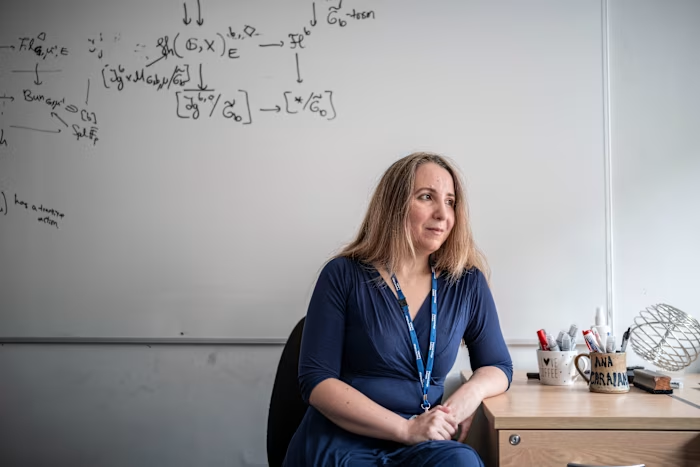
Her office is in the austere Huxley Building at Imperial College, close to London’s science and natural history museums, while her daily tools are a few computers and the wall board on which she and her students exchange concepts and calculations.

Caraiani uses OpenAI’s free model to allow researchers to test evidence and generate routine technical results, but describes himself as “at the lighter end” of using the technology.
“I think I should do math,” she said. “I shouldn’t stand there and ask computers to do math for me. »
Some practitioners do not see AI as a threat but above all as a means of acquiring knowledge that has long eluded the human mind. Anthropic’s Alpöge described working closely with the company’s Claude AI model until it “flew, danced and glowed” as it approached the finish line.
British mathematician Marcus du Sautoy said Thursday evening at an event in London that he was “very excited about the way this tool is transforming our subject.” It helped him solve a conjecture he had been working on for 40 years, he said.
“I realize now that I would have died without knowing the answer to this conjecture, without this machinery,” said du Sautoy, the Charles Simonyi Professor for the Public Understanding of Science and professor of mathematics at the University of Oxford.

Pure mathematics underlies the physical sciences and the structures of billions of years old natural phenomena and our high-tech environment. Caraiani highlights how the human journey toward an answer produces not only theoretical insight, but also often unanticipated practical uses.
Knowledge crucial to modern cryptography – which protects data on a global scale – emerged from long efforts to tackle Fermat’s centuries-old Last Theorem. Caraiani did his dissertation at Princeton with Andrew Wiles, who ultimately proved the theorem in the mid-1990s.
“We basically think that ultimately every branch of pure mathematics is connected to each other – and applications appear,” Caraiani said.
Kim finds technology useful as a stress test, to highlight counterexamples that contradict emerging ideas and show that they are not worth pursuing.
But, like humanities academics, he worries that AI “is very easily exploited” by students who seek to generate answers to evaluate without fully engaging in their work.
The Institute for Advanced Study in the United States recognizes the current “stressful” environment facing mathematics candidates. He invites them to mention the useful and useless impacts of AI on their research.
Imperial announced last month that it had received a £5 million grant from XTX Markets to create a project called Langlands Lab to explore the use of AI in research and support doctoral training. The initiative aims to “advance research at the frontiers of mathematics while developing new ways of understanding, explaining and communicating mathematics using AI-assisted methods,” the institution said.

Caraiani is concerned about the broader impacts. She called for solidarity with researchers in other fields, including the humanities, to bring together “all those who carry out intellectual work of any kind.”
“If there is this kind of institutional capture by AI companies, my concern is that all of humanity will not benefit equally,” she said. “In fact, inequality will increase. »
And in math, she says, it’s crucial to know the why as well as the what. Alpöge, a Riemann hypothesis researcher at Anthropic, highlighted the strangeness of this mathematical era, in which answers often exceed explanations.
He said he was “presenting to the world a complete argument” for Riemann’s proof without having mastered a “vast neighborhood” of theory around it.
“The role of mathematics has never been to simply prove results,” says Caraiani. “It was about building structures and understanding them – largely as a way of understanding our universe. »
Gn bussni