Measles elimination under threat – and what a Florida study of Pfizer’s COVID vaccine really shows: The state of US vaccine policy

Welcome to our bi-weekly series in partnership with CIDRAP at the University of Minnesota.
A Florida study comparing deaths after the Pfizer and Moderna COVID vaccines is getting a lot of attention, and one of its statistics is filling the echo chambers: a 40% higher death rate with Pfizer. This edition concludes with a closer look at this figure and why it does not show that the vaccine caused deaths.
First, we’ll tell you about the last two weeks of vaccine policy, including a stalled CDC alert on measles in pregnancy, a missed deadline for childhood vaccination plans, and a decision on whether the United States will maintain measles elimination status. We’ll then look at the Florida study to understand what happened and whether this study should change the way you think about your COVID vaccine. Let’s discuss…
The PDF version of today’s update is here. Read previous installments here and today’s update on the unbiased science substack here.
The state of American vaccine policy
The past two weeks have brought more measles fallout and new signs of delays in federal vaccine work.
1. A CDC alert on measles in pregnancy has not been approved. About a month ago, scientists at the Centers for Disease Control and Prevention (CDC) attempted to warn clinicians about measles in pregnancy through the agency’s Rapid Health Alert Network, but the CDC director’s office did not approve the alert. The Washington Post reports, and the Department of Health and Human Services (HHS), which oversees the CDC, has not explained why. Scientists are now preparing a slower model MMWR report or considering a non-CDC review. Measles during pregnancy can cause serious complications for the mother and baby, including increased risk of pneumonia, hospitalization and death for the mother, as well as miscarriage, premature birth, low birth weight and congenital measles for the baby. In Pennsylvania, home to the largest measles outbreak in the United States, state officials reported that 77 pregnant women have been diagnosed with measles since April.
2. HHS Misses Deadline for New Childhood Immunization Plans. HHS officials, however, failed to meet President Donald Trump’s Nov. 8 deadline for new childhood vaccination plans. Bloomberg reported on November 6 that HHS had already sent a draft to the White House. An HHS spokesperson said the Safer Childhood Vaccines Task Force needs time for careful scientific review. The deadline comes from a White House decree signed Aug. 10, which gave the task force 90 days to plan for offering childhood vaccines as single products (starting with MMR, which protects against measles, mumps and rubella), revamping the schedule, finding alternatives to aluminum-based adjuvants and improving safety monitoring. The separate MMR vaccines are not licensed in the United States, and Merck has said it could take up to 10 years to be approved and manufactured. These plans would be in addition to HHS’s overhaul of the children’s schedule in January 2026, which reduced the number of diseases for which routine vaccinations were reduced from 17 to 11. A federal judge blocked that overhaul in March, so the previous schedule (with the 17) remains in effect.
As a reminder, the CDC is accepting nominations for new ACIP (Advisory Committee on Immunization Practices) members until December 31 (anyone can apply or nominate someone by emailing ACIP@cdc.gov or using the CDC’s online form). The call follows a legal battle over the current committee. In June 2025, HHS Secretary Robert F. Kennedy Jr. fired all 17 members of the vaccine advisory committee and replaced them with its own choices. In March, the same judge blocked 13 of these meetings and every committee vote had taken place, leaving too few members to meet. The government appealed that part of the decision, and the First Circuit heard arguments in October but did not rule. As applications close at the end of the year, a new committee could be in place at the beginning of 2027.
3. A PAHO committee meets this week to decide whether the United States maintains its measles elimination status. This week, a Pan American Health Organization (PAHO) commission meets Nov. 10-13 to decide whether the United States can still claim to have eliminated measles, a status held since 2000. The commission will decide whether the virus has been spreading in a continuous chain for at least a year, the threshold for losing that status. According to Policythere have been more than 7,000 cases since January 2025, making loss of status likely. CDC Director Dr. Erica Schwartz said she expects a decision by early next week and that the federal response to measles would not change if the status was lost. CNN reports. Write in the BMJDr. Jennifer Nuzzo notes that Venezuela and Brazil both regained their status through large vaccination initiatives, demonstrating that real investment in public health can reverse a loss of status.
Closer Examination of Claim That Pfizer’s COVID Vaccine Caused Hundreds of Thousands More Deaths
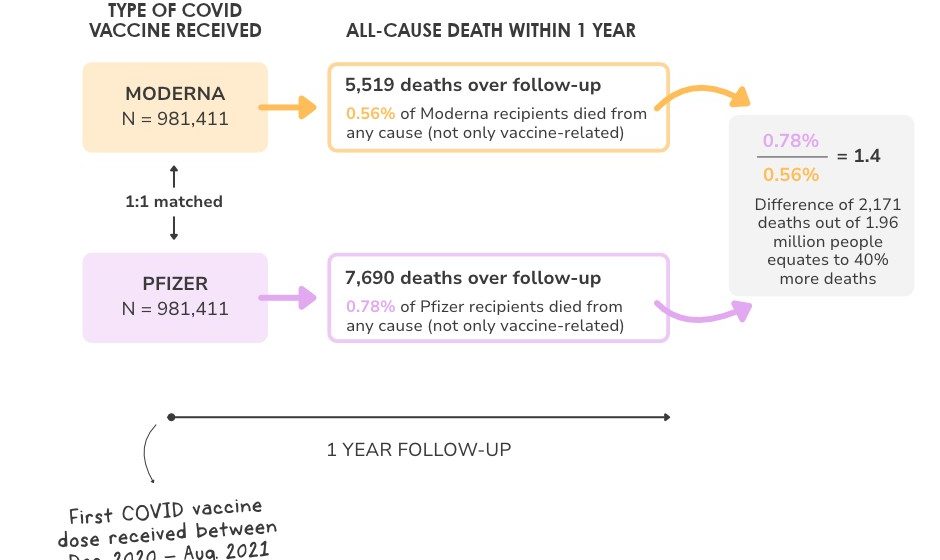
An article published in Global epidemiology last week generated some media interest. In it, researchers conducted a 1:1 matched cohort study among Florida adults who received their first dose of the COVID vaccine between December 2020 and August 2021. Much of the media focused on a single statistic that adults who received the Pfizer COVID vaccine died at a 40% higher rate over the next 12 months than adults who received the Moderna vaccine. Several of us received the Pfizer vaccine as our first dose, and we’d be lying if we said this statistic didn’t shake us up a little, so we decided to dig a little deeper into the paper.

Of approximately 11.3 million eligible adults, researchers compared 981,411 Pfizer recipients to the same number of Moderna recipients based on age, gender, race, ethnicity, month of vaccination, type of vaccination site and census tract, then counted deaths over the next 12 months. During follow-up, 5,519 deaths from all causes occurred in Moderna recipients and 7,690 in Pfizer recipients, equating to a hazard ratio of 1.4, hence the claim of a “40% higher mortality rate.”
A relative measure (e.g. a hazard ratio of 1.4 or a 40% increase) seems harsh and emotional, but fails to recognize that the absolute number of deaths in each vaccinated group was low overall and that 99% of the study population remained alive a year later. This nuance is missing in the “40%” statement. A discrepancy of 2,171 deaths (or 221 per 100,000 people over the year) is significant, and we are not dismissing this discrepancy at face value, but drawing the conclusion that these deaths were related to the COVID vaccine is unfounded, given the observational study design.

The study only found the solid bars above, so it can’t distinguish between these explanations. In the diagram, the dotted line indicates the number of deaths that would have been without a vaccine – a quantity that was not measured in the study.
Three reasons to be skeptical of this claim
A matched cohort study pairs each person in one group with a similar person in the other group. This way, if a group experiences more deaths, the difference is more likely to come from the element studied (here, the vaccine received) than other factors, such as the age or place of residence of the people. Researchers call these other factors “confounding factors” because they can confuse the comparison. But matching only makes groups similar on factors that researchers agree on. Groups may still differ in ways that have not been measured, and these unmeasured differences may still affect the results.
1. Despite matching on demographic and geographic characteristics, the Pfizer and Moderna groups may differ in terms of health and behaviors.
The authors directly acknowledge that groups may differ on important factors that could affect the risk of death, such as other health conditions or behaviors that matching alone cannot explain. We can’t say whether the groups actually differ because the study couldn’t collect data on these factors, which is the biggest problem with the analysis as a whole. It’s like comparing two used cars of the same make, model and year. If one of them breaks down more often, you can’t reasonably blame the model until you know each car’s service history and mileage.

In 2021, the COVID-19 vaccine people received often depended on when and where they were vaccinated. Matching by site type, vaccination month, and census tract balances these factors, but not the specific clinic or exact date. People vaccinated at different clinics or on different dates may still differ significantly in terms of their underlying health, in ways that matching alone cannot resolve.
2. The 40% higher death rate could reflect the fact that Moderna’s vaccine protects better against COVID, rather than Pfizer’s vaccine which causes harm.
The authors acknowledge that the Moderna vaccine may have slightly better protection than the Pfizer vaccine against COVID. Two big ones VA studies found that Moderna vaccinees were somewhat less likely than Pfizer vaccinees to be infected or hospitalized with COVID, although neither paper found a difference in COVID deaths.
Better protection against COVID could also affect non-COVID deaths. Acute COVID can trigger heart attacks, strokes and other health problems weeks later, but a death certificate can only cite a heart attack as the underlying cause. This would change how a death is labeled and classified in the study, but not the number of people who died. If this mislabeling occurred more often among recipients of the Pfizer vaccine, some of the additional “non-COVID-related” deaths observed, which account for about 87% of the additional deaths reported in the paper, could potentially be traced back to COVID itself. The authors reran the analysis in people without a documented COVID diagnosis before vaccination and in 2021, many infections were not laboratory confirmed or recorded. So while better protection against COVID may explain some of the difference, the study is unable to show how much.
If this explains part of the difference,…
Gn Health