
Unlock the White House Watch newsletter for free
Your guide to what Trump’s second term means for Washington, business and the world
Mediators are stepping up efforts to advance a deal between the United States and Iran, days after President Donald Trump said he rejected an Iranian proposal to reopen the Strait of Hormuz and restart negotiations to end the war.
Negotiators are expected to deliver the final amended draft of a proposed interim deal to Iran on Tuesday, after shuttling back and forth between U.S. and Iranian officials the day before, two officials briefed on the talks said.
Under the terms of the deal, which mediators hope will restart negotiations on a final settlement to end the war, Iran would allow the free flow of traffic through the Strait of Hormuz and the United States would lift its blockade on Iranian ports in response.
One of the officials said progress had been made but the parties continued to haggle over the timing of the next phases of the deal.
These would include the United States reinstating an oil waiver to allow Iran to sell oil, allowing Tehran access to some of its frozen assets abroad, and items related to Iran’s nuclear program, including allowing inspectors from the International Atomic Energy Agency to return to the republic, the officials said.
The White House declined to comment.

Mediators have been working for weeks to break the months-long impasse between the warring sides, fearing that the impasse could trigger a new escalation in the conflict that has lasted more than seven months.
Trump said Sunday he expected further negotiations with Tehran this week, saying Iran wants a deal. But the US president added in an interview with Axios that “this is not the deal I want to make” and that Iran “overplayed”.
Iranian Foreign Minister Abbas Araghchi said last week that Tehran had submitted a proposal to mediators under which Iran would agree to open the strait within seven days and resume negotiations on a final settlement.
In exchange, they want the United States to agree to lift its blockade, allow access to part of its frozen funds and restore the oil waiver.
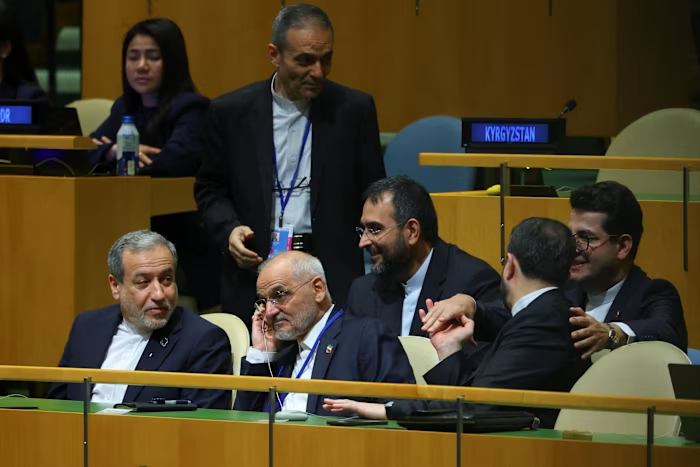
The offer was made on the sidelines of the UN General Assembly, where Araghchi held indirect talks with Trump envoys Steve Witkoff and Jared Kushner, the president’s son-in-law.
On Monday, Qatari mediators met with Araghchi in New York and U.S. officials in Washington, where they discussed a modified version of the Iranian proposal.
Araghchi later told state television that he expected to receive the U.S. response on Tuesday.
Last week’s negotiations were the first between the United States and Iran since the failure of a memorandum of understanding signed by the parties in June, which was supposed to reopen the strait and establish the framework for negotiations on ending the war.
But the situation began to unravel after about two weeks, after Iran began attacking ships transiting the strait along a corridor that runs along the coast of Oman, accusing them of taking an “unauthorized route.”
Both sides accused each other of violating the memorandum of understanding and engaged in cycles of intensified strikes.

In recent weeks, Trump has declared the strait to be open and under American control, with American forces having guided tankers through the waterway, through which about a fifth of the world’s oil and gas passed before the war.
However, ships still risk being threatened by an Iranian attack and the strait remains closed to imports and exports of other commodities, including petrochemicals, refined fuels and raw materials for fertilizers.
The Trump administration has said it will not return to the June memorandum of understanding. Instead, he pushed for a more comprehensive deal that would include more substantial Iranian commitments on its nuclear program, according to people familiar with the negotiations.
He has also sought to increase pressure on Iran’s struggling economy by threatening secondary sanctions on entities that trade with the Islamic republic.
Andrew L Peek, who previously served as Trump’s deputy secretary of state for Iraq and Iran, said the White House could probably afford to “remain” in the status quo “for a while”.
The fact that there is no “deal that we have to defend politically now” and that “we are not in a ground war with Iran” has created a “relatively stable situation politically,” said Peek, who is now with the Atlantic Council.
But Crisis Group’s Ali Vaez said the talks showed both sides were still interested in finding a diplomatic solution, despite fears Iran could pull out as it comes under increasing economic pressure.
But he added that he was “not sure they will reach a point that would be mutually satisfactory.”
“There are efforts to resolve the squaring of the circle because everyone understands that if that doesn’t happen, some sort of escalation on the part of the Iranians is very likely,” Vaez said. But “they still lack the flexibility necessary to give the other side the prospect of victory. It’s a Sisyphean challenge.”
Gn headline