Mexico arrests cartel leader ‘El Chapo Isidro’, triggering outbreak of violence in Sinaloa

GUASAVE, Mexico (AP) — Heavy gunfire, helicopters and burning trucks marred the Mexican state of Sinaloa on Saturday after authorities captured cartel leader Fausto Isidro Meza Flores, known as “El Chapo Isidro,” in an operation that left at least 11 people dead.
Meza Flores, one of the FBI’s ten most wanted fugitives, was captured and flown to Mexico City on Saturday after exchanges of fire between Mexican forces and cartel gunmen terrorized residents of the town of Guasave.
Mexico’s Defense Ministry said Saturday afternoon that seven suspected cartel gunmen and four Mexican soldiers had been killed.
The capo rose through the cartel ranks to lead the Beltrán Leyva Cartel and later became the leader of his own group, the Meza-Flores Transnational Criminal Organization. The United States had received a $5 million reward offer for information leading to his arrest, and he was wanted on charges of trafficking drugs into the United States and illegally carrying firearms.
WATCH: Mexico’s foreign minister talks Trump, cartel violence and US trade talks
The Mexican government said in a report Saturday that intelligence from the Trump administration helped authorities capture him, but provided few details about how Mexican and U.S. authorities coordinated to arrest Meza Flores.
He was also a key ally of “Los Mayos,” a faction of the Sinaloa Cartel, designated a foreign terrorist organization by the Trump administration last year. His capture represents a major blow to the cartel as it battles with another faction for control of the northern Mexican state.
U.S. and Mexican authorities celebrated the arrest as a security victory. US President Donald Trump has put pressure on the Mexican government to take on criminal groups.
As a fierce exchange of fire settled into a tense calm Saturday, experts warned that the elimination of the capos could trigger a new wave of violence in a region already caught in a power struggle between warring cartel factions.
Action by Mexican forces against cartel fuels violence
The capture of Meza Flores and his number 2 in the town of Guasave, Sinaloa, triggered a wave of violence when an exchange of fire broke out on Friday around 7 p.m., according to residents of this municipality of 290,000 inhabitants. Soon, military helicopters and drones were flying over the city, and helicopters were opening fire on key locations in the city.
Videos show screaming civilians fleeing gunfire at a baseball game, burning cars and businesses, and helicopters circling and shooting at people below. Such shows of force by cartels are common after the capture or assassination of leaders.
“Fighting was happening everywhere in Guasave,” said Alma Camacho, a Guasave resident and local journalist. “It spread throughout the city.”
Mexican authorities said they used “stealth and surprise” to arrest Meza Flores, establishing a security perimeter around the building where he was located. After being attacked with guns and explosives by suspected cartel members, members of the armed forces entered a house and arrested him.
READ MORE: Why Mexican cartels are increasingly using car bombs and other explosives
A video shared by Mexico’s Defense Ministry shows Meza Flores and two others being taken by heavily armed soldiers to a military plane to appear before prosecutors in Mexico City. A total of eight people were arrested, according to authorities.
Because of the violence, the Mexican army and National Guard special forces were unable to extract Meza Flores from Guasave until 4 a.m. Saturday, said a federal official who requested anonymity because he was not authorized to discuss the case.
“Getting him (Meza Flores) out was extraordinary,” the official said, describing the intense response of members of the criminal group who maintained at least “10 roadblocks” with vehicles set on fire in the streets of Guasave.
Terror in Sinaloa
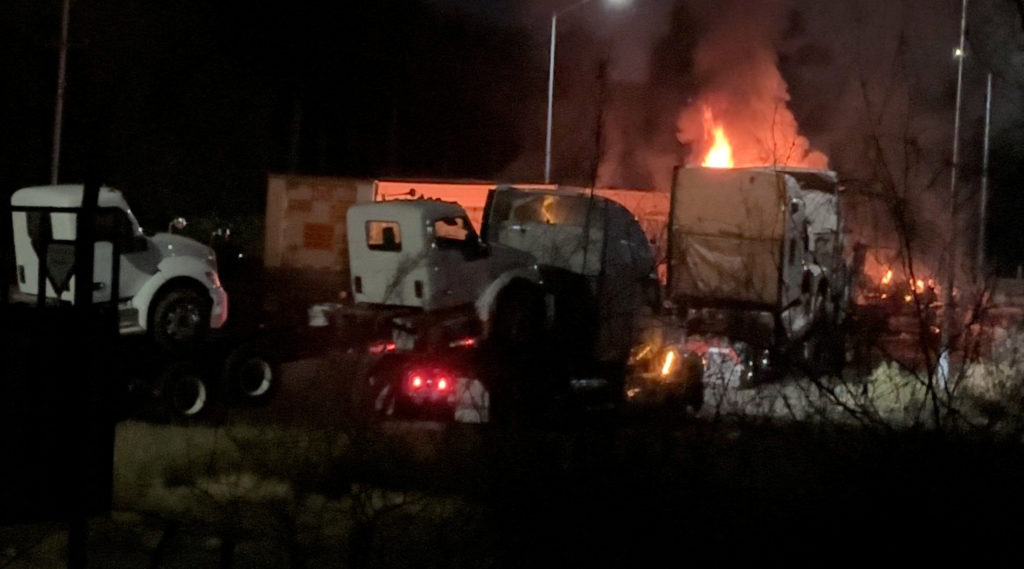
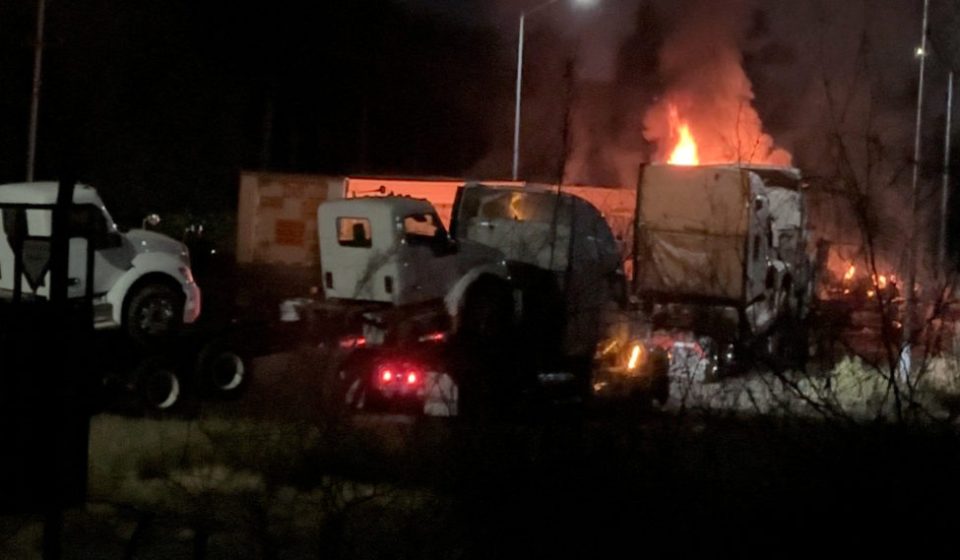
Vehicles burn on a highway near Los Mochis, Sinaloa, Mexico, November 20, 2026, following the interim government’s announcement of the arrest of Beltrán-Leyva cartel leader Fausto Isidro Meza Flores, known as “El Chapo Isidro,” in an operation between Mexico’s Secretaría de la Defensa Nacional and U.S. intelligence agencies, in this image still taken from a video obtained on social networks on November 21. 2026. Photo by Yohari Leon via Facebook/via Reuters
Guasave resident and firefighter Paola Sánchez said thousands of people were terrorized Friday night as they took cover from intense gunfire at grocery stores and elsewhere.
“Last night, many businesses were burned … as well as cars and trucks,” Sánchez told the Associated Press.
She said that the city’s firefighters had to take refuge at their station and wait Saturday morning for the order from their superiors to send the first teams to check if businesses or vehicles were still burning.
A worrying calm seemed to settle over the city on Saturday. Mexican Security Secretary Omar García Harfuch wrote on X on Saturday morning that the armed forces would remain deployed in the state of Sinaloa to protect civilians. He deplored the death of the four soldiers killed during the operation.
Burning trucks continued to drive along the highway leading into the city, blocking roads on Saturday.
“The aftereffects of last night’s war persist. Cars burned in the streets, several Oxxo stores completely burned,” Camacho said, referring to a chain of convenience stores in Mexico.
Guasave residents remained “very scared” because security forces were absent from the streets, Camacho said.
Capture invites celebration and warnings
The detention of Meza Flores marks another high-profile capture of a cartel leader as Mexican President Claudia Sheinbaum faces pressure from Trump to crack down on the cartels. Sheinbaum took on illegal groups more aggressively than her predecessors, and homicides declined significantly during her two years in office.
The US and Mexican governments celebrated the capture on Saturday, with the DEA praising Mexican authorities.
“Results like these don’t happen overnight. They rely on lasting cooperation and trust. That’s what partners can accomplish together,” US Ambassador Ronald Johnson said in an X post. “We will continue the hunt.”
Mexican Security Secretary García Harfuch called the detention “an important step in the pacification of Sinaloa.”
READ MORE: US Designates Two More Mexican Cartels As Foreign Terrorist Organizations
Sheinbaum’s government has targeted a number of cartel leaders, including Jalisco New Generation Cartel leader Nemesio Oseguera Cervantes, known as “El Mencho,” who was killed by the military in February.
Mexican security analyst David Saucedo said the capture of Meza Flores was another case of the governments of Mexico and the United States increasingly falling back on a long-standing security strategy that critics say could fuel more violence in the long term.
The so-called pivot strategy relies on focusing on capos like Meza Flores as a way to fight the cartels. But experts say it often triggers violent power conflicts between groups, like the one underway in Sinaloa.
“What is obvious is that this is the result of pressure from the United States,” Saucedo said. “What they’re doing is capturing high-level ringleaders – the leaders – but they’re not dismantling the entire organization. They’ve arrested No. 1 and No. 2, but the entire network of hitmen, street drug dealers, businesses and political and police connections remains intact.”
Megan Janetsky and Fabiola Sánchez reported from Mexico City. Thomas Strong contributed to this report from Washington.
A free press is the cornerstone of a healthy democracy.
Support trusted journalism and civil dialogue.
Gn headline