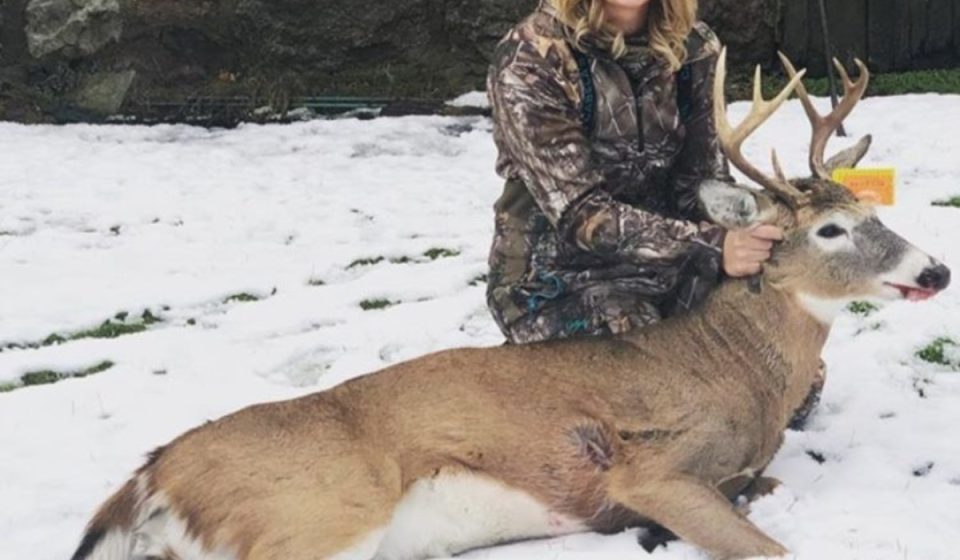
Deer parts and meat trimmings should be double bagged for landfill, while hunters fielding animals should avoid brain and spinal tissue to limit the spread of chronic wasting disease.
PRESS RELEASE
MICHIGAN STATE UNIVERSITY EXPANSION
*************************
Understanding Chronic Wasting Disease
Chronic wasting disease (CWD) is a neurological disease that affects members of the deer family, such as deer, elk and moose. CWD is caused by a prion or misfolded protein. Prions are primarily found in the brain and spinal fluid, but they can also be detected in deer saliva, urine, and feces.
Deer that contract CWD may take months or even years to show symptoms of the disease. Symptoms may include extreme weight loss, lack of coordination, drooping head and/or ears, excessive drooling, excessive alcohol consumption, and excessive urination. CWD is always fatal to infected deer.
CWD is spread both through direct contact between animals and through indirect contact with saliva, urine, feces, blood, carcass parts of an infected animal, and contaminated soil or plants. Once deposited in the landscape, prions can remain infectious for years. Unlike viruses, bacteria or fungi, there is no antidote or cure for prion disease.
CWD is not known to affect humans, although the Centers for Disease Control and Prevention recommends not eating meat from infected deer. Beyond the potential risks to human health, CWD poses a threat to deer population health and management.
Deer hunting is an important wildlife management tool and has significant direct and indirect impacts on Michigan’s economy. A 2019 study on the economic impact of hunting, fishing and trapping in Michigan conducted by the Michigan United Conservation Clubs estimated that hunting alone generated more than $8.9 billion in annual spending.
Best practices for hunters
If you hunt in Michigan, it is important to know how to properly dispose of a deer carcass. Proper disposal of killed deer carcasses will help combat the spread of diseases like CWD.
Hunters can choose to remove the whole deer from the field or quarter it and remove it from the woods. Both methods are acceptable.
When field dressing your deer, always wear disposable or rubber gloves, have a plastic sheet or tarp handy to lay under the carcass during field dressing, and have non-porous garbage bags on hand. These steps will prevent direct contact with the soil, which will prevent soil contamination and ultimately the spread of disease. Once the viscera is removed, place it in a non-porous trash bag and remove it from the wood. You can throw them in a landfill.
Burying the viscera where your deer was killed is also an acceptable disposal method. To do this, dig a hole at least two feet below the natural ground surface and in accordance with local ordinances. Burying the viscera discourages scavengers.
If you quarter the deer in the field, be careful to avoid cutting the spine and brain tissue; these are the areas that contain the greatest quantity of prions. Carefully remove the meat quarters from the bone and place them in your bag of choice for wrapping.
When leaving the carcass behind, the best practice is to bury the remaining bones and body parts at least two feet below the natural ground surface and in accordance with local ordinances. Place the carcass and any remains, including the viscera, in the ground.
All harvested deer parts, such as bones or meat trimmings, should be double bagged in a nonporous trash bag and disposed of in a landfill.
Screening for chronic wasting disease
Identification of deer with chronic wasting disease is not possible by visual observation alone. For positive identification, the deer’s lymph nodes must be tested in the laboratory.
Common signs that may indicate a deer is sick include poor body condition (e.g., visible ribs, hips, and/or spinal bones) and lack of alertness (e.g., not reacting to surrounding sounds). Deer with CWD may also have lost their fear of humans.
However, deer may be in poor physical condition but not sick if they have recently nursed or are in an environment with limited access to food. The deer may also be suffering from another disease.
CWD testing is recommended but not required. In 2026, targeted CWD surveillance will occur in Ionia, Kent, Mecosta, Montcalm and Newaygo counties. To find Michigan Department of Natural Resources (DNR) checkpoints and drop box locations near you, visit Michigan.gov/DeerCheck. You can check your deer CWD lab results at Michigan.gov/DNRLab.
For any county not included in the 2026 CWD targeted surveillance areas, CWD testing is available by purchasing a free lymph node submission kit. Visit Michigan.gov/CWD and click on “Get My Deer Tested” for more information and a list of where kits are available.
Hunters play a very important role in reducing the spread of CWD through human behavior. Some strategies hunters can use to reduce their risk of spreading CWD include following proper field dressing procedures and using best practices for carcass handling and disposal.
Hunters can also help with disease surveillance by testing the lymph nodes of their harvested deer if they hunt deer in an area where CWD has been detected.
2026 Movement restrictions
Movement restrictions apply to deer harvested throughout Montcalm County and in Otisco, Orleans, Ronald or North Plains Townships in Ionia County.
Nelson, Spencer, Courtland, Oakfield, Grattan or Cannon Townships of Kent County may not be possessed or transported outside of these listed areas except:
- Harvested deer consists of boneless meat, quarters or other parts to which no part of the spine or head is attached: antler; antlers attached to a skull or skullcap cleaned of all brain and muscular tissue; hides; upper canines; or a finished taxidermist mount.
- OR the deer carcass is taken directly to a registered processor.
- AND/OR the intact deer head detached from the carcass is taken directly to a licensed taxidermist.
Although it is very unlikely that you will see a deer in the wild with CWD, it is important to know the signs of a sick deer. If you encounter one, contact the Michigan Department of Natural Resources Wildlife Division at 517-284-9453, or the after-hours Report All Poaching (RAP) line, available 24/7 at 1-800-292-7800. Reports of a sick deer can also be submitted online.
Declare your harvest
Please remember that deer hunters are required to report a successful harvest within 72 hours or before transferring possession of the deer to another person, processor or taxidermist. Harvest reports allow the DNR to obtain real-time data on the number of deer harvested, which helps the department make decisions regarding deer herd management, better evaluate hunter activity and determine disease prevalence rates.
Information collected from the harvest survey is not public and is only used when specifically required by law. Hunters can receive technical assistance in reporting their harvest by telephone by locating the nearest DNR Customer Service Center and calling the telephone number listed for that location or by calling the Wildlife Division main line at 517-284-WILD (9453) during regular business hours, 8 a.m. to 5 p.m. Monday through Friday.
To declare your harvest via eLicense:
- Visit Michigan.gov/DNRHarvestReport on a computer or mobile device to go directly to the report page.
- Enter your license number for the harvest tag or eHarvest tag you used and your date of birth to begin the harvest report.
- If you do not have your deer hunting license number, you can log in to eLicense (using your driver’s license and date of birth, or your username and password), then click on the Harvest Report tab to view the tags available for harvest reports.
- If you don’t already have an account, you will have the option to create one to enter your report.
- Enter the crop report information.
If you have a paper kill tag, you must continue to attach a paper kill tag to a harvested deer. The paper kill tag must remain with the head if the deer’s head and body are separated.
If you have an eHarvest tag, you must ensure that validation of your eHarvest tag has been completed. Go to the Harvest Validation section for more information on sustainable labeling requirements. Anyone in possession of a deer after the harvest declaration deadline has expired must be able to present the confirmation number.
For more information on chronic wasting disease, tips and tools for hunters and venison eaters, and other deer-related topics, visit the Michigan State University Extension Chronic Wasting Disease website.
This article was written by Katie Ockert, Michigan State University Extension. For more information, visit https://extension.msu.edu. To contact an expert in your area, visit https://extension.msu.edu/experts or call 888-MSUE4MI (888-678-3464).
Michigan State University Extension programs and materials are open to all without regard to race, color, national origin, sex, gender identity, religion, age, height, weight, disability, political beliefs, sexual orientation, marital status, familial or veteran status.
*************************
Gn Health