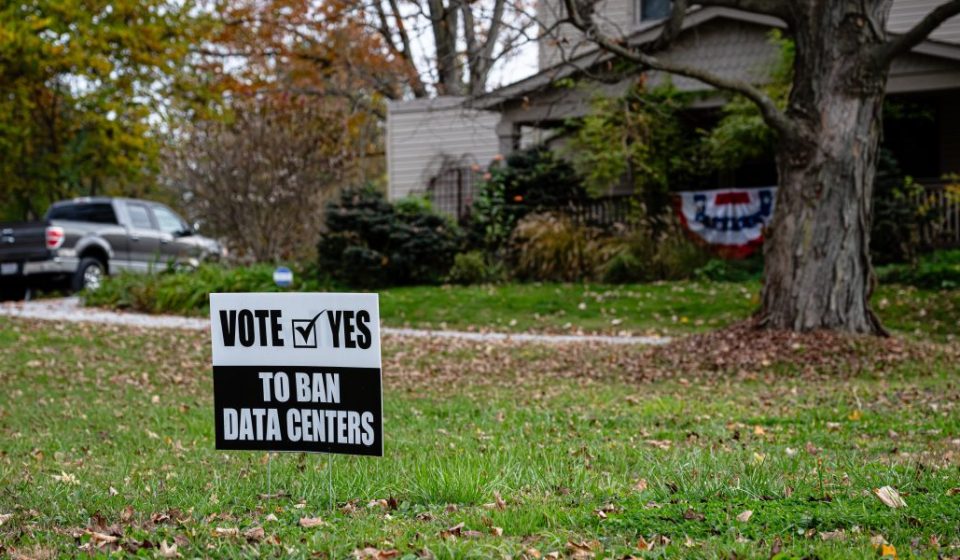
The American data center The construction project suffered a resounding midterm defeat at all levels of government. Candidates and ballot measures favoring restricting, or even stopping altogether, the development of facilities that fuel the artificial intelligence boom won overwhelmingly on election night.
Newly elected Democratic governors in Georgia, Ohio and Texas have promised moratoriums on new data center construction and have all taken tougher regulatory stances than their outgoing Republican opponents. The trend continued in various congressional elections, in which candidates who criticized their competitors’ records in promoting data center development came out on top, even flipping key districts in Ohio and South Carolina.
Many local communities, primarily in Ohio and Illinois, voted directly on their AI concerns and passed a series of ballot initiatives restricting data center development — nearly 40 proposals, according to tracking by research firm Redbud Consulting.
“What’s good for the AI industry is clearly not good for average voters,” said Shobita Parthasarathy, a public policy professor at the University of Michigan. “I would like data center operators and the AI industry to really take this as a sign that they have done a very poor job of addressing the public’s concerns and taking them seriously.”
Parthasarathy pointed out that many Americans now decide how they feel about these energy-guzzling facilities based on their experience living nearby and their “real knowledge” of their deficiencies. These concerns range from negative impacts on energy bills to environmental and health issues, but also include anger at the outsized power wielded by the tech oligarchy.
Americans’ vote in the midterms gave them a concrete way to fight back, Parthasarathy said: by blocking the water-sucking, heat-spewing brick-and-mortar buildings that fuel the rapid wealth accumulation of tech billionaires.
Tech Money ≠ Changing mentalities
Numerous polls have recorded Americans’ anger toward data centers. About three-quarters of voters surveyed by NBC News on Election Day said they were opposed to building these facilities in their communities. These sentiments align with an August Heatmap survey that found a similar share of Americans would strongly oppose a new data center near their homes.
More than half of voters surveyed by NBC this week said AI and data centers were a crucial or major factor in their decision, although they were almost evenly divided when it came to deciding which party would best address their AI concerns.
The AI industry tried to make a dent in the midterms, but much of its money was focused on a congressional primary in New York, where the money helped defeat AI critic Alex Bores.
During the general election, an Intercept analysis found that AI super PACs significantly reduced their spending on congressional races compared to primaries, amid growing anger toward data centers; only 5 percent of their direct spending went to contested general elections. Industry observers told The Intercept that this suggests that tech developers and CEOs have taken note of the electorate’s aversion to AI and data centers.
This is not to say that tech moguls, more generally, have been stingy with their money. Elon Musk spent nearly $450 million ahead of the midterm elections, including more than $200 million in Texas, where his companies are headquartered.
“It shows that when an issue is felt deeply and widely by the American people, no amount of money can change their minds.”
“If Elon Musk wants to continue spending half a billion dollars and get no results, there are probably other ways to do it,” said Mitch Jones, deputy director of Food & Water Action, which has advocated for data center regulations at the federal, state and local levels. “It shows that when an issue is felt deeply and widely by the American people, no amount of money can change their minds.”
Musk’s money wasn’t enough to make the Texas races happen the way he wanted. Surprise upsets in the state Senate and gubernatorial elections resulted in victories for Democrats James Talarico and Gina Hinojosa, respectively.
Talarico promised to end tax breaks for data center developers and minimum federal requirements to protect the network, the environment, jobs and transparency. Hinojosa called for a moratorium on all data center approvals “until laws can be passed by the Legislature to protect Texans.” Outgoing Texas Republican Gov. Greg Abbott had already temporarily suspended environmental permits and grid connections until about the end of the year, but Hinojosa’s proposal would last longer and be broader.
Promises for mastering AI
The new incoming class in Congress includes many Democrats who have promised to limit the harms of AI. Ohio Democratic Sen.-elect Sherrod Brown flipped a district after portraying his opponent in ads as a cheerleader for the data center industry.
In typically red South Carolina, Democratic Sen.-elect Annie Andrews defeated her opponent, Sen. Darline Graham, after accusing her of being bought by developers. The pro-AI super PAC Building the Future spent $2.5 million supporting Graham, according to Politico.
In Mississippi, Democrat Scott Colom, who called for a temporary ban on data centers, narrowly beat his outgoing opponent on Wednesday evening in a state which has not elected a Democrat to the Senate for more than four decades.
Just because Trump is expected to veto Democrats’ proposals to regulate AI doesn’t mean they shouldn’t push for them, said Jones, of Food & Water Action. He hopes Congress will approve a ban on “artificial superintelligence,” as well as a federal moratorium on new data centers.
“They should show the American public that they stand with us and are taking action to force Trump to veto these bills,” Jones said.
Although moratoriums generally target new construction and not existing data centers, Jones says they are still necessary to prevent even more expansive construction.
“We don’t need more,” he said, citing a Forbes estimate that the total cost of projected construction ranges from $2.8 trillion by 2030 to $10.30 trillion by 2032 in the United States.
With Trump still in charge, states led by Democratic governors could be where tighter data center regulations may be put in place.
In Georgia, Democratic Governor-elect Keisha Lance Bottoms has promised a temporary statewide pause on data centers. Ohio’s newly elected Democratic governor, Amy Acton, has proposed an “immediate moratorium upon taking office on all new construction.” And in Kansas, Democrat Cindy Holscher, who declared victory in the gubernatorial race, argued for stopping new developments.
Ballot measures
Local communities are also getting creative. Jones said some cities have turned to ballot measures to get around “elected officials who aren’t keeping pace with their constituents.”
About half of the roughly 40 measures passed in the midterms were in Ohio. Most passed by a wide margin, and as of Thursday morning, all but one vote was in favor of the restrictions, according to Redbud Consulting’s tracker.
Nick Owens, who helped write 10 local ballot measures in Ohio that restrict data center development after an unsuccessful statewide petition attempt, said it gives voters faster and easier access to the ballot to curb the “tremendous growth of large-scale data centers.”
“Communities know how they want to govern themselves,” said Owens, who was a Trump delegate to the 2024 Republican National Convention and is currently a co-founder of the grassroots group Conserve Ohio. The results “just validated everything I saw on the ground, talking to people and in polls nationwide,” he added.
Owens plans, once again, to push for a statewide moratorium, as well as limiting the covert use of nondisclosure agreements by tech companies and developers.
“They could settle in localities where pushbacks are less organized.”
Parthasarathy, a public policy professor, said more communities could explore ballot measures in response to developers’ lack of transparency and desire to build more.
“I don’t think their hunger for data centers is going to go away,” she said. “They could settle in localities where pushbacks are less organized.”
Gn bussni