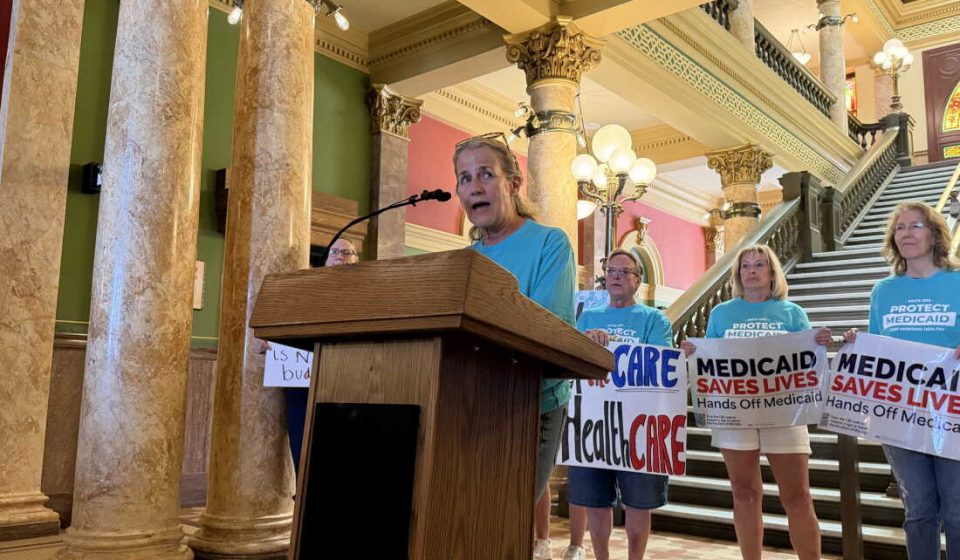


Rep. Mary Caferro, a Democrat in the Montana House, spoke at a July rally at the Montana Capitol in Helena, criticizing the state’s accelerated rollout of Medicaid work requirements. She is among several Democrats who have pushed the state to delay implementing the rules until the Jan. 1 federal deadline.
Aaron Bolton/MTPR
hide caption
toggle caption
Aaron Bolton/MTPR
Bethany Zulick returned to school in January to become a high school English teacher.
Years ago, she taught English as a second language abroad and loved it.
“It’s so exciting to me to see someone learn a new word or have that spark of understanding,” said Zulick, who lives in Missoula.
Zulick knew she could make enough money as a substitute teacher to make returning to school financially viable — except for the cost of health insurance. She didn’t want to risk not being able to see her doctor for her allergies or for preventative care.
The health insurance offered by Montana State University was too expensive, Zulick said, almost as much as its tuition. But then she found a solution that allowed her to take the plunge: Medicaid. She would not have to pay a monthly premium.
This worked well for a few months, as Zulick taught during the day and took online classes at night.
But in June, the state sent a letter that she said left her “completely confused.” She knew Montana was rolling out a system for Medicaid work requirements over the summer, but she figured she wouldn’t have to prove she met the requirements until next year, when her Medicaid enrollment came up for renewal.
Yet the letter from the Montana Department of Public Health and Human Services outlining the new requirements gave conflicting information about when Zulick would have to prove she met them. First, this was said during its next renewal, which would take place next spring.
Further down, she was told she would have to submit documentation to prove her compliance much sooner — “within 30 days” of the June 26 letter date. She wondered: was this a standard mass mailing letter that she could ignore, or was her insurance at stake?
All states must implement the new work requirements by Jan. 1, but three states — Montana, Nebraska and Arkansas — have already started.
Medicaid advocates worry that the accelerated timeline in these states could cause thousands of people to lose coverage because they are confused about the new rules, even if they are eligible for the program — and that Montana could offer a troubling preview of what will happen nationally next year.
State health department officials say they are well prepared and have told state lawmakers they expect to process about 5,000 registrations per month.
Increasing confusion and decreasing help
State Rep. SJ Howell of the Montana House has received dozens of calls from confused constituents, especially about letters like the one Zulick received.
“The advice coming from the department is very, very confusing, and it’s very difficult to find help to understand what’s going on,” said the Democratic lawmaker, who questioned Health Department leaders about the letters during a hearing in early September.

About 100 people protested changes to Medicaid in July at the Montana Capitol in Helena. Montana is among three states that adopted Medicaid work requirements months before the federal deadline. The new rules have caused confusion among some Montanans about Medicaid, and critics say the confusion would lead people to unnecessarily lose their coverage.
Aaron Bolton/MTPR
hide caption
toggle caption
Aaron Bolton/MTPR
Letters sent to enrollees have been updated to be clearer, state health officials told lawmakers during the hearing.
In Montana, nearly 71,000 people are subject to the new rules. Medicaid costs are split between the federal and state governments, and states are responsible for administering the program, which provides health insurance to low-income or disabled people.
Under the new work requirements, enrollees must prove they work, volunteer or study 80 hours per month — or they must prove they qualify for one of several exemptions, such as being “medically fragile” or being the primary guardian of a family member.
Montana began with a soft launch of work requirements in July and gave enrollees until October 1 to comply.
Critics say that’s not enough time because the state hasn’t finished setting up new computer systems or hiring the staff it said it needed. Of the 59 positions, only about 20 have been filled, state health department officials told state lawmakers at the Sept. 9 hearing.
The state had already hired more than half of those workers earlier this summer, but officials said they lost staff due to turnover.
State health officials said they would eventually be able to automatically verify that students are enrolled at public universities. However, that computer system isn’t expected to be operational until next year, leaving students like Zulick to track down and submit the proper documents to prove their enrollment at the university.
However, there are fewer outside resources to help residents with these bureaucratic tasks.
For example, Cover Montana, a nonprofit that helps Montanans fill out these documents, lost its federal funding last year, going from a staff of 18 to two part-time employees working a phone line.
The state has a hotline, but federal data shows Montanans stay on hold much longer than the national average and many callers hang up before they can reach a state employee.
“We were concerned about the chaos that could be generated by rushing the state,” said Aaron Wernham, CEO of the Montana Healthcare Foundation, a nonprofit aimed at improving health in the state.
“Given how little information the state has provided about what they’re doing, I’m much more worried about chaos,” Wernham added.
Wernham pointed to a similar upheaval in 2023, when states undertook a massive process to redetermine the eligibility of all Medicaid enrollees, after regular eligibility checks were disrupted during the pandemic.
Many Montanans who were financially eligible have lost Medicaid coverage for technical reasons, such as filling out paperwork incorrectly — about 87,000, according to state data from two years ago.
Even vulnerable Montanans who did not need to fill out paperwork, because their coverage should have been automatically renewed, were removed from the Medicaid rolls, including people experiencing homelessness.
Long-sought requirements in the state
The Montana Legislature passed a measure in 2019 expressing its desire to add work requirements to Medicaid, but the state until now did not have permission from the federal government to move forward.
Work requirements create liability for people who rely on the social safety net, said Montana Senate President Matt Regier, a Republican.
“In an economy like this, if you’re an able-bodied adult who can work, you really need to step up,” he said.
Asked about confusion among registrants about the rules, Regier said the Oct. 1 deadline provided more than enough time to work out the kinks in the new system.
Ultimately, Zulick learned she didn’t have to worry about the delay because she had gotten married in July and was no longer eligible for Medicaid, although she didn’t know that would be the case when she received the June letter.
But others still fear losing coverage, including Heather Reel, who attended a rally at the state Capitol in July to oppose Montana’s early rollout.
Reel relies on Medicaid for its mental health coverage. Without it, she said, she would struggle to care for her teenage son, who is autistic and nonverbal. Between her shifts at a fast-food restaurant and caring for her son, she worries that she’s too busy to figure out how to report her work hours.
Montana deployment is a potential preview
The handful of states that implement Medicaid work requirements early are building the plane as they take off, said Akeiisa Coleman, who provides Medicaid analysis for the Commonwealth Fund, a nonprofit aimed at making health care more equitable.
“Montana is going to be an example of what we might see nationally as things unfold,” she said.
Although most other states are meeting the Jan. 1 deadline to build and test their Medicaid systems, they still may not have all the components in place, she said.
If states can’t automatically renew or deny coverage based on the new rules, officials will have to do it manually, on a case-by-case basis. That could create delays and more disruption, leading more people to lose coverage, Coleman said.
Jon Ebelt, a spokesperson for the state health department, said in a statement that Montana’s Medicaid office was ready for the change on Oct. 1.
“We are committed to ensuring eligible Montanans maintain their coverage while meeting requirements, and we will continue to closely monitor implementation,” Ebelt said.
Democratic state lawmakers have repeatedly asked state health officials to extend the Oct. 1 deadline for enrollees to comply with the new rules, but state health department leaders have said they have no plans to do so.
This story comes from NPR’s health reporting partnership with Montana Public Radio And KFF Health News.
Gn headline