‘My name was poison’: Donny Osmond talks fame, failure – and his friend Michael Jackson | Pop and rock

FFor a brief period in the early 1970s, Donny Osmond ruled the world. He was THE Global favorite among teenage girls. Even Michael Jackson followed him. He was 14 when his most famous song, Puppy Love, spent five weeks at number one in the UK. My sister had a huge poster of him on her bedroom wall. Then again, everyone’s sisters had a poster of him on their bedroom wall. Between 1972 and 1973 he had six Top 5 hits in the UK, including three No. 1s (including The Twelfth of Never and Young Love). It had the same success in the United States.
Osmond was clean, religious and respectful, with a great ability to create covers of saccharine standards. From his purple velvet cap to his mournful eyes and dazzling American smile, he was a marketing dream. We had just finished Beatlemania. And now there was Donnymania.
Did Osmond realize how big he was at the time? “You better believe it,” he says today. How was it? “Amazing. Amazing.” In October 1973, a viewing balcony at Heathrow collapsed after fans went wild when Osmond and his brothers arrived in the country. Just afterwards, David Dimbleby hosted a BBC debate on teenage “hysteria”, questioning whether the Osmonds were bad for the country’s girls and whether they should be deported. “My brother Alan said, ‘Donny, don’t forget this moment because no one ever understands that!’ » How did that make him feel? “I enjoyed every second of it. I thought it was so cool.
Osmond was not evicted. But in 1974, his solo career came to an abrupt end. He continued to have hits with his brothers for another year and then it all fell apart as well. At 18, he was a pop has-been on two fronts. Osmond and his sister Marie reinvented themselves with a television show, but ratings fell after Osmond married. The show was canceled in 1979. By the time he was 21, his career had been cut short for the third time – and there seemed to be no coming back. It was not simply that Osmond was no longer popular, but that, in one way or another, he had become an embarrassment. Even towards himself.
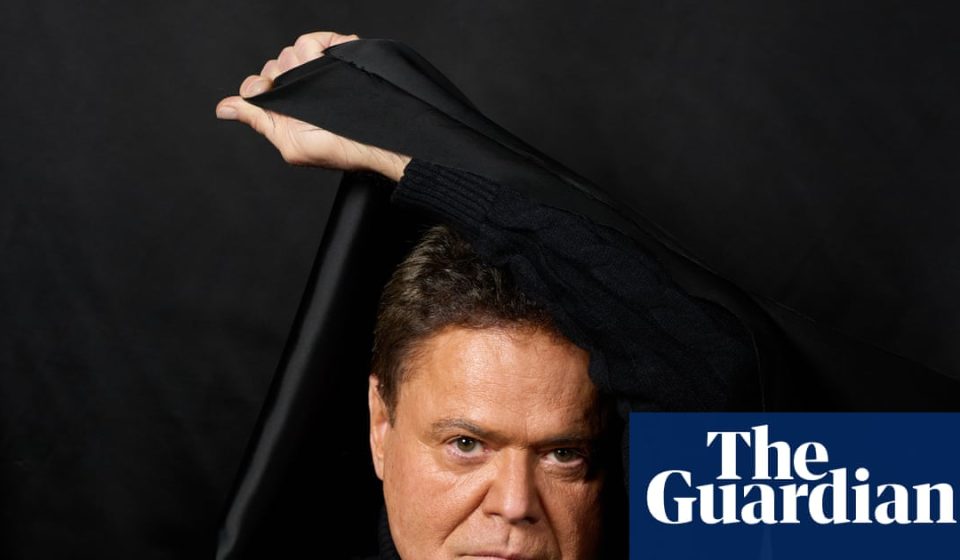
And yet, almost half a century later, Osmond is in residence in Vegas for six months a year, he released his 65th album a few years ago and is about to embark on a UK tour. At 68, he is the father of five boys and a grandfather 16 times. We meet in a London studio where he has his photo taken. Today, he looks both typically Donny and, unsurprisingly, different. He has the slight body of a teenager and the monumental face of a Mount Rushmore president, giving him the appearance of a puppet. The hair is still blue-black and the teeth are pearly white. How does he handle this? “Well, as for my hair, I have a lady who takes care of it. Her name is Clairol.” He takes a break. “It’s a joke!” he said, patting my knee playfully. Osmond is one of life’s kneeling men. “I’d get gray sides if I didn’t take care of it. I wouldn’t do that. But I’m very careful about what I eat. And I guess I was lucky in the DNA department. My mother had perfect skin.”
Has he had cosmetic surgery? “No!” But, he says, there was a time when he tried Botox. “I hate it.” For what? He freezes his face in a rictus smile. “Nothing works. I tried it 15 or 20 years ago. It took away my crow’s feet and I worked really hard for those crow’s feet.” He laughs.
Osmond, originally from Ogden, Utah, was five years old when he entered showbiz. There is footage of him on the Andy Williams Show singing You Are My Sunshine. He was the youngest Osmond brother in the group at the time and clearly the most notable, just as Michael was in the Jackson 5. It was an extraordinary musical period. The Beatles and the Rolling Stones, arguably the two greatest bands of all time, spent the ’60s battling for supremacy. Now there were the Osmonds and the Jackson 5, the biggest boybands, going head-to-head. There was perfect symmetry between them – five brothers, similar ages, with Donny and Michael both solo stars in their own right. The Jackson 5 were dark, soulful and funky. The Osmonds were white, soulful and dabbled in hard rock. While Donny was initially the biggest solo star, the Jackson 5 had the edge over the Osmonds. They were a phenomenon, with their first four Motown singles hitting No. 1 on the US Billboard 100 in 1969 and 1970, a year before the Osmonds had their first success.
Even today, more than 50 years later, Osmond seems to be reliving old battles with his great rivals and friends. He tells me he wants to set the record straight and looks at me with the intensity of a man about to deliver an essential truth. “The Osmond brothers were the first boyband. People say, ‘No, it was the Beatles,’ but the Beatles weren’t a boyband. Then people say the Jackson 5.” And this is where it gets controversial. “We were before the Jackson 5. I’ll tell you a story.”
Osmond moves closer to make his point. “The first time I met the Jackson 5, we were in Toronto playing and they were playing the next night. They arrived a day early to see our show. I looked to the right of the stage and Michael was looking around the corner looking at me. But what happened next was truly amazing. We were in our hotel room and Joe and Katherine (the Jacksons’ parents) were sitting on the couch with my mom and dad. I can see it like it was yesterday.” He says that each boy instinctively sought out his contemporary, from the oldest to the youngest. “So Jackie and Alan were talking, Wayne and Tito were talking, Jermaine and Merrill, Marlon and Jay.” Break. “And Donny and Michael were nowhere to be found. Guess where we were?” He smiled. “We were in the other room playing with our toys, trying to be kids. We were 13 or 14 years old. And did you manage to be children? “Mike and I talked about it a lot. We both missed out on a childhood, but we agreed that we made up for it in the excitement of our lives.
That night, Osmond says, Joe Jackson told his father something that has stuck with him to this day. “Joe revealed something to my dad that the world doesn’t know. He said, ‘I used to sit my kids down on The Andy Williams Show and tell them you’re going to do this, pointing at us on TV.’ When the Osmonds’ first hit, One Bad Apple, was released, “everyone said the Osmonds were copying the Jacksons. But in reality, it was quite the opposite.”
Both the Jacksons and the Osmonds were ruled by their harsh, disciplinarian fathers. Joe Jackson was known for his violence. Michael said he used to sit in a chair with a belt in his hand while watching them practice. I ask Osmond what the two fathers had in common. “Not much. My father was strict. He was an Army sergeant. But Dad was not Joe. Joe was mean. He was not a nice man. I can tell you that from first-hand experience. I would go to Mike’s house and we would have all kinds of funny discussions. But Joe didn’t like me to be there. “Why? “He just didn’t like me being in the house.” How does he know? “Because of the glares he gave me.” Did he say something? “No, he just watched.”
That said, Osmond admits it hasn’t been easy standing up to his own father. When he was eight, the brothers were on tour in Sweden and Osmond was desperately homesick. “I just wanted to go home and play with my trucks. I wrote a letter to my mom saying, ‘Please, I want to come home.’ I told my brother Jay what I wrote and he ratted me out. He told my father. He was so angry. What did his father tell him? “He said, ‘You’re going to stay here and you’re going to do your job.'” Now, he said, he understands his father’s position: If he had gone home, it would have ruined the tour for everyone.
Life on the road and in the studio quickly becomes his only reality. “I didn’t know anything different. If I had a normal life, going to school and everything, then I would have something to compare it to, but being on television, learning dance routines, spending 25 hours a day in the rehearsal room was my norm.” When did he realize his life was different from most other young boys? “I remember making the decision around age 12, when One Bad Apple became our first No. 1 record, that I was going to do this for the rest of my life.” Was this a good thing or a reluctant acceptance of his future? “It was Yeah! When you have a #1 record on the Billboard charts, it’s Yeah! » Did he realize the impact he had on the girls? “You better believe it!” I would get on stage with my brothers, Alan would introduce me and the place would go crazy. It was great.
The success was wonderful while it lasted, he says. But when the girls fell in love with Osmond, nothing was left. His religion (the family are members of the Church of Jesus Christ of Latter-day Saints, often called Mormons), his songs and his lack of composure were all ridiculed by a merciless music press. I start to ask about a particularly cruel quote from Rolling Stone magazine, but before I ask, Osmond quotes it to me: “‘The worst day in the history of rock ‘n’ roll was the day Donny Osmond was born.’ Is this the one you’re talking about? He laughed bitterly. “Try this as a teenager.” How old was he when this was written? “Sixteen, I think.” How did you feel? “Devastating. I mean, come onnnnn. I can laugh about it now. But I would like…
Gn entert