NASA blew up an asteroid with a spacecraft to change its trajectory 4 years ago. We have just had our first glimpse of the consequences.

Four years ago, NASA conducted a test that could one day save humanity. The space agency slammed a spacecraft against a small asteroid to see how effectively it could change its trajectory, which could prove useful in the future if a similar object was on a direct collision course with Earth.
The test worked. NASA found that the collision changed the time it took for the asteroid, a chunk of football stadium space rock called Dimorphos, to orbit a larger asteroid nearby by 32 minutes. Before the test, the agency said a change of 73 seconds or more would be considered a success.
Although NASA was able to judge how far Dimorphos had been from its previous trajectory, it took an entirely separate mission to provide the first glimpse of how the impact had impacted the asteroid’s surface.
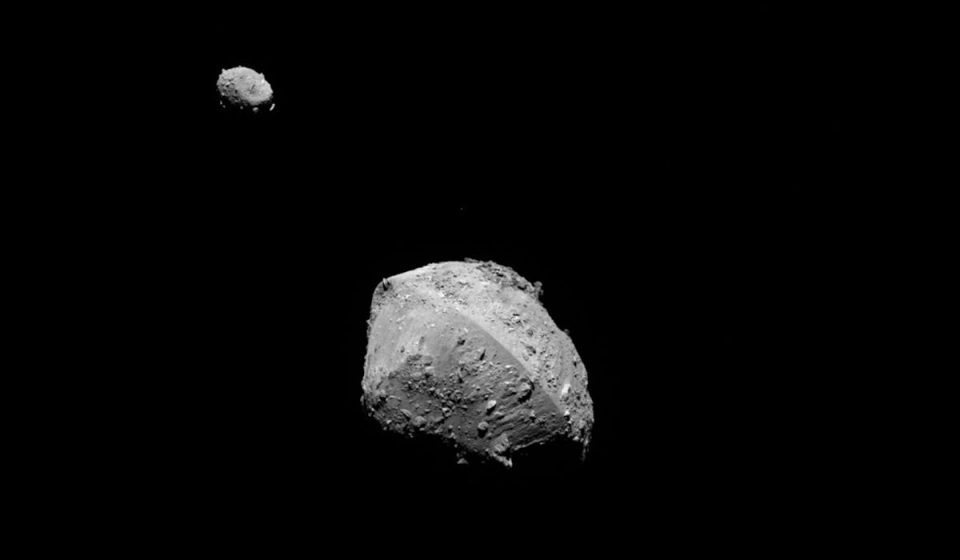
On Wednesday, the European Space Agency (ESA) released the first images of Dimorphos captured by its Hera spacecraft, launched in late 2024 to observe Dimorphos and its larger parent asteroid, Didymos, following NASA’s collision test. ESA scientists overseeing the Hera mission described what they learned from the images at a press conference in Berlin.
“Basically there were two categories (of potential outcomes),” said Hera principal investigator Patrick Michel. “Either we create a small crater or we completely reshape the asteroid. And in fact, what we find is that we have both. We have a crater… so large that it spans the entire width of the asteroid.”
The impact also left Dimorphos “tumbling wildly through its orbit,” according to Hera mission scientist Michael Kueppers.
Impact craters on large asteroids are common, but there is a limit to what scientists can learn from observing them when they don’t know the exact size, speed and trajectory of the object that created them. A man-made crater can provide much more information.
“This offers a unique opportunity to study the physics of impacts on the scale of an asteroid,” Michaël Marsset, an astronomer at the European Southern Observatory in Germany, told the Guardian.
How NASA redirected an asteroid
NASA launched its Double Asteroid Redirection Test (DART) mission in November 2021 as part of a crash course with Dimorphos. After 10 months of transit in space, the 1,260-pound DART spacecraft slammed into Dimorphos while traveling at approximately 14,000 miles per hour on September 26, 2022.
A few weeks later, NASA announced that the mission had been an undisputed success, changing the trajectory of Dimorphos’ orbit by more than 25 times the minimum change required for success.
“We all have a responsibility to protect our planet. After all, it’s the only one we have,” Bill Nelson, then NASA administrator, said at the time. “This mission shows that NASA is trying to be ready for whatever the universe throws at us. NASA has proven that we are serious about being a defender of the planet. This is a watershed moment for planetary defense and for all of humanity, demonstrating the commitment of the exceptional NASA team and its partners around the world.”
In addition to changing the asteroid’s trajectory, the impact released tons of “ejecta” into space. Studying these displaced pieces of rock, many of which remain in orbit around Dimorphos, is another part of Hera’s main mission.
Gn headline