“NATO will collapse”: Russia blocks Ukraine negotiations and seeks to divide Europe | Russia-Ukraine War

Kyiv, Ukraine – A Russian drone struck a small house in the northern Ukrainian town of Hlukhiv, burying a nine-year-old boy and his grandmother under the rubble.
Two Ukrainian police officers arrived Saturday to dig them up, apply a tourniquet to the woman’s bloody arm and take them to their car.
But a second drone hit their vehicle, killing one of the police officers, Mykola Savchenko, who covered the boy with her body, the Interior Ministry said.
Such double-tapping attacks are Ukraine’s daily reality as the war approaches its fifth anniversary. They are also a metaphor for Russia’s latest attempts to target both Ukraine and those that kyiv has long hoped could help it survive Moscow’s onslaught: NATO and Europe.
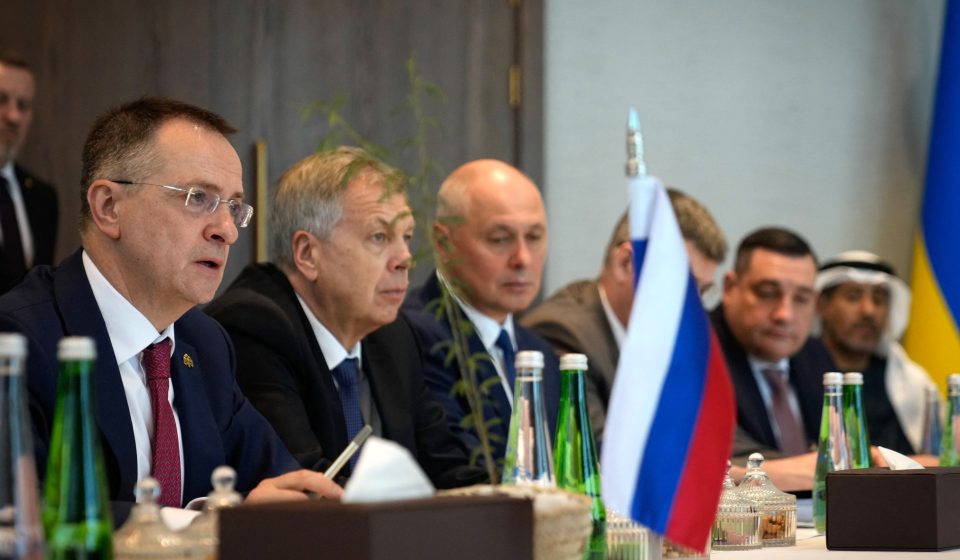
On the surface, Russia is engaged in diplomacy mediated by the United States. But Russian diplomats who met with U.S. negotiators in Abu Dhabi last week for trilateral talks involving Moscow, kyiv and Washington laid out demands that go far beyond any peace deal.
Moscow did not accept kyiv’s proposal to freeze the war along the current front lines because Ukraine does not have Western missile interceptors to shoot down Russian missiles and drones.
Instead, the Kremlin has shifted the focus of ceasefire and peace negotiations toward demands that, if agreed, could dismantle Europe’s post-Cold War security architecture, analysts say.
Russia wants NATO to withdraw its troops from Central and Eastern Europe and bar any future expansion of the bloc, according to leaked documents obtained by The New York Times, The Economist and several Ukrainian media outlets.
Moscow also wants to conclude non-aggression pacts with individual European countries, which could appear attractive to Russia’s neighbors, such as Estonia or Finland.
“Agreements of this type could be concluded, among others, with certain NATO member states, which would then receive, for example, additional individual security guarantees” from Moscow, Russian negotiator Alexei Drobinin said at a press conference after the Abu Dhabi talks.
But a series of such agreements could effectively negate NATO’s fundamental principle that any armed attack against one member state is an attack against all 32 of its members.
“NATO will collapse and European nations will (individually) come face to face with Russia,” said Boris Bondarev, a former Russian diplomat who left his post at the Foreign Ministry to protest Moscow’s full-scale invasion of Ukraine in 2022.
“Europe will surrender to Russia without firing a single shot in its defense, without losing a single soldier or spending a single shell,” he told Al Jazeera.
“Such individual agreements constitute an absolutely blatant attempt to demolish the unity of Europe, which is already on its last legs, and to undermine the unity of NATO,” said Bondarev, also author of Time to Win the War, a book that traces the potential steps needed to reach a peace agreement.
Any non-aggression pact would most likely include conditions prohibiting a signatory country from participating in a future conflict between Russia and another European country, he said, thereby destroying any potential for collective defense against Moscow.
Russia’s demands were presented to US special envoys Jared Kushner and Steve Witkoff, but not to European leaders.
“The Russians want to talk to the Americans. They don’t want to talk to Europe,” Maria Kucherenko, executive director of the Strategic Intelligence Institute, a think tank in kyiv, told Al Jazeera.
For Kucherenko, who has scrutinized Moscow’s negotiating tactics for years, the “maximalist” demands perpetuate the Kremlin’s habit of asking for everything.
“Russia’s demands will be maximalist, as they were before, and they will be misleading about the next steps (towards a peace deal) in their interests. They will put politics before security, as they have done all these years,” she said.
Kushner, a real estate developer and son-in-law of US President Donald Trump, used the word “very” extensively to describe the negotiations.
“These deals are very hard and complex, and this one is very emotional, very complex. It’s a very hot war,” Kushner said at a news conference.
For Ukrainian President Volodymyr Zelensky, Russia’s demands seem supernatural.
Russian President Vladimir Putin “lives in a different reality,” Zelensky wrote Wednesday on X, adding: “I can also draw him a picture where I fully occupy Russia. But that’s not true.”
“We are all very cautious about this because no one really understands 100% what they want,” Zelensky said at a news conference a few hours later.
A senior Ukrainian negotiator has denounced the “difficulty” of the Abu Dhabi talks.
“This round of negotiations was one of the most difficult. I think the Russians came with very strict instructions, so it was very difficult to facilitate the discussions,” Davyd Arakhamia, who has participated in every round of negotiations since 2022, said on Wednesday.
Blocking negotiations will not only weaken kyiv and demoralize Ukrainians, but could also help Russia buy time until it is politically stronger in major European countries.
French far-right leader Marine Le Pen has pledged to phase out France’s military and financial aid to Ukraine within six months if she wins April’s presidential election. She is currently the favorite.
And if Germany’s ruling coalition collapses amid debates over the budget, debt and economic stagnation, the far-right Alternative for Germany (AfD) party is in a good position to win an early vote. He is leading national polls and is well ahead of Chancellor Friedrich Merz’s Christian Democratic Union.
The AfD also wants to end its aid to Ukraine, push for immediate peace negotiations with Moscow and lift sanctions so Germany can again buy Russian oil and gas.
If Le Pen and the AfD win, it would deepen Ukraine’s struggles with its allies at a time when the Trump administration is already pressuring kyiv to compromise on its sovereignty.
“We will not be able to resist the common position of the European Union and the United States, and any chance of maneuver between Washington and Brussels will be lost,” kyiv-based analyst Alexei Kusch told Al Jazeera.
Gn headline