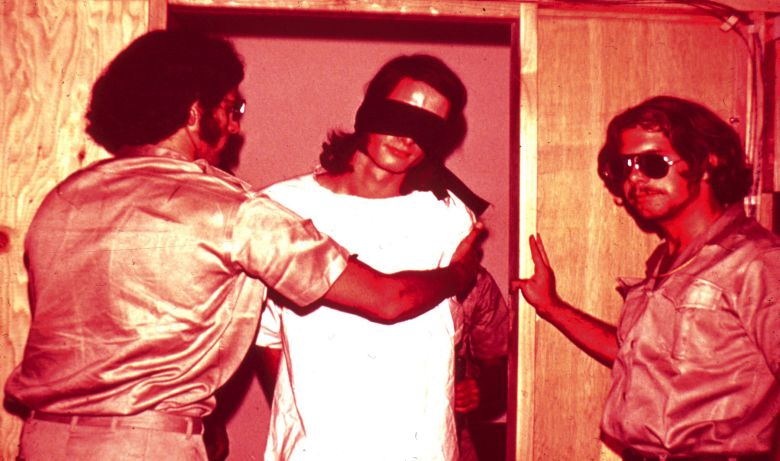

The Stanford Prison Experiment lasted less than a week in 1971, but its assertions about human nature endured for decades. Now, a new Netflix series is putting one of psychology’s most controversial studies and some of the biggest concerns surrounding it back in the spotlight.
Organized by American psychologist Philip Zimbardo, the experiment involved a simulated prison set up in the basement of a Stanford University building. He selected 24 male students from more than 70 respondents to a newspaper ad for “a psychological study of prison life” and randomly assigned them to prisoners and guards. At the heart of this work was a fundamental question about good and evil.
“Zimbardo was basically trying to understand whether ordinary people might be willing to both give and follow orders if placed in a particular environment, and to see what the role of the situation was in producing people’s behavior,” said Catherine Sanderson, the Poler Family Professor of Psychology at Amherst College and a former student of Zimbardo. She did not participate in the experiment. “What he wanted to show is that normal people can do horrible things.”


The experiment, meant to last up to two weeks, quickly spiraled out of control – at least according to the official account. Within 36 hours, one of the prisoners suffered an apparent nervous breakdown and on the second day, the inmates staged a rebellion. The guards cracked down vigorously, dousing the attackers with fire extinguishers, stripping them naked and locking them in a dark closet called “the hole.”
All this took place against a backdrop of real unrest regarding detention conditions and the treatment of incarcerated people. Just weeks after the experiment ended, a prison uprising at Attica Correctional Center in New York was foiled with deadly force, leaving 43 people dead. The event brought media attention to Zimbardo’s work, propelling it beyond the academic realm and into social discourse, where it has remained ever since.
But over the years, the profile of the Stanford Prison Experiment has changed dramatically, from an unprecedented insight into the human psyche to a widely criticized study whose methods and conclusions have been called into question.

“Our understanding of what happened has really evolved a lot over time,” Sanderson said. “The study not only raised ethical issues, but also the question of whether the behaviors occurred spontaneously or were instead instructed by Zimbardo.”
As Netflix launches its own reimagined version of the experiment, a key question remains: Did the study reveal something fundamental about authority — or did the way it was conducted help produce the behaviors for which it became famous?
Zimbardo designed the study in part as a follow-up to the famous obedience experiments conducted by American psychologist Stanley Milgram in the early 1960s. In the first of these studies, participants were asked to administer what they believed to be increasingly painful electric shocks to an invisible person, for giving incorrect answers on a memory test, and 65% of participants continued to the maximum level despite hearing the person’s apparent distress.
In reality, the distress was simulated by an actor and, if planned today, Milgram and Zimbardo’s experiments would face serious obstacles under modern research ethics due to concerns about deception, psychological harm, conflict of interest, and lack of informed consent about the intensity of the experiment.

To begin with, the prisoners in the Stanford experiment did not know that the study would begin with a realistic arrest by local police at their home. Upon entering the simulated prison, inmates were subjected to a strip search and then had to change into loose-fitting scrubs without underwear. They wore nylon stockings on their heads, simulating shaved hair.
The guards wore uniforms and mirrored sunglasses to avoid eye contact. The study team gave them wooden batons and instructions not to physically harm the prisoners, but to maintain public order. Zimbardo acted as prison warden, observing and recording the experiment.
As prisoners began showing obvious signs of distress early on, some relatives allowed to visit them expressed intent to contact lawyers to stop the study. During the first four days, three detainees were released after showing signs of distress.
On the fifth day, Christina Maslach, then a recent Stanford graduate in social psychology who would later marry Zimbardo, visited the prison and was horrified by what she saw. Zimbardo ended the experiment the next day.
Audio and video evidence from the experiment, as well as post-study interviews with participants, later revealed that Zimbardo, who died in 2024, directly influenced the study’s results by interacting with participants and coaching guards, as well as preventing some inmates from leaving the simulated prison when they first requested it.
“One of the hallmarks of good experimental design is that the experimenter in charge of the study does not interact with the participants,” Sanderson said. “The fact that Zimbardo was so heavily involved is a major problem, because he had particular beliefs, expectations – one might even say objectives – in conducting the study.”
But at the time, the results were well received, and Zimbardo built on newfound fame: “In the public eye, like if you were lecturing in front of a big class, you are an artist and so you have to put in a good performance and learn from your mistakes to be more effective next time,” he said in a 2009 interview.

Zimbardo was a very powerful and compelling speaker, according to Sanderson: “The Stanford prison study had brought him a lot of fame, and he was very charismatic. That kind of appeal meant that people didn’t pay much attention to maybe some of the details of what really happened.”
Yet the revelations about his involvement effectively served to undermine the conclusions about authority and human nature advocated by Zimbardo.
“I think there is certainly a general view that good people can do bad things in particular circumstances, such as being anonymous or being ordered to do so,” Sanderson said. “However, the Stanford prison study is not a good example of evidence of this.”
This skepticism reflects a broader awareness within psychology of the reliability of study results. In 2015, an attempted replication of 100 studies published in leading psychology journals resulted in only 36% of replications achieving statistically significant results, compared to 97% in the original studies. This “replicability crisis” has exposed flaws in the way psychological research is conducted and published, including small sample sizes and pressure to produce striking results rather than robust, replicable conclusions.
The first major attempt to revisit the Stanford experiment actually produced a completely different result. But this first overhaul, commissioned by the BBC, also began by shaking up the approach.
The BBC aired its take on Zimbardo’s work in 2002 as a television series called “The Experiment.”
The study involved 15 male volunteers – six guards and nine prisoners – in a prison built on the grounds of a movie studio. But the guards did not become tyrannical, as in the Stanford experiment. Instead, the prisoners defied the guards and gained the upper hand. Even more surprising, they then built a shared community.
According to Stephen Reicher, the Bishop Wardlaw Professor of Psychology at the University of St. Andrews in England, who conducted the research with Alex Haslam, then a psychologist at the University of Exeter, the striking difference in results was partly due to the fact that the guards were not trained beforehand by an authoritative figure like Zimbardo.
“Normally in an experiment you are neutral,” Reicher said. “Zimbardo has actually positioned himself as the guard leader. In general terms, he tells them what to do. He tells them to impose power. He tells them to make people feel powerless.”
In the BBC version, such leadership does not exist: “We took seriously the idea that we should just give people this role and see what happens. Without clear leadership, we found that the guards did not want to impose power, did not want to be brutal, and as a result they became helpless. They had no cohesion as a group. They did not know what to do,” Reicher noted. “Conversely, the prisoners were a cohesive group, had a clear idea of how to act, and in fact this reversed the power relations in our study. »
The revisited experiment, although made for television, was designed as a scientific study, Reicher said.
“We submitted it to a scientific ethics committee,” he added. “We designed it like any other study. We didn’t just film what people were doing, we did surveys every day. We even took hormonal data.”
However, even though the prisoners came…
Gn entert