New culprit at the start of Alzheimer’s disease: the blood-brain barrier blocks protective proteins


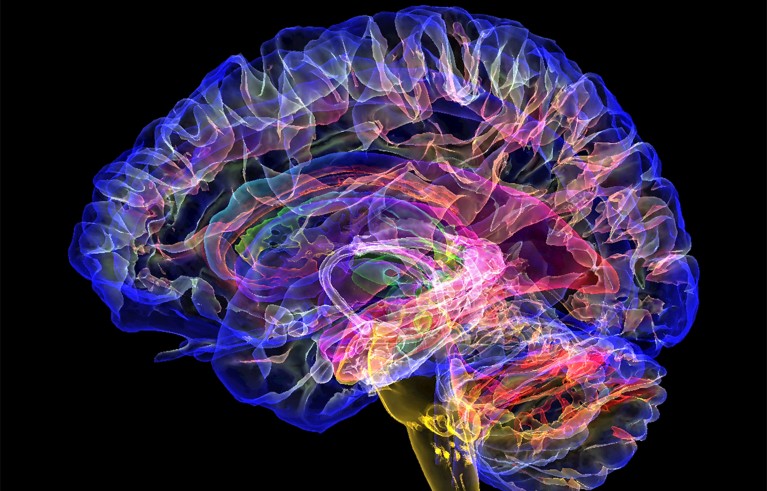
Credit: KH Fung/SPL
For decades, scientists viewed the blood-brain barrier as an impenetrable layer. Over time, this view changed, as researchers realized that the barrier was more permeable than initially thought. Now a team has cataloged nearly 100 proteins that can pass through it to maintain brain health.1
The team also discovered that the transport of some of these crucial proteins is disrupted in mice with a brain disease mimicking early-stage Alzheimer’s disease.
“The paradigm in this field is that the blood-brain barrier is normally impermeable and then becomes permeable because of Alzheimer’s disease,” says study co-author Andrew Yang, a neuroscientist at the Gladstone Institute of Neurological Disease in San Francisco, California. Instead, his team’s work suggests that the blood-brain barrier actively imports the proteins the brain needs to function and that the loss of these proteins is behind the dysfunction seen early in the disease, he adds.
Protein labeling
Yang and his colleagues developed a technique to label a wide range of proteins in the blood and track which ones can enter the brain. Of the 861 proteins mapped, 92 crossed the blood-brain barrier into the brain. Most of these proteins were produced in distant organs, notably the liver.
The team focused on apolipoprotein A1 (APOA1), which has been linked to potential protective effects against Alzheimer’s disease. Once inside the brain, APOA1 stimulates brain cells called astrocytes to release cholesterol, which is important for maintaining the synapses through which neurons communicate. But how the protein crossed the blood-brain barrier was unclear until now, Yang says.
His team discovered that two receptors for APOA1 – SR-B1 and ABCA1 – are present on the blood-brain barrier as well as on astrocytes. This suggests how the protein moves from the blood-brain barrier to specific brain cells that need it, the authors say.
When Yang’s team blocked the ABCA1 receptor in lab-grown astrocytes, the protein no longer had the same cholesterol-regulating effects.
Link to Alzheimer’s disease
Scientists have long known that the blood-brain barrier breaks down as Alzheimer’s disease progresses, allowing harmful molecules into the brain. Yang’s team discovered that a different problem emerged first.
Using their labeling technique on a mouse model of Alzheimer’s disease, the researchers found that the blood-brain barrier stopped importing protective proteins such as APOA1 into the brain before the barrier began to break down. This disruption of protein transport was accompanied by loss of neuronal connections, behavioral changes and other early signs of the disease.
Yang and the team wondered whether increasing the supply of APOA1 in the blood could help counter some of the damage caused by Alzheimer’s disease. To find out, the team engineered mice with Alzheimer’s disease to produce extra APOA1 in the liver. When more APOA1 crossed the blood-brain barrier and entered the brain, the mice had fewer markers linked to Alzheimer’s disease. For example, they had reduced fat accumulation in astrocytes and reduced levels of inflammatory molecules.
Gn Health