
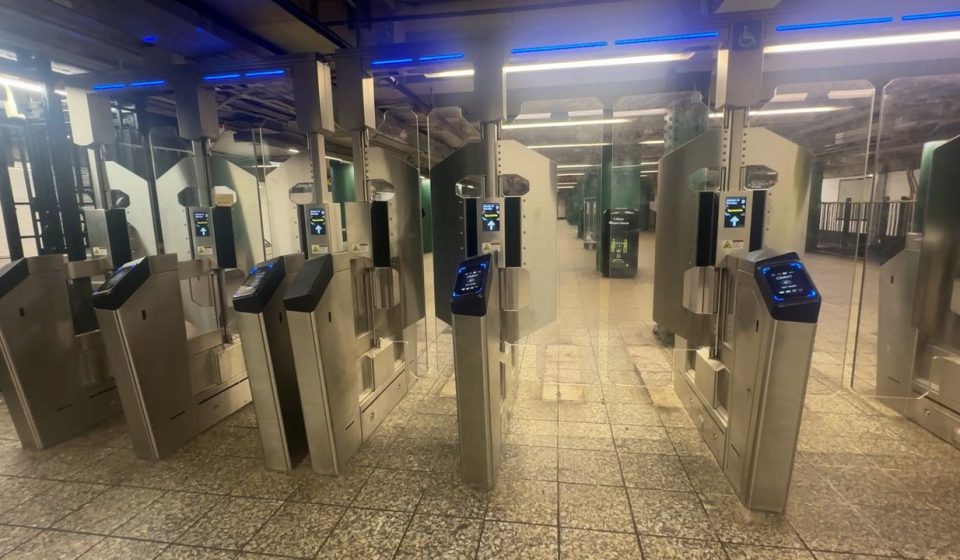

Modern fare barriers installed at 20 subway stations as part of a pilot program reduced fare evasion by an average of 35 percent in the first half, according to the MTA and Gov. Kathy Hochul’s office.
The doors were designed to improve access for passengers in wheelchairs or pushing strollers and luggage, while making it more difficult for people to enter without paying. Hochul’s office said more than 63 million people had passed through the gates.
The doors have lounge-style doors and use sensors and cameras to detect if someone has paid. They are also designed to close after a person passes without hurting them.
Three companies are part of the pilot program: Cubic, Conduent and S Traffic. According to the governor’s office, Cubic, the company behind OMNY, performed best at two stations with some of the highest rates of fare evasion.
At Hoyt Street on Lines 2 and 3 and at Nostrand Avenue on Lines A and C, Cubic’s doors have helped reduce fare evasion by more than 70 percent, Hochul’s office said. Conduent also saw significant declines, while S Traffic, a Korean company, saw more modest results.
The governor’s office said the MTA was preparing to install fare gates at 50 more stations. The three companies will compete for two contracts, and the MTA ultimately plans to install doors at 150 stations over the next few years.
Some subway riders said they supported the change.
“The tariff barriers, I think they’re pretty cool,” Lisa Brown said. “Because there’s no way to get away with these bad boys. So, yeah, they did good.”
Janet Oak, a subway rider, said the gates are aimed at people who avoid paying even when they can afford the fare.
“Some people really can’t pay. You know, and I can kind of understand,” Oak said. “But even people who can afford to pay would just slide in. So I think it’s great.”
Trooper Keith Nicholas said the gates don’t eliminate all opportunities for someone to avoid paying.
“If someone taps, they would like… it to be open for a few seconds. Someone else could come through, or if someone leaves, it could be open, someone could come through,” Nicholas said. “But it’s still better than having spikes above the turnstiles.”
He was referring to the toothed fins that the MTA installed on turnstiles to prevent people from jumping over them. The MTA has also pointed to emergency exit doors as a major source of fare evasion. MTA President and CEO Janno Lieber called them the “highway of fare evasion,” and the MTA said exit gates were responsible for more than 50 percent of fare evasion.
The new fare barriers eliminate the need for these exit gates, according to the MTA.
Subway fraud was about 10% in July, compared with nearly half of bus riders who didn’t pay, the MTA said.
The MTA’s current capital plan, approved in 2025, provides $1.1 billion to fund fare barriers.
The MTA says the next 20 stations expected to receive new fare barriers will be:
Brooklyn
- 36th street
- Bedford Avenue
- Coney Island-Stillwell Avenue
- Hoyt-Schermerhorn
- Avenue of the Myrtles
- Newkirk Square
Bronx
- Third Avenue-149th Street
- 161st Street Stadium-Yankee
- Fordham Street
- Parkchester
Manhattan
- 14th Street-Union Square
- 72nd street
- 86th street
- 125th Street
- Rue des Chambres
- Spring Street
Queens
- Astoria Boulevard
- Flushing-Rue Principale
- Forest Hills-71st Avenue
- Sutphin Boulevard/Archer Avenue-JFK Airport
Editor’s note: This story has been updated to reflect corrected numbers from the governor’s office.
Gn bussni