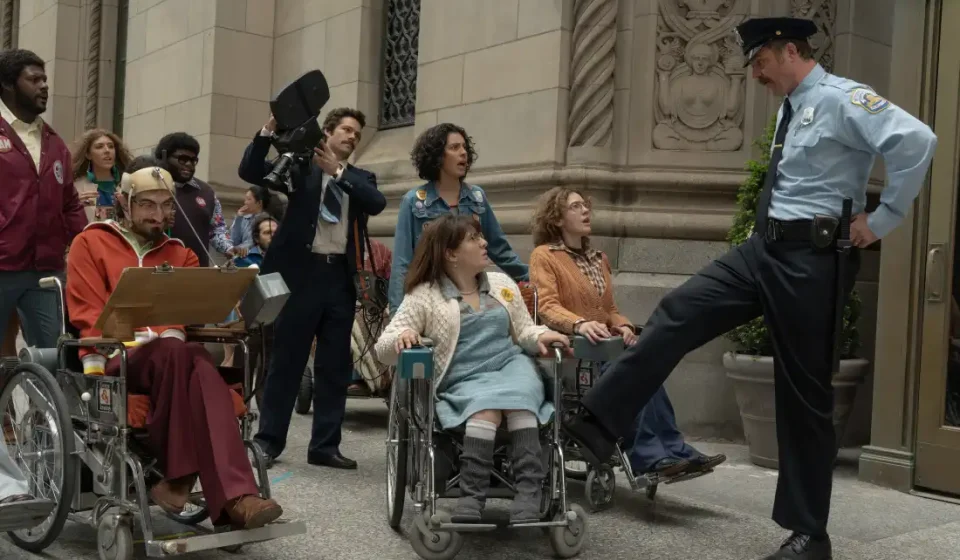

Andrew Pilkington, Siena Rafter, Charlie Rush-Reese, Dylan O’Brien, Roberta Colindrez, Ruth Madeley and Madeline Delp in Being Heumannpremiering November 13, 2026 on Apple TV.
Apple TV
hide caption
Apple TV
Judy Heumann is known as the mother of the disability rights movement – but she is less well known than most other civil rights activists of her era. Now a new film seeks to change that.
Being Heumannthe latest film from Oscar-winning director Sian Heder, tells the story of the young woman from Brooklyn who led the movement to win the nation’s first civil rights protections for people with disabilities.
Before the passage of the Americans with Disabilities Act (ADA) in 1990, there existed Section 504 of the Rehabilitation Act of 1973. It was a single sentence, written into law, promising people with disabilities the right to fair employment and access to public life without discrimination.
But for years, there were no rules or regulations requiring the federal government to enforce these protections.
Until the spring of 1977, when a group of disabled activists decided to act. Led by Heumann and Kitty Cone, activists took over the former Department of Health, Education, and Welfare building in San Francisco for nearly a month – widely considered the longest sit-in at a federal building in U.S. history.
People of all disability groups – from wheelchair users to people with intellectual and health-related disabilities – camped out, demanding and ultimately winning passage of the rules that made Section 504 enforceable. The protests paved the way for federally funded institutions, such as schools, libraries, municipal buildings and other entities, to be made accessible to people with disabilities.

View of disability rights activists, including Judy Heumann (center left, with sign) and Kitty Cone (center right), during a demonstration in front of the White House, Washington, DC, April 26, 1977.
HolLynn D’Lil/Getty Images
hide caption
HolLynn D’Lil/Getty Images
“Judy always said, ‘Disability only becomes a tragedy to me when society fails to provide the things we need to live our lives’ — job opportunities or barrier-free buildings, for example,” says former NPR correspondent Joe Shapiro, who covered disability and was a friend of Heumann until his death in 2023.
Viewing disability rights as fundamental civil rights was a new concept at the time, but it remains central to the movement today.
Shapiro says Heumann was fueled by the idea of a generation of young people with disabilities coming of age under the ADA: “They see the ADA as a floor, not a ceiling, and Judy loved that this new generation demanded more.”
With the film released in theaters this month and now streaming on Apple TV, NPR sat down with some members of the ADA generation to talk about Heumann’s legacy and the threats they see today to the movement she helped start.
“It’s our job to carry on her legacy and keep that fire burning for all these decades,” says Kaleigh Brendle, who started a disability rights organization called Judy’s League to push back the Trump administration’s efforts to roll back Section 504 protections.
Last month, a federal judge dealt a blow to disability rights activists by agreeing to remove references to “integration” of disabled people from the Section 504 regulations. That erased some of the language that Heumann and his movement helped win 50 years ago.
While she watched Being Heumann, Brendle says she “simultaneously felt sad that we were here again because I know it would hurt for her to see so much risk to what she fought for. But it also strengthened my resolve.”
Brendle, who is blind and has other disabilities, organized a watch party for the Being Heumann along with four other members of Judy’s League. They spoke to NPR about their impressions.
These are excerpts from that conversation, edited for length and clarity.
On what stood out the most Being Heumann:
Liam Holland, 25, Philadelphia: The very first line of the film is Judy singing “(Sign 504)!” This immediately gave me chills, because almost 50 years later, 504 is exactly why we started Judy’s League. Seeing her lead the chant struck us because we are still fighting the exact same battles today.
Cricket Bidleman, 27, Baltimore: As Liam said, seeing the story come full circle wasn’t particularly encouraging. But we did it once, so we can do it again. We can save 504 of them.
Kaleigh Brendle, 23, Berkeley, California: What I loved seeing over and over again was just the unwavering determination that Judy showed, that fire that wouldn’t go out…And I think right now, we’re seeing relentless challenges to our rights from this administration, from all sides. … It really gave me hope and renewed what I think we need to do now.
Ellana Crew, 30, Baltimore: I feel like I’ve never seen so many real disabled people on screen in one place… They’re laughing, they’re swearing, they’re telling dirty jokes… It was one of my favorite things, honestly, it was just like, “OK, wow, I didn’t expect that to be in this movie.” They don’t shy away from people with disabilities as sexual and romantic beings, something society rarely lets us talk about. And… it’s remarkable how many of the film’s sentiments, based on that 1970s era, still seem so relevant today.
What parts of the disability rights movement at the time still seemed relevant:
Ellana’s crew: Many of the attitudes expressed by non-disabled people (in the film) seemed quite indistinguishable from the attitudes I hear today. Like some of the same feelings, some of the same pity views, charity-based mindsets like, “Oh, well, we feel bad for you, but there’s nothing we can do about it, it’s just too hard.” “I think people would be surprised how often this still happens today, or maybe not.
Cricket Bidleman: It’s amazing how, in some ways, we’ve made so much progress. I mean, we now have computers and technologies that work for us, and autonomous vehicles and things like that. But discrimination hasn’t really changed much.
Kaleigh Brendle: What really moved me was hearing Judy lead the chant “Sign 504” because I, along with several other people from Judy’s league…we were in Austin, Texas on the steps of the Capitol in July. And all these years later, we had to chant “Hands off 504.”
On how the legacy of Judy Heumann and other activists shaped today’s disability rights movement:
Liam Holland: Every week I drive a mile alone (in my wheelchair) to buy chicken for my mash dinner. This trip has many curb cuts. Before the 504, sidewalks did not have ramps, which prevented disabled people from accessing the sidewalks. The sit-in (1977) forced the government to impose public access. So every sidewalk I cross is directly linked to this fight. … People at the grocery store see me coming alone every week. They punch me, take my card out of my wallet, put it back… And then I ride on the sidewalks listening to music. So what Judy means to me, quite simply, is independence and normalcy.
Leigh White, 30, Galloway, New Jersey: Unfortunately, the story rhymes. And we’re not back where we started, but we’re in the crucible, if you will, where we’re being shot at from all sides. And it’s important to remember his courage, his tenacity, and his true dedication… People with disabilities are the largest minority group in the United States. And it cuts across all genders and races and everything. So by fighting for disability rights, it kind of lifts all boats.Kaleigh Brendle: I always tell other people who don’t understand the disability experience: if you broke your arm tomorrow, you would expect the world to accommodate you. You expect to receive the accommodations you need while you deal with this temporary disability. Why are we wrong to expect what you would expect in this situation?
Cricket Bidleman: We’ve made so much progress because of people like Judy and… all those activists and advocates who came before us. And even though I have to fight with people to get access to media or textbooks or standardized tests to access various trainings, it’s still nothing compared to some of the things we saw in the movie.
Leigh White: As part of the “ADA generation”, we can reap the benefits. And looking back, we are truly able to appreciate the work she did and then carry the torch into the future. So that the struggles we are going through now, we hope that the next generation of young people with disabilities will not have to experience the same…
Gn entert