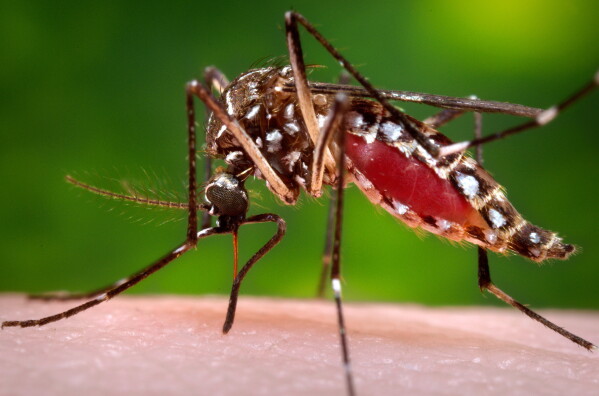
WASHINGTON (AP) — Children who lived in Brazilian neighborhoods bustling with special type of mosquito They were much less likely to catch dengue or another worrying virus, chikungunya, researchers reported Saturday.
The major study of more than 5,700 children in one of the world’s countries dengue hotspots offers new evidence that breeding mosquitoes that are incapable of transmitting these viruses may be a viable strategy rather than relying solely on pesticides and trying to avoid getting bitten.
In neighborhoods populated with these so-called Wolbachia-carrying mosquitoes, researchers found about a 69% reduction in dengue and chikungunya infections among schoolchildren compared to similar neighborhoods — an effect that held up even during Brazil’s severe dengue outbreak in 2024, said Dr. Sri Edupuganti of Emory University, who is part of the international research team.
The researchers reported their findings at a meeting of the American Society of Tropical Medicine and Hygiene.
“It’s really exciting,” said Dr. David Hamer, a global health expert at Boston University who was not involved in the Brazilian study. He predicts that combining increased use of these Wolbachia mosquitoes with existing measures to combat mosquito-borne diseases could “decline dengue to much lower levels” in many places.
The latest research comes as Florida grapples with an unusually large outbreak of the virus, which appears to be the case. largest of any U.S. state since at least the 1940s.
Usually, in the continental United States, dengue primarily affects people traveling abroad. But as of Friday, Florida health officials had counted more than 650 locally acquired cases, about three-quarters of them in Hillsborough County, where Tampa is located.
Outside the United States, the nonprofit World Mosquito Program was the first to adopt the Wolbachia strategy.

How it works: Scientists breed mosquitoes to carry a type of bacteria called Wolbachia. It is harmless to humans and common in many insects, but not in dengue-carrying Aedes aegypti mosquitoes. Bacteria significantly reduce the ability of mosquitoes to transmit certain viruses. Female mosquitoes spread the bacteria to their offspring, allowing Wolbachia to gradually establish itself in the local mosquito population by releasing enough specially bred insects – male and female – into an area.
Field trials and other studies in Indonesia and elsewhere have shown that this strategy can significantly reduce dengue diagnoses. But because people with mild symptoms may go undiagnosed, the new study from Belo Horizonte, Brazil, went further. Researchers analyzed the blood for signs of dengue, chikungunya or the Zika virus.
The four-year study compared children living in neighborhoods that all received the same pesticides and other mosquito control interventions, but half were randomly assigned to have Wolbachia mosquitoes released in the area. There were too few cases of Zika to determine whether the special mosquitoes had any effect on the disease.
___
AP Medical Writer Mike Stobbe contributed to this report.
___
Associated Press health and science coverage receives financial support from AP Fund for Journalism and private foundations. AP is solely responsible for all content. Find AP standards to work with philanthropies, a list of supporters and funded coverage areas on AP.org.
Gn Health