Nicaragua: Daniel Ortega cancels the next elections, Washington denounces an authoritarian drift


The United States warned on Tuesday July 21 that it would not remain “arms crossed” against Nicaragua, after President Daniel Ortega refused to organize elections next year, denouncing his “true authoritarian nature”.
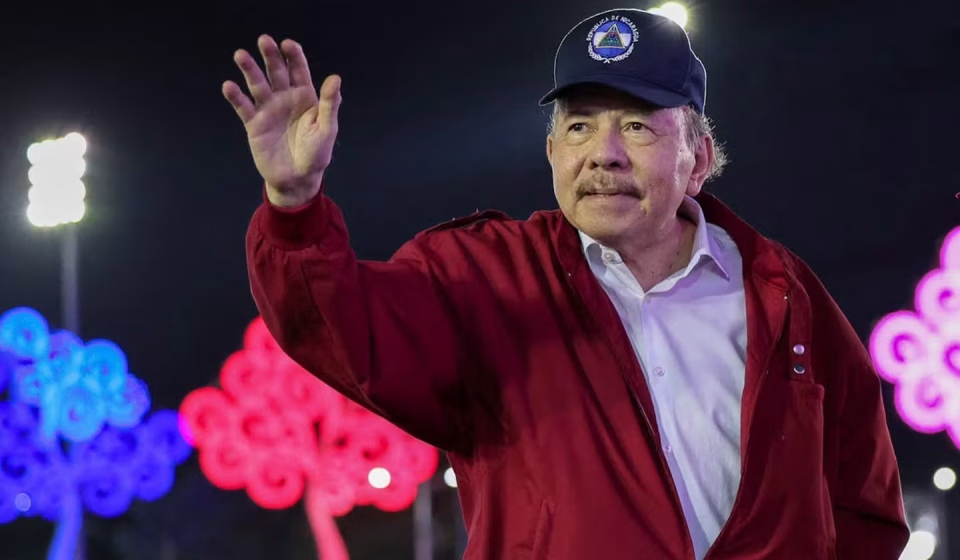
Former Marxist guerrilla and leader of a revolution against an autocrat supported by the United States, Daniel Ortega, now 80 years old, has been in power since the 2007 elections, contested by the international community.
With his wife, Rosario Murillo, elevated to the rank of co-president, they rule Nicaragua with an iron fist, particularly since the repression of the 2018 protests which caused the death of more than 300 people, according to the United Nations (UN), and which they consider to be a coup attempt coordinated by Washington.
Nicaragua was due to hold general elections in 2027, but Daniel Ortega refused to hold any new elections to prevent the exiled opposition from coming to power. “Let them forget!” Here in Nicaragua there will be no more elections that allow them to try to seize power.”he declared in front of thousands of supporters. “The history of the parties installed by the Yankees (the Americans) returning to government is over, forever”he said. The Nicaraguan Parliament affirmed on Tuesday that it had started “analysis” necessary reforms to comply with “presidential orientations”.
“Demonstrates cowardice”
Donald Trump and the international community “will not sit idly by while the dictatorship (…) increases repression and creates instability that threatens national security” of the United States, warned the American Secretary of State, Marco Rubio, on
“Abolish” the elections “demonstrates cowardice and fear (by Daniel Ortega) of the will of the Nicaraguan people”he added, calling on members of the international community to “joining forces to show the Murillo-Ortega dictatorship that it cannot be expected to maintain business-as-usual relations with other nations”.
Washington imposes sanctions on the Nicaraguan government, such as visa restrictions targeting more than 2,350 officials and their families, but does not exert similar pressure, particularly economic, to that currently suffered by Cuba. The Secretary General of the Organization of American States (OAS), Albert Ramdin, expressed his regret for “regime that abandoned democracy”. The Costa Rican government recalled its ambassador to Managua for consultations.
An increasingly authoritarian regime
During the last elections, organized in November 2021 after the imprisonment of opponents likely to contest the presidency, Daniel Ortega won a large victory with his Sandinista National Liberation Front (FSLN) party, a former guerrilla which overthrew the dictator Anastasio Somoza in 1979.
Thanks to a constitutional reform in 2024, he extended the duration of the presidential term from five to six years. Nicaragua defines itself as a state “revolutionary” And “socialist”and the red and black flag of the FSLN was elevated to the status of a national symbol.
Opposition leaders interviewed by Agence France-Presse (AFP) believe that Mr. Ortega fears defeat at the polls and has decided to move towards single-party rule. For Juan Sebastian Chamorro, coordinator of a political movement in exile, Daniel Ortega finally admitted his intention to “turn Nicaragua into a one-party country like China, North Korea and Cuba”. According to him, his decision was motivated by “our pressures and those of the international community”.
“Ortega admits what worries him most: he failed to neutralize the opposition (…)he knows that the desire for change is still alive and that it continues to compete with him for the country”declared Félix Maradiaga, former presidential candidate and ex-political prisoner, stripped of his nationality and exiled in the United States. “Fear has increased”affirms for her part the former guerrilla commander and former political prisoner Dora Maria Tellez, emphasizing “failure in the attempt to board” local parties in a “electoral farce”.
Many opponents, intellectuals, journalists and religious leaders had to go into exile, many after being imprisoned. Some 450 were stripped of their nationality and had their property stolen. In July, UN experts condemned the “purge” ongoing after the Nicaraguan government’s decision to cancel the work permits of some 2,000 lawyers without explanation. Constitutional reforms have also deprived the judiciary of its status as an independent power, redefining it as a “organ” to be coordinated by the co-chairs.