A developing Super El Niño exerts its influence throughout the atmosphere, shaping weather patterns from the southwest to the Atlantic. FOX Weather meteorologists Ian Oliver and Haley Meier explain how the powerful weather pattern will continue to affect the United States this fall and winter.
TAKEAWAYS:
- NOAA has announced that the 2026 El Niño has reached Super El Niño status.
- Water temperatures in the Niño 3.4 region of the equatorial Pacific have climbed up to 2.0°C above average for three consecutive months.
- A Super El Niño will have a major impact on the winter of 2026-2027, bringing more storms to the southern United States and above-average temperatures to the north.
NOAA’s Climate Prediction Center (CPC) announced Thursday that the 2026 El Niño has officially reached Super El Niño status, also known as a very strong El Niño.
PENA BECOMES FIRST NOVEMBER TROPICAL STORM TO FORM IN CENTRAL PACIFIC SINCE 1982 AMID INTENSIFYING EL NIÑO
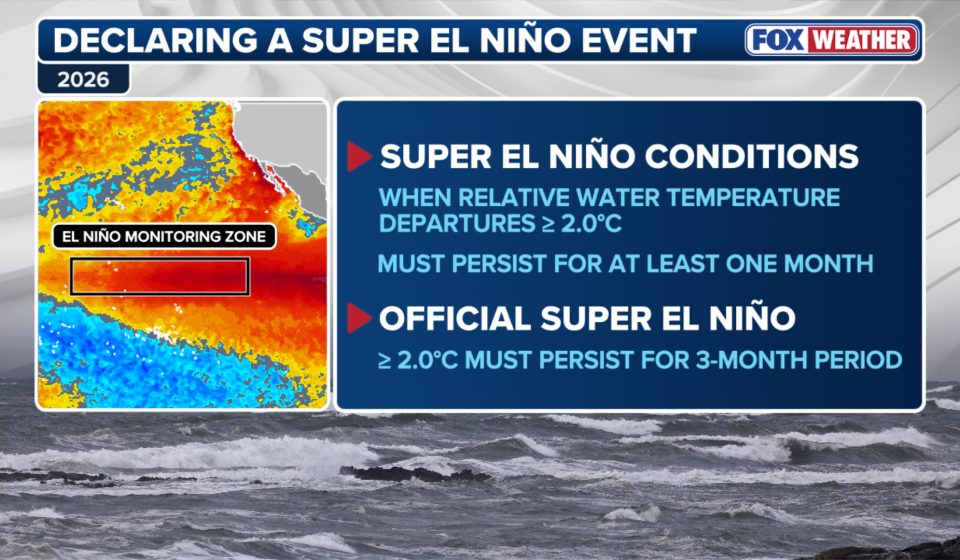
Water temperatures in the Niño 3.4 region of the equatorial Pacific, where forecasters are monitoring El Niño strength, climbed up to 2.0°C above average, reaching the threshold for designation.
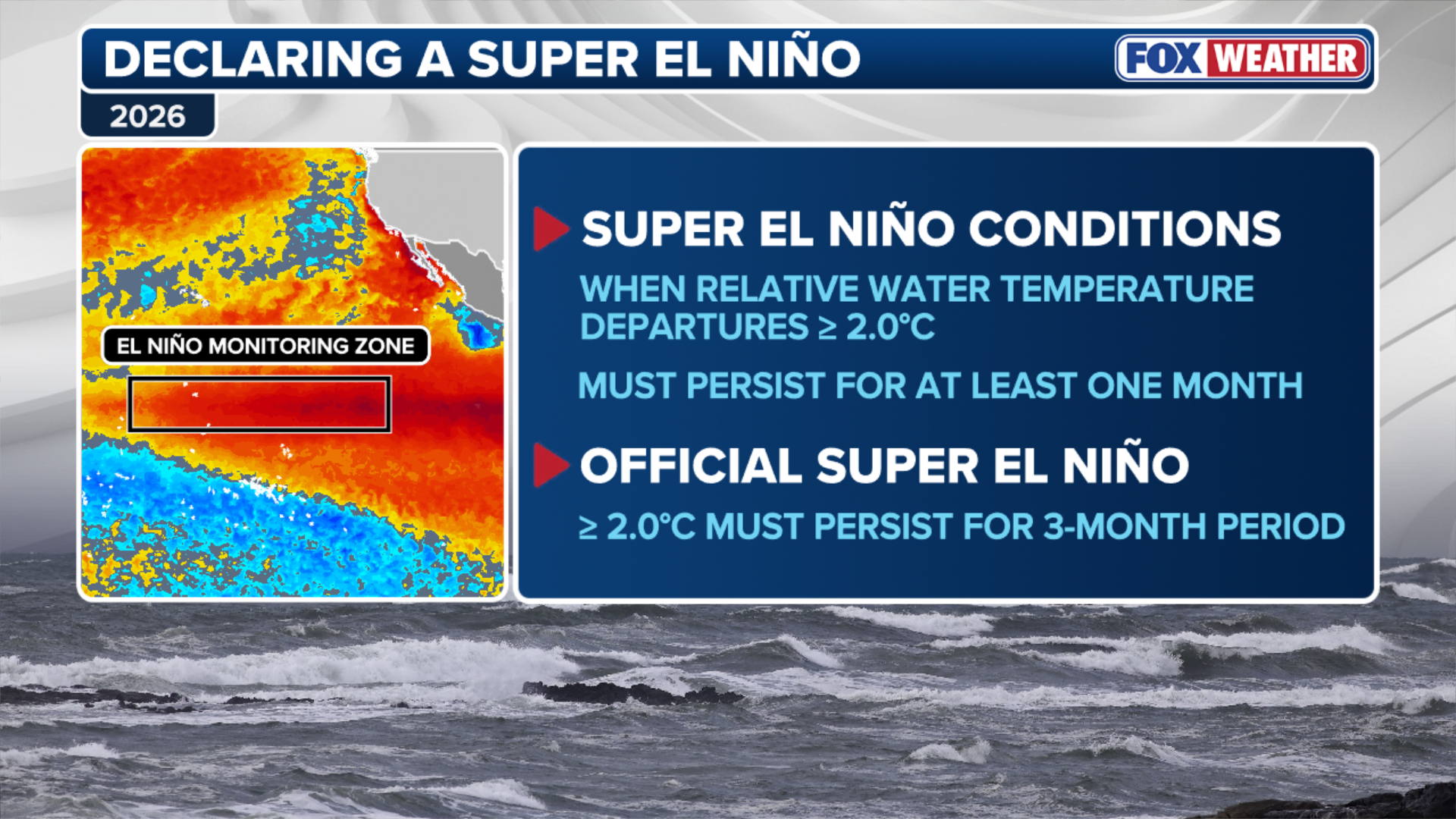
To determine the strength of the climate pattern, forecasters use a three-month average of ocean temperatures rather than daily readings. This approach allows for short-term fluctuations to be taken into account and provides a more coherent picture of changing ocean conditions.
(FOX Weather)
The latest assessment found that the three-month period from August to October reached the 2°C threshold. An earlier assessment covering the July-September period did not record temperatures high enough to qualify as a Super El Niño.
NASA SATELLITES REVEAL STRIKING OCEAN COLOR CHANGE AS SUPER EL NIÑO STRENGTHENS
El Niño has been raging since late spring and gradually strengthens throughout the summer and into the fall.
Forecasters have predicted for months that the weather pattern would reach Super status by late fall, with conditions possibly lasting until spring 2027. Until then, La Niña conditions are expected to take over.
(FOX Weather)
Even before officially reaching Super status, El Niño has already demonstrated its potential to influence weather patterns around the world, particularly during hurricane season in the Atlantic and Pacific basins.
SUPER EL NIÑO-POWERED WINTER COULD LIGHT MORE STORMS, LEADING TO A MORE ACTIVE PATTERN IN THE SOUTH
The last Super El Niño occurred between 2015 and 2016, making the current event particularly significant.
What impact will Super El Niño have on winter 2026-27?
One of the hallmarks of a Super El Niño is an extensive and very active Pacific jet stream. This acts like a storm conveyor belt, directing repeating systems and moisture across the southern part of the country.
Hollywood star Nicolas Cage’s home was damaged after a huge sinkhole swallowed the driveway. Authorities said severe coastal erosion caused the collapse, with the sinkhole measuring about 30 feet by 30 feet. Drone footage shows the extent of the damage with the entire driveway in the hole as the ocean crashes under the house and over the debris. Authorities confirmed the home was unoccupied at the time and no injuries were reported.
According to NOAA’s Winter Outlook for the 2026-2027 season, increased storm activity is expected from Southern California, across the southern United States and into Florida.
California, the Southwest, Texas, the Gulf Coast, the Southeast, and parts of the Mid-Atlantic could see more frequent storms and above-average precipitation.
Florida could be particularly vulnerable to periods of heavy rain and even severe weather.
Signs of this active trend were already evident last week, when several rounds of storms caused flooding in parts of the Sunshine State.
Check out the scene in Palm Bay, Florida, where roads are completely flooded, forcing residents to use canoes and boats to cross the area, with more rain expected through Wednesday.
Along the Pacific Coast, repeated atmospheric river events could lead to periods of heavy rain and mountain snow.
What will be the impact of temperatures?
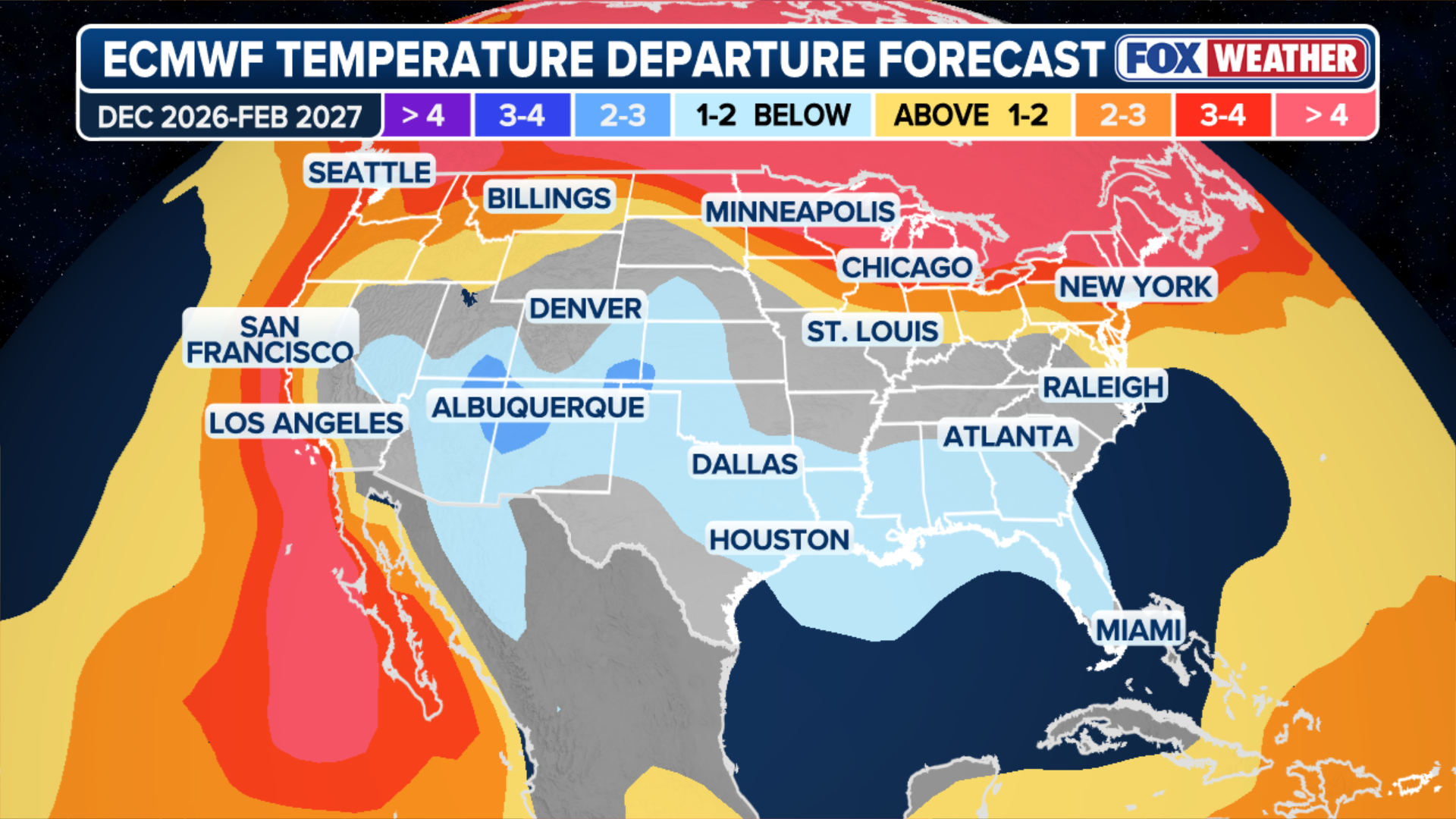
Super El Niño can also influence winter temperatures across the country, creating a notable divide between the northern and southern United States.
(FOX Weather)
This trend is largely due to the position of the jet stream, which typically moves farther south during El Niño winters. The resulting circulation can allow milder air from the Pacific to spread into northern states while directing stormier conditions south.
SUPER EL NIÑO YESTERDAY AND TODAY: HOW THIS YEAR’S STRENGTHENING EVENT COMPARES TO HISTORICAL EXTREMES
Persistent high pressure and Pacific-influenced air across the Pacific Northwest, Northern Plains, Upper Midwest, and Great Lakes could contribute to above-average winter temperatures. Much of Canada is also expected to experience a warmer than average winter.
Meanwhile, frequent precipitation, widespread cloud cover and active storm tracks across the southern United States could keep daytime temperatures below average in parts of the Southwest, Southern Plains and Gulf Coast.

Severe flooding in Melbourne, Florida.
(Hannah Scott)
What does Super El Niño mean about snowfall?
Snowfall potential can also vary significantly during a Super El Niño winter.
Since snowstorms depend on a combination of abundant moisture and sufficiently cold temperatures, changes in the jet stream can create contrasting results in some of the country’s major winter regions.
HOW TO WATCH FOX WEATHER
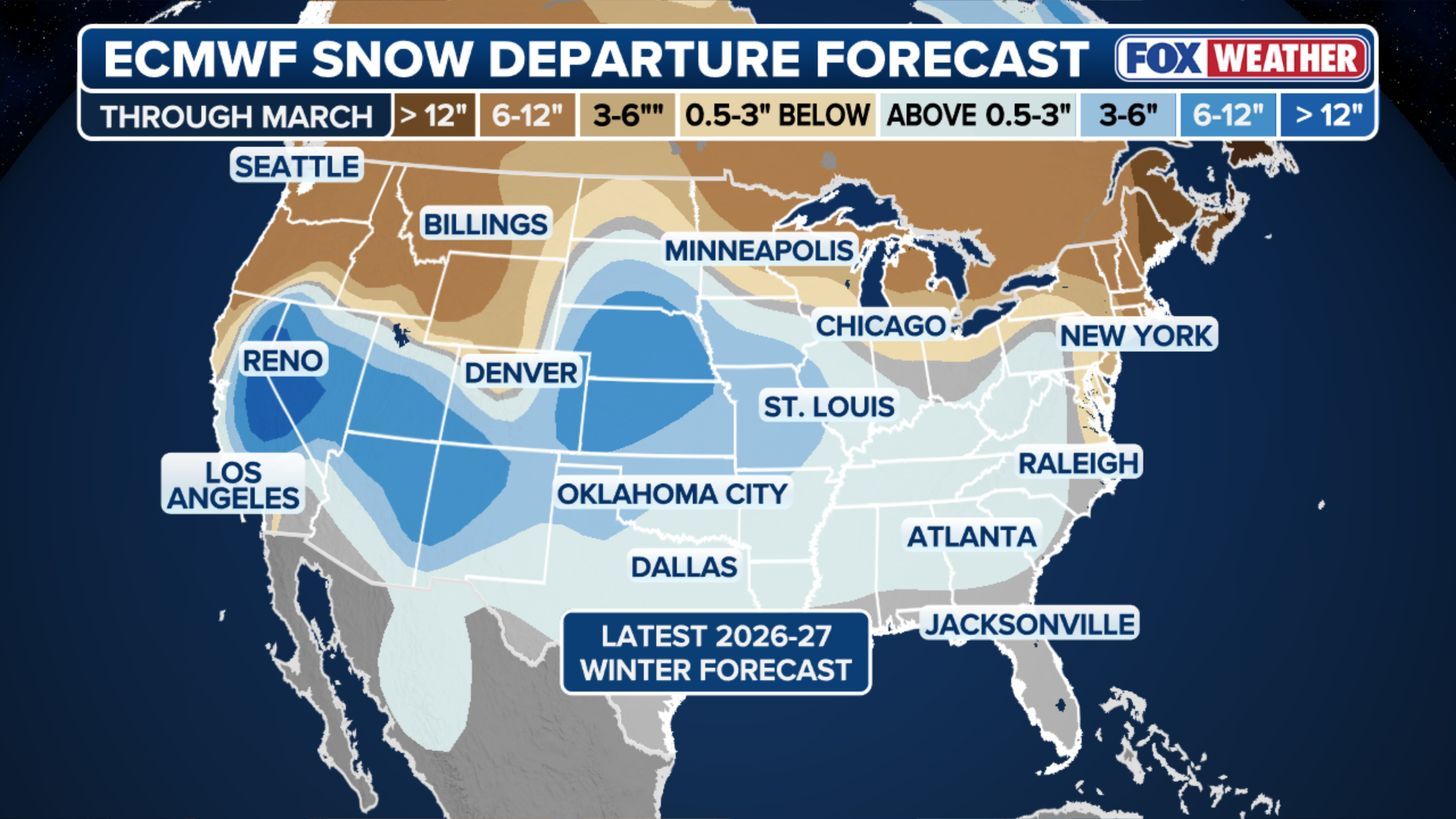
With the active Pacific jet stream directing moisture toward California and the Southwest, mountain elevations in the Sierra Nevada and southern Rockies could see significant snowfall.
(FOX Weather)
Farther east, a stressed southern storm track could increase the risk of heavy precipitation and northeast coastal winds from the Southern Plains to the mid-Atlantic.
If cold air masses push south enough and interact with this active moisture corridor, the pattern could support high-impact winter storms.
However, with the northern branch of the jet stream typically shifted further north during El Niño, traditionally cold and snowy regions could experience below-average seasonal snowfall. This includes parts of the Northern Rockies, Midwest, and Northeast.

North Attleboro, MA – February 12: A car maneuvers on a snowy I-95 South.
(Jonathan Wiggs/The Boston Globe/Getty Images)
That doesn’t mean winter storms are out of the question. Isolated surges of air in the Arctic can still bring extremely cold temperatures and significant snowfall, even in an overall warmer-than-average winter.
‘HISTORIC’ EL NIÑO INCREASINGLY LIKELY, WITH 83% CHANCE OF BECOME STRONGEST EVER RECORDED
What is the impact of a Super El Niño on the Nor’Easters?
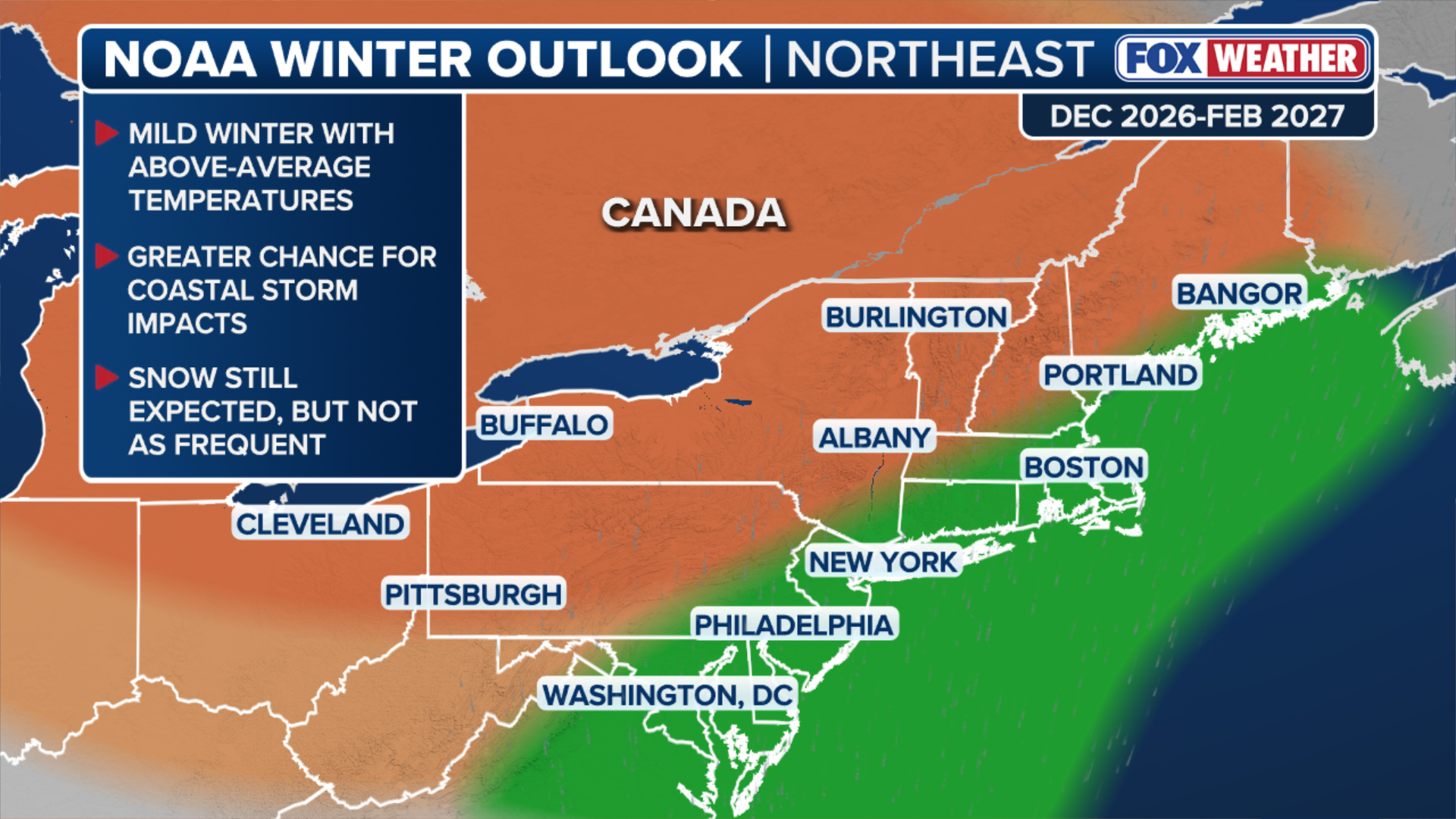
Northeast events may become more frequent during El Niño winters, as large-scale weather patterns often favor storm development in the southern United States before systems move toward the East Coast.
(FOX Weather)
Unusually warm waters of the tropical Pacific influence the jet stream, often strengthening the subtropical jet across the southern United States. This may create a more active storm track from the Gulf Coast and Southeast toward the Atlantic Coast.
Rather than heading north across Canada, more weather disturbances could move east through the southern states before turning northeast along the coast, creating favorable conditions for the Northeast to develop.
These storms strengthen by drawing their energy from the marked contrasts between warm and cold air.

Nantucket, MA – February 13: At the height of the snowstorm, the Brant Point Lighthouse is flown over by a seagull.
(Stan Grossfeld/The Boston Globe/Getty Images)
During El Niño winters, northward-moving storms can bring warm, moisture-rich air from the south into contact with colder air from the northeast.
This temperature contrast can contribute to rapid intensification of storms, potentially producing powerful winds, heavy precipitation, coastal flooding and, when temperatures are cold enough, significant snowfall.
However, even though northeasterly winds will be more prevalent during El Niño, this does not guarantee that this will result in more impacts in the form of rain, snow, and wind.
Gn headline