
Updated November 21, 2026, 9:04 a.m. ET
Federal forecasters released an updated winter weather outlook for the country on Nov. 19, and the role of climate troublemakers El Niño and the polar vortex is now in greater focus.
And ready or not, the “very strong” El Niño is here and will continue to impact our weather in December and throughout the winter, according to new forecasts from meteorologists at the National Weather Service and NOAA’s Climate Prediction Center (CPC).
“The strong El Niño will likely have a major influence on temperatures and precipitation this winter through next spring,” National Weather Service meteorologist Brad Pugh noted in an online forecast.
December forecast

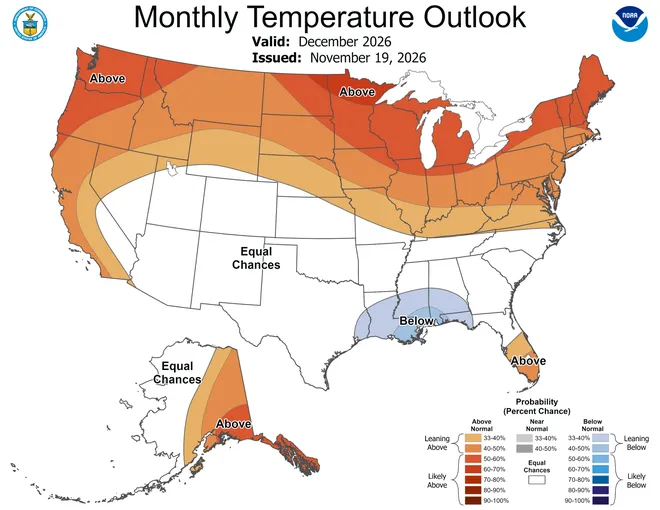
The temperature forecast map for December (above) shows that warmer than average temperatures are likely across the northern part of the country. Only a small portion of the Gulf Coast is expected to experience below average temperatures in December.
The rest of the country has an “equal chance” of experiencing above, below or near normal temperatures next month, according to the forecast.

The National Precipitation Map for December (above) shows that above-average rain and/or snow is likely over the West and East Coasts, as well as throughout the southern portion of the United States.
Precipitation is expected to be more above average over the Southeast and Florida. Below-average precipitation in December is expected to be limited to parts of the far northern Rockies and northern Plains.
Winter forecast

The temperature forecast for the entire winter (December to February) (above) does not look much different from the December forecast, according to the CPC forecast. Above average temperatures are expected in the northern part of the country, from the northwest to the northeast. Areas where temperatures will be the most above average include Washington state, the Great Lakes and New England.
The Southeast and Florida are expected to experience “near normal” temperatures throughout the winter. The rest of the country has an “equal chance” of experiencing temperatures above, below or near normal.
No region of the country is expected to experience below-average temperatures this winter.

And as for precipitation (above), areas that have been hit in recent weeks will likely continue to receive heavy rain or snow throughout the winter. Overall, as with the December forecast, the entire southern portion is expected to experience a wet winter. Areas that could be particularly hard hit include Southern California, all of Florida and along the Southeast coast, according to CPC forecasts.
Unusually dry areas include the northern Rockies and western Great Lakes, the PCC predicts.
El Niño will rule the roost

According to forecasters, El Niño is expected to be the determining factor in our weather in December and throughout this winter. “Very strong El Niño conditions are present and (will) significantly impact the December 2026 monthly forecast for temperatures and precipitation in North America,” weather service forecaster Dan Collins said in an online forecast.
Beyond that, “a strong El Niño continues and is expected to persist through January-February-March 2027,” Pugh said.
El Niño is a natural climate phenomenon in which the surface waters of the central and eastern Pacific Ocean become unusually warm, causing extreme weather events around the world, including droughts in some areas and heavy rains in others.
What will the polar vortex do next?
Above the North Pole, “sudden and unusual stratospheric warming (SSW) was observed in November, as the polar vortex moved,” Collins said.
Sudden stratospheric warming, as the name suggests, is a rapid warming over the Arctic that can disrupt the polar vortex and, sometimes, lead to intense cold events further south, over the United States, weeks later.
Indeed, an SSW generally means below-normal temperatures for the eastern United States in the weeks following this type of event, the PCC said. However, current models predict only a slight cooling of the southeastern United States in early December, “perhaps due to currently relatively warmer-than-average Arctic temperatures,” Collins said.
Additionally, Laura Ciasto, a meteorologist with the weather service, told USA TODAY that the latest forecasts consistently show a shift toward a negative Arctic Oscillation (AO) toward late November/early December.
The Arctic Oscillation is a weather pattern that often brings cold and snow to the eastern United States.
“Although several factors can impact AO, forecasts have consistently shown that the recent polar vortex disruption (i.e. sudden stratospheric warming) plays at least some role in negative AO,” Ciasto told USA TODAY via email.
Snow forecast? The federal government does not include this
In long-term monthly or seasonal forecasts, federal forecasters do not predict snow, only precipitation.
Why is this? “The outlook does not predict seasonal snowfall accumulations, as snow forecasts are generally not predictable more than a week in advance,” the PCC said.
Indeed, whether precipitation falls as rain or snow depends primarily on the track and temperature of individual storms, which are details that cannot be predicted months in advance.
Are there any areas of the United States of particular concern for weather this winter?
“We have already seen flooding impact the Florida Peninsula this month and there is an increased risk of additional flooding this winter with the strong to very strong El Niño,” Pugh told USA TODAY.
Contributor: Reuters
Doyle Rice is a national correspondent for USA TODAY, specializing in weather and climate.
Gn headline