North America. Saint-Pierre and Miquelon: faced with Trump’s desire, France and Canada appear as allies


France and Canada united against the American imperialism of Donald Trump? Friday September 4, the United Nations (UN) adopted a text calling for the promotion of a global cartographic representation more faithful to the real size of the continents. The American President, Donald Trump, whose country was the only one to have voted against it in the UN vote, has appropriated this new instruction in his own way. A few days later, on September 7, he published an image, undoubtedly produced using artificial intelligence, of North America entirely covered in Stars and Stripesthe flag of the United States. In yet another provocation, the occupant of the White House includes Mexico, Greenland, Iceland, Canada, the West Indies (Guadeloupe, Martinique, Saint-Martin, Saint-Barthélemy) and the French overseas community, Saint-Pierre and Miquelon.
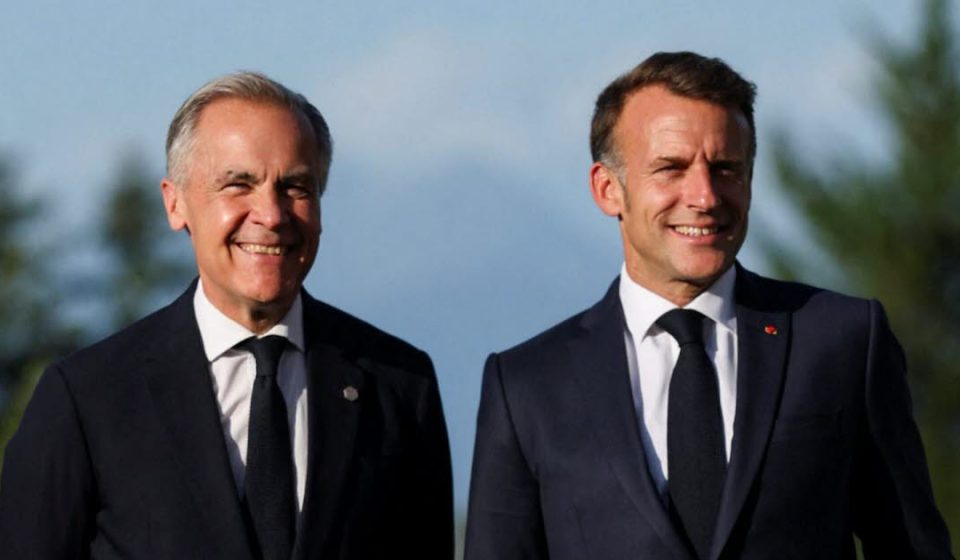
In response to this new affront, it is on this last territory that France and Canada have decided to show their fangs. An archipelago of three islands linked by sandy isthmuses, Saint-Pierre and Miquelon is in fact located about twenty kilometers from the coast of Newfoundland, at the eastern end of the maple leaf country. French President Emmanuel Macron decided to stop there conveniently, from September 19 to 21, on his way to New York, where he must attend the UN General Assembly, and chose to invite Canadian Prime Minister Mark Carney, whose relations with Donald Trump are as cold as winter. “This will be the first official visit of a Canadian Prime Minister to the archipelago, a symbol of the strength of the relationship which unites our two countries,” indicated the French presidency, confirming information from La Tribune Sunday.
The location of the archipelago at the heart of the trip
“France and Canada share the same values of freedom, democracy, the rule of law and respect for the sovereignty of nations,” underlined the Élysée. “In a world marked by the return of the balance of power, geopolitical tensions and new dependencies, France and Canada share the same ambition: to work together, and with all the countries which share these values, to strengthen their capacity to decide and act for themselves,” he added. Emmanuel Macron and Mark Carney will work “to strengthen ties between the archipelago and Canada, to facilitate trade and to support its development, particularly in the economic and human fields”.
In addition to this demonstration of solidarity between the two allies, this trip should also make it possible to discuss with elected officials and local economic players the situation of the archipelago, on the front line in the face of global warming, and its “development prospects”. Faced with the disappearance of coastal ice, the village of Miquelon had to make an unprecedented move. Its 600 inhabitants are considered the first climate refugees in France. The president will also talk about “the rise of strategic sectors such as space, fishing, digital technology or the blue economy (activities linked to the sea, Editor’s note)”, continues the Élysée. The last visit by a French president to these strategic islands, located 4,300 kilometers from the mainland, dates back to François Hollande in 2014.
However, this is not the first time that Saint-Pierre and Miquelon has been the scene of tensions between Paris and Washington. In December 1941, the Free French Forces of General de Gaulle took control, despite the opposition of American President Franklin D. Roosevelt, who wanted to maintain the status quo with the government of Marshal Pétain in Vichy.