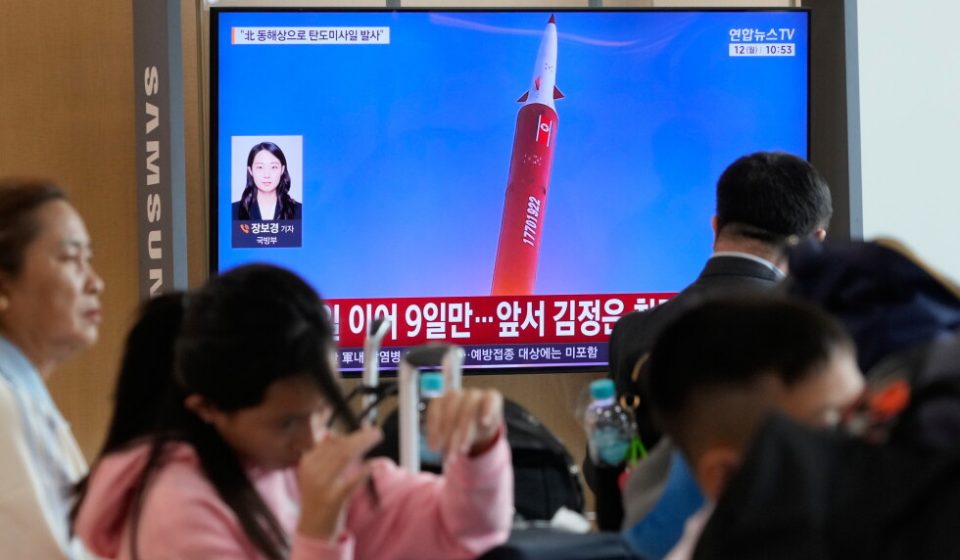

SEOUL, South Korea (AP) — North Korea fired several ballistic missiles toward its eastern waters Monday, the South Korean military said, adding to a recent series of weapons demonstrations that have heightened tensions during a prolonged freeze in diplomacy.
Jang Do-young, a spokesman for South Korea’s Joint Chiefs of Staff, said missiles of various types were fired from an area around the North Korean capital, Pyongyang, where the country’s main airport has been a major launch site in recent years.
Jang said one of the missiles traveled more than 900 kilometers (559 miles) before falling into the sea, but did not comment on the details of the flight of the other weapons. The joint leaders did not say how many missiles were detected.
Japanese Deputy Defense Minister Takashi Koyari said Japan detected at least two missiles launched 17 minutes apart and that the weapons landed in waters outside its exclusive economic zone. Koyari said the first missile flew about 220 kilometers (137 miles) and the second more than 910 kilometers (565 miles), following an “irregular” flight path that he said suggested it could be a hypersonic weapon. No damage was reported to aircraft or ships.
While maintaining a hard line toward Seoul, North Korea has stepped up its weapons testing as it seeks to expand its arsenal of nuclear-capable systems, including an Oct. 3 test of what the North described as a intermediate-range hypersonic missile designed to evade missile defenses in South Korea and Japan.
North Korea also conducted more missile tests and live-fire exercises and ordered a new warship as leader Kim Jong Un continues to flaunt his nuclear weapons program while rejecting U.S. and South Korean offers to resume long-stalled diplomacy.
The latest launch took place days after South Korea’s flight tests on Friday. its own nationally developed hypersonic weapon, designed to fly at least five times the speed of sound and evade missile defense systems, which President Lee Jae Myung has described as key to strengthening the South’s conventional defense capabilities. Without directly addressing the growing threat from North Korea, Lee’s office said the hypersonic weapon, once fully developed, would enhance South Korea’s ability to strike key targets in the “Korean Peninsula theater of operations” by surprise.
Jang, the South Korean military official, said the latest North Korean launches were likely intended to advance the country’s missile technologies while also serving as a possible response to South Korea’s hypersonic test.
The South’s presidential national security office called on North Korea to “immediately cease” its repeated missile launches, which violate UN Security Council resolutions against the North and “do not help manage the current situation on the Korean Peninsula.” Koyari said Japan had lodged a protest with North Korea through its embassy in Beijing.
Tensions further escalate after three South Korean soldiers injured landmine explosions last month near the heavily armed inter-Korean border. The South Korean military and the U.S.-led United Nations command concluded that the blasts were caused by devices planted by North Korea, which has denied responsibility and ridiculed the South’s demands for an apology.
In recent years, Kim has ended all diplomacy and cooperation with South Korea and portrayed his neighbor as a permanent enemy amid a prolonged standoff in broader nuclear negotiations with Washington. He has so far rejected calls from US President Donald Trump to revive their diplomacy, which failed in 2019, with his government demanding that Washington abandon its “hostile” policy towards Pyongyang and drop demands for North Korea’s denuclearization as a precondition for negotiations.
___
AP writer Mari Yamaguchi contributed from Tokyo.
Gn world