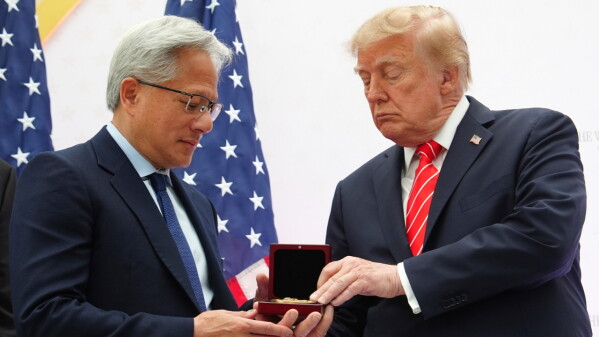
NEW YORK (AP) — Jensen Huang has been in the spotlight for weeks, but after the 11 day trouble period which included the resignation and reinstatement of the Nvidia executive, the company’s board of directors joins him at the center of scrutiny.
The board of directors, made up of 10 people, voted unanimously rehire Huang as Nvidia’s president, CEO and board member, writing in a statement Monday that the decision was made after discussions with Huang and “input from senior levels of the U.S. government.” President Donald Trump said he believed his intervention was crucial to reintegration.
Just six days earlier, the board had struck a different tone. Board members unanimously accepted Huang’s resignation after he admitted that he had an affair with a woman suspected of being a Chinese spy. The advice did not intend to reintegrate him, Nvidia President Harvey Jones said at the start of the quarterly earnings conference call.
“Giving in to pressure to bring back someone who has damaged the reputation of the company is foolish,” said Kathleen Day, a lecturer at the Johns Hopkins Carey Business School.
The board’s stunning reversal has sparked questions about its independence and what Trump’s role means in business and politics.

Nvidia CEO Jensen Huang leaves after a welcoming ceremony with President Donald Trump and Chinese President Xi Jinping at the Great Hall of the People, Thursday, May 14, 2026, in Beijing. (AP Photo/Mark Schiefelbein, file)
License for this photo
Concerns revolve around corporate governance and Trump intervention
Nvidia’s board includes both corporate executives with long-standing ties to the company and a group of newcomers with experience at major companies such as Taco Bell, PepsiCo and Eli Lilly.
Some experts have called for the board to resign following the devastation.
Day, who has expertise in financial crises and corporate governance, emphasized that the board has a duty to represent shareholders, not the CEO.
“Shareholders should demand a new board,” she said.
Corporate governance experts say board members’ long tenures can compromise their independence. Under New York Stock Exchange and Nasdaq rules, companies must have a majority of independent directors.
“Traditionally it’s good practice” to limit the length of time people can serve on a board, said Nada Kakabadse, professor of politics, governance and ethics at the University of Reading’s Henley Business School. “They should last eight years maximum. Four years, plus four more years if they perform well. But beyond that, they really don’t become independent anymore, do they?”
It’s not unusual for U.S. tech bosses to fill their boards with allies or high-profile figures who may not be aware of what’s happening at the company, Kakabadse said.
Corporate America has a culture of “hero leaders” — entrepreneurs who founded companies and are seen as the only ones who can guide them through tough times, she said. But at some point, companies can get so big that “you need proper corporate structure, you need proper governance.”
Many people also wonder what “input” the company received from senior government officials and why it persuaded the board to make a complete turnaround.
“The board should have listened to the president’s request and stuck to its position that it was time to find a new CEO,” said Peter Cohan, associate professor of management practices at Babson College. “In my opinion, by giving in to Trump, the board is putting the company at risk. Because Huang has understood that he can do whatever he wants and he will get away with it.”

Jensen Huang, Chairman and CEO of Nvidia, awaits the groundbreaking ceremony for Coherent’s manufacturing facility expansion beginning June 16, 2026 in Sherman, Texas. (AP Photo/Jeffrey McWhorter, file)
License for this photo
The idea of an independent board of experts looking out for the long-term interests of the company and its shareholders “kind of disappears” if the sitting president “basically tells them what to do,” said Daniel Kinderman, a professor of political science and international relations at the University of Delaware.
“That really is the hallmark of crony capitalism, isn’t it? he said.
Kinderman said the episode could “open the door a little bit more for more aggressive actions by elected officials” in their dealings with businesses.
Lawmakers hold board accountable
The Nvidia saga has made waves in Washington, particularly in discussions around export controls. Huang’s case has raised questions about Nvidia’s compliance with these restrictions. The reinstatement has renewed fervor on Capitol Hill for more transparency from Huang and the board.
Elected officials from both parties quickly reacted to this reinstatement with criticism and skepticism.
Democratic Sen. Elizabeth Warren, the new chairwoman of the Senate Banking Committee, said the decision to bring Huang back was “reckless.” She wrote in a statement Monday that this doesn’t change the fact that Huang, Nvidia executives and the company’s board “still owe Congress answers.”
Sen. Kirsten Gillibrand, a New York Democrat, called on Huang and the board to testify publicly before Congress. “A boardroom vote does not resolve a national security risk,” she said in a statement Monday.
California Attorney General Rob Bonta, who is investigation into Nvidia about the Huang case, said in an interview with CNBC on Tuesday that the president’s intervention “does not bode well for the federal government’s enforcement of the law without fear and without favor.”
The California Department of Justice said Thursday it is asking Nvidia whether its advanced chips or confidential information may have been transferred to China and whether Nvidia misled investors and the public.
A logo of Nvidia is displayed at the Computex Taipei show, one of the world’s largest computer and technology exhibitions, in Taipei, Taiwan, Wednesday, June 3, 2026. (AP Photo/Chiang Ying-ying, File)
License for this photo
Some members joined Nvidia’s board in the 1990s
Two board members, Mark Stevens and Tench Coxe, joined the board in 1993 when Nvidia was founded. Both Stevens and Coxe were previously venture capitalists who made their first investments in Nvidia.
Two other longtime board members, Jones and Brooke Seawell, are respectively the former chief executive and chief financial officer of Synopsys, which makes chip design software and counts Nvidia as its largest customer. Jones joined Nvidia’s board in 1993, while Seawell joined four years later.
Stephen Neal, designated as the board’s “lead independent director,” joined the board in 2019. He is chairman emeritus of Cooley LLP, Nvidia’s longtime law firm, and has advised the company on “various governance matters,” according to his biography.
Other board members have less direct connection to Nvidia.
Melissa Lora, former president of Taco Bell International, spent 31 years at the fast-food company and joined Nvidia’s board of directors in 2023. Aarti Shah, formerly senior vice president and chief digital officer of pharmaceutical company Eli Lilly, joined in 2020.
John Dabiri, an engineering professor at the California Institute of Technology whose lab studies fluid mechanics, was added to the board in 2020. Dawn Hudson was the NFL’s chief marketing officer and former CEO of Pepsi-Cola’s North American division who has served on the board since 2013. Suzanne Nora Johnson was a Goldman Sachs vice chair who joined the board in July.
None of the board members provided comment in response to requests from The Associated Press.
___
Chan reported from London.
___
This story corrects that Shah joined Nvidia’s board in 2020, not 2021.
Gn bussni