Nvidia’s board and interim CEO did just enough Tuesday to keep Jensen Huang’s growing army of supporters at bay. At least for a few days.
“A clean quarter and guidance strengthens the board’s position but does not close the issue,” Dan Ives, a technology analyst at Yorkville Ives & Co., wrote in a note to investors after the AI chip giant’s earnings release.
I listened to Nvidia’s earnings conference call and thought that interim CEO Colette Kress and Chairman Harvey Jones performed well under extraordinary circumstances.
Jones came out in great shape. He said the board had no intention of reinstating Huang and made clear that questions regarding the ousted CEO were off-limits.
Nvidia shares fell after these comments.
Then Kress quickly delivered some good news. Nvidia raised its revenue growth forecast for fiscal 2028. It also pushed back against concerns that the company might have to cut prices to compete, and said profit margins would recover after falling in the current quarter.
The stock has rebounded. As of Tuesday evening, shares were up nearly 5% in after-hours trading.
So far, so good.
Jones also said Nvidia would consider internal and external candidates for its next CEO.
This brings me to the most intriguing moment of the call.
The curious case of Ian Buck
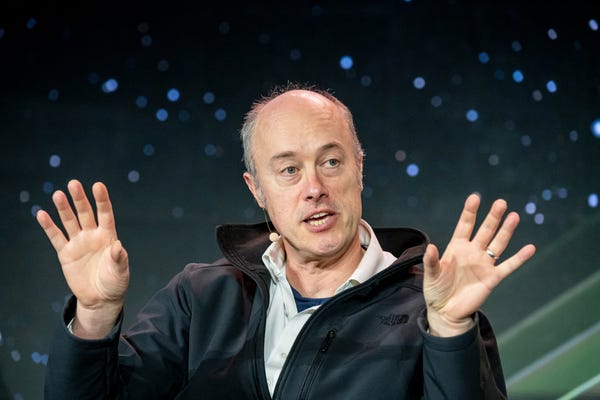
Ian Buck, vice president of hyperscale and high performance computing at Nvidia. David Paul Morris/Bloomberg via Getty Images
As the Q&A session began, Nvidia announced that Ian Buck, vice president and president of hyperscale and high-performance computing, would join Kress to answer analyst questions.
It was a big deal.
Buck is a serious technologist who helped invent CUDA, the software that makes Nvidia’s chips so useful for AI. He has also spent more than two decades with the company and maintains close relationships with its largest clients.
Business Insider has an excellent profile of Buck, who has emerged as a potential successor to Huang.
“His hat is in the ring,” Ives said when asked about Buck’s appearance on the call.
Nvidia now seemed to have a near-perfect setup. The board had ruled out Huang’s return, Kress had reassured Wall Street about the company, and a respected in-house tech executive was introduced to investors.
Awesome.
Except Buck said absolutely nothing.
Not a word.
I was still waiting for an analyst to ask him a question. Nobody did it. And Buck never offered anything.
It was so weird.
If you are proposed as a possible CEO of one of the most valuable companies in the world and given the opportunity to address Wall Street during a leadership crisis, surely you will say something?
Maybe Nvidia wants a strong, quiet guy as its next CEO. (Huang, as we recently learned, is not exactly the quiet type).
All joking aside, if I was a serious investor in Nvidia, I would have wanted to hear from Buck.
“It was strange, but then again, this situation is quite strange,” Ives told me after the call.
Jensen’s comeback campaign
Meanwhile, Huang still has powerful and wealthy supporters who won’t leave. And despite stock market gains Tuesday night, Nvidia shares are still below where they were before Huang, which isn’t a good look for the board.
“His return to Nvidia is in all of our best interests,” Shopify CEO Tobi Lutke wrote on X after Tuesday’s results. He added that there could never be a real replacement for a founder like Huang.
Ives agrees. “The 15% extraordinary meetings threshold, activist pressure and the Commerce Department’s stance on the export investigation remain the next steps in the saga,” he wrote.
Billionaire activist investor Bill Ackman has previously explained how shareholders could pressure Nvidia’s board to bring Huang back.
According to Nvidia’s bylaws, shareholders representing at least 15% of the company’s voting rights can demand a special meeting of shareholders, provided they have held their shares for at least one year.
They could then seek to replace the directors with people who favor Huang’s reinstatement. A new board of directors could then reappoint him as CEO.
It’s a formidable challenge. Removing directors without cause requires the support of two-thirds of Nvidia’s outstanding voting shares, according to the company’s bylaws.
And 15% of Nvidia, at current valuations, represents over $500 billion in stock. Huang owns about 3.5%, leaving his supporters needing an additional 11.5 percentage points.
Who has so much money?
Only some of the world’s largest investment funds and sovereign wealth funds.
Oh, and Elon Musk.
Sign up for the AI Insider newsletter here. Contact me by email at abarr@businessinsider.com
Gn headline