WASHINGTON (AP) — Extramarital affairs are usually private affairs. Jensen Huang has global implications.
The 63-year-old is the main face of the artificial intelligence revolution with his black leather jackets and gray hair. He runs the company Nvidia, which produces highly sought-after computer chips. This earned him a late night phone call with President Donald Trump, a promoter of the industry.
But Huang was also in touch with a Chinese businesswoman who allegedly provided intelligence – as well as advanced chips – to China. The woman, Alice Huang, is a former executive at Singapore-based cloud computing company Megaspeed.
It is a saga of personal betrayal, industrial espionage and high-tech development, the fallout of which ripples throughout Washington. There are bipartisan calls for investigations at the Capitol. The US Department of Justice has opened its own investigation. Nvidia, one of the most valuable companies in the world, is conducting an internal review.
Some expect technology to reshape human civilization by endowing computers with vast creative and analytical powers, and Trump has reiterated that “he who wins, AI wins.” Nvidia is the backbone of American projects for dominating the field.
Asked about the Huang affair, Trump said this week that he had spoken to the tech executive as the scandal grew.
“I think he’ll be in good shape,” Trump said, adding that “he said he had absolutely no idea that the person in question was a spy.”
As for when the president first became aware of concerns about Alice Huang, Trump brushed off the question.
“They could have been mentioned,” he said. “It certainly didn’t have much of an impact on me.”
Authorities are investigating Megaspeed and Alice Huang
While the AI race between the United States and China is often portrayed as a fierce and far-reaching rivalry, the Justice Department has consistently warned of the espionage threat posed by Beijing.
This includes efforts to cultivate special relationships within government and the private sector, as well as acquire sensitive technologies such as U.S.-developed AI chips.
Last year, Megaspeed came under scrutiny from the U.S. Commerce Department for allegedly circumventing U.S. export laws and funneling a large quantity of advanced Nvidia chips to Chinese users. The company has denied the allegations. U.S. intelligence officials ultimately concluded that Alice Huang had spied for China, according to the New York Times.
The Commerce Department’s investigation has been turned over to the Justice Department, and its national security division is investigating whether Megaspeed violated export control laws in a probe that will also include scrutiny of Alice Huang, according to a person familiar with the matter who insisted on anonymity to discuss an ongoing law enforcement investigation.
Megaspeed did not immediately respond to a request for comment Tuesday and The Associated Press was unable to reach Alice Huang.
Jensen Huang apologized to his company for the matter, saying it hurt his wife and their children, but he did not respond to reports that Alice Huang was a suspected spy. Nvidia’s board said it had “no reason to believe” that national security or Nvidia’s secrets had been compromised, and that Huang would remain in charge while cooperating with the investigation.
Beijing said “the allegations of Chinese espionage were unfounded” and called them “nothing more than smears.”
Trump is close to Jensen Huang
After their first dinner together at Mar-a-Lago in early 2025, Trump viewed Huang as a tech titan well-positioned to deliver on his own promises of an economic renaissance.
The computer chips produced by Nvidia would essentially turn data centers into factories producing raw intelligence, which could then be applied across the economy to produce cars, new drugs, advanced weapons, and seemingly unprecedented wealth.
Trump regularly called Huang to discuss this future.
“From the time I met him, the only thing he talked to me about was creating more jobs, reindustrializing the United States, protection, national security,” Huang told AP in an interview this summer. “He knows that if America is rich, we have a lot of tax revenue. We can fund the military, we can fund our economy, we fund our communities, create more jobs.”
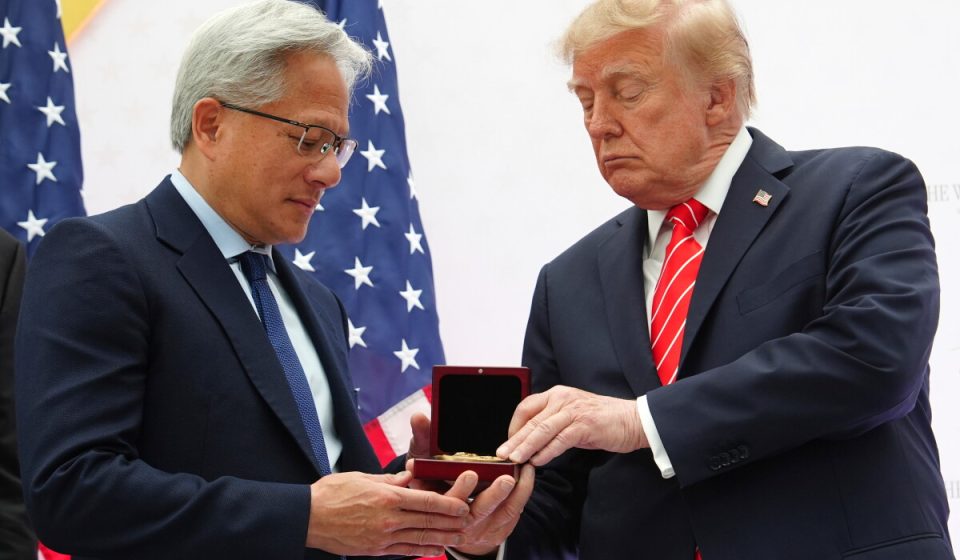
Trump saw his political fortune – and that of the country – in Huang’s Nvidia. Huang joined Trump aboard Air Force One for a state visit to Beijing earlier this year. Last month, Trump awarded Huang a National Science Medal.
The president called him “the man whose determination laid the foundation for the explosion of superintelligence and put America ahead of the race, an extraordinary man, who came to know him so well.”
Nvidia also donated $25 million to help fund the construction of Trump’s ballroom at the White House.
Several estimates suggest that more than half of the stock market gains during Trump’s second term came from growth of the AI industry and the construction of data centers.
Without that growth, consumer spending could collapse, leading to another economic setback for a president who has already failed to keep his campaign promise to stop inflation. Rising prices are one reason why voters harshly rebuked Republicans in last week’s midterm elections, returning control of Congress to Democrats.
Nvidia CEO pushed to sell chips to China faces congressional scrutiny
While Huang said his interest was in helping America succeed, he also expressed his strong belief that Nvidia should be able to sell some of its less advanced chips, such as the H200, to China. Nvidia has long argued that the sales would help ensure the broader AI ecosystem is tied to America, eliminating Chinese chipmakers developing semiconductors and systems to compete with its business.
Those arguments have already faced scrutiny, including from Massachusetts Democratic Sen. Elizabeth Warren, who wanted him to appear before the Senate Banking Committee to answer questions about his desire to ease export restrictions.
Huang has so far refused to appear, and Democrats reacted angrily when his infidelity was revealed, raising fears that a bulwark of American technology may have been compromised by the Chinese government.
Warren said in a statement Monday that Nvidia has been granted permission to export “hundreds of thousands of advanced AI chips to China, including to companies linked to the Chinese military.”
And Huang’s relationship with Alice Huang, Warren continued, “raises important questions for NVIDIA to answer about the extent to which these activities were related.”
___
Chan reported from Hong Kong and Ng from Kuala Lumpur, Malaysia. Associated Press journalists Wu Jia in Beijing, Didi Tang in Washington and Russ Bynum in Savannah, Georgia, contributed to this report.
Gn bussni